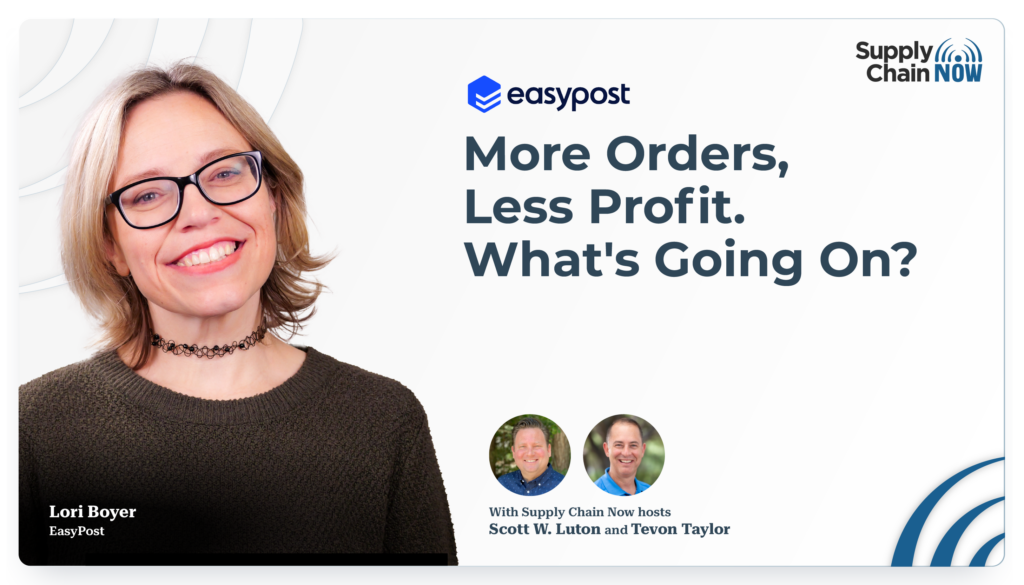
[00:00:00] Lori Boyer: The headline number is,
[00:00:01] Lori Boyer: as we know, e-commerce
[00:00:03] Lori Boyer: sales, e-commerce brands
[00:00:06] Lori Boyer: are selling more orders. Those have grown in the last year, so if we’re just talking in the last year, about 10% more orders
[00:00:12] Lori Boyer: over the last year.
[00:00:13] Lori Boyer: But revenue is not keeping up. So revenue’s like 4% to 5% growth. So it’s still growth.
[00:00:19] Lori Boyer: We love growth,
[00:00:20] Lori Boyer: but it’s not growing at the rate it should be.
[00:00:23] Lori Boyer: So for some,
[00:00:25]
[00:00:37] Scott W Luton: Hey, hey, good
[00:00:38] Scott W Luton: morning, good
[00:00:39] Scott W Luton: afternoon, good evening, wherever you may
[00:00:41] Scott W Luton: be. Scott Luton and Sheriff Tevin E. Taylor here with you on
[00:00:44] Scott W Luton: Supply Chain Now. Tevin, how you
[00:00:46] Scott W Luton: doing today?
[00:00:47] Tevon Taylor: I’m doing great, Scott. How are you?
[00:00:48] Scott W Luton: I’m doing fantastic, uh, fantastic. We got a great show here today.
[00:00:53] Scott W Luton: Folks, we’re bringing back
[00:00:54] Scott W Luton: one of our faves here today as we dive into a compelling topic.
[00:00:59] Scott W Luton: Orders are up, profits are down, but as the legendary
[00:01:03] Scott W Luton: Marvin Gaye would ask, “What’s
[00:01:05] Scott W Luton: going on, Tevin?” Uh, we’re di- we’re diving into all that
[00:01:09] Scott W Luton: here today. I’m not gonna sing for y’all folks. I’m not gonna ruin your day. But
[00:01:12] Scott W Luton: We’re gonna be unpacking why e-commerce growth today leaves a lot less room for operational mistakes. We’re gonna be sharing some of the assumptions that might be costing your
[00:01:21] Scott W Luton: team and your organization, and we’re gonna be sharing what leading organizations are doing and changing right now to protect margin, delight customers, all without slowing down growth. All of that and much, much more, folks. This is gonna be one of your most practal, uh, practical
[00:01:37] Scott W Luton: and actionable hours of the day.
[00:01:39] Scott W Luton: Now, Tevin, given your proven track record of making stuff happen in global supply chain, especially, uh, logistics, warehousing, transportation, technology,
[00:01:49] Scott W Luton: I’m looking forward to your insights here today. Should be a
[00:01:52] Scott W Luton: good one, huh?
[00:01:52] Tevon Taylor: I’m looking forward to sharing them. And of course, with Lori, it’s gonna be an amazing conversation
[00:01:57] Scott W Luton: It always is one of my favorite hours of each month.
[00:02:02] Scott W Luton: So let’s get to work welcoming in the one and only Lori Boyer, Director of Content Marketing with EasyPost, also host
[00:02:09] Scott W Luton: of
[00:02:10] Scott W Luton: a wonderful podcast called “Unboxing Logistics.” Make sure you add that to your, uh, to your, uh, iPhone or smart device, because Lori always brings the heat and has that been there, done that perspective.
[00:02:22] Scott W Luton: So get your thinking caps on, folks. Let’s welcome in Lori.
[00:02:26] Scott W Luton: Hey, hey, Lori. How you doing today?
[00:02:28] Lori Boyer: So good. Great to see you both. Two of my favorites. I’m really excited
[00:02:34] Scott W Luton: same all the way around. And we had a
[00:02:36] Scott W Luton: great, uh, pre-show session, uh, very lively as always. And hey, wanna say hello to Ava Shaw. Great to have you back with us. Let us know what part of the world you are tuned in from and look forward to your perspective. Uh, but Lori and Tevin, a couple things here.
[00:02:53] Scott W Luton: Let’s start with a fun warming question, and I wanna start by recognizing it’s Bunker Hill Day, right? It is Global Garbage Professional Day. We gotta celebrate those folks that all of us depend on every day. then I’m gonna, I’m gonna wrap on this one here. It is National Eat Your Vegetables Day. So Lori and Tevin, we’re really gonna create some friction here, I’m afraid. I want to know
[00:03:17] Scott W Luton: your favorite vegetable and your least favorite vegetable. so
[00:03:21] Scott W Luton: Lori, and we’re gonna start
[00:03:22] Scott W Luton: with
[00:03:22] Scott W Luton: you, put you on
[00:03:23] Scott W Luton: the
[00:03:23] Scott W Luton: spot, your thoughts
[00:03:24] Lori Boyer: Oh, so in my family, broccoli is beloved. It is so loved. Once when my daughter was about two years old, I was in the store and pushing her around, and she was like, “Mommy, I want broccoli, broccoli.” And I was like, “No, no broccoli. We already had broccoli at home.” And she’s like, “But Mommy, we need broccoli.” And some lady was like, “Wow, I wish I could get my kids to beg for broccoli.”
[00:03:49] Lori Boyer: So broccoli’s very popular. Eating a little tree makes everyone happy, right? Um, but I hate Brussels sprouts.
[00:03:56] Scott W Luton: Hmm.
[00:03:57] Lori Boyer: so bitter and gross and just so disgusting. So if you say Brussels sprouts, Tevin, I’m seeing it in your eyes. We’re gonna fight
[00:04:06] Scott W Luton: So let’s lean into that challenge.
[00:04:09] Scott W Luton: Uh, Tevin, your favorite and your
[00:04:10] Scott W Luton: least favorite
[00:04:11] Tevon Taylor: I mean, I do like Brussels sprouts.
[00:04:13] Tevon Taylor: It’s
[00:04:13] Lori Boyer: Right
[00:04:13] Tevon Taylor: favorite. The easiest is a potato. Um, like who doesn’t love potatoes? I don’t… It, it’s almost hard to call it a
[00:04:19] Tevon Taylor: vegetable, but you
[00:04:20] Scott W Luton: Hmm
[00:04:21] Tevon Taylor: like french
[00:04:21] Tevon Taylor: fries,
[00:04:22] Tevon Taylor: so I like potatoes.
[00:04:23] Tevon Taylor: But, um, the least favorite
[00:04:26] Tevon Taylor: by far, onions.
[00:04:27] Tevon Taylor: I won’t eat
[00:04:28] Tevon Taylor: anything with
[00:04:29] Tevon Taylor: onions. If it has onions.
[00:04:31] Tevon Taylor: in it,
[00:04:31] Tevon Taylor: you gotta take it out. I’ll pick it out. My in-laws make fun of me because they can’t cook what they
[00:04:36] Tevon Taylor: want ’cause I’m like, “I
[00:04:37] Scott W Luton: Okay.
[00:04:38] Scott W Luton: Interesting.
[00:04:39] Tevon Taylor: Yeah
[00:04:39] Scott W Luton: Okay.
[00:04:40] Scott W Luton: Uh, I thought I loved you, Tevin, until you’re breaking my
[00:04:43] Scott W Luton: heart with that.
[00:04:43] Lori Boyer: We do. I love onions
[00:04:46] Scott W Luton: You know, I wasn’t a big fan of Brussels sprouts either, Laurie,
[00:04:48] Scott W Luton: until
[00:04:49] Scott W Luton: Amanda starts making them with, um, with balsamic and bacon, and they are really, really
[00:04:56] Lori Boyer: So you’re saying if you can make them not taste like Brussels sprouts,
[00:05:00] Scott W Luton: Okay.
[00:05:01] Lori Boyer: they’re good. Is that what I’m hearing from you,
[00:05:04] Lori Boyer: Scott?
[00:05:04] Scott W Luton: Um, all right. Well, it’s great to see everybody. And Lori, let’s do this. I know you’re, you’re climbing up the appearance charts here and we, we really enjoy these conversations.
[00:05:12] Scott W Luton: It helps a
[00:05:12] Scott W Luton: lot of people. We get lots of
[00:05:13] Scott W Luton: feedback. But for our new audience members, let’s level set a bit. Tell us about yourself and what EasyPost does in a nutshell.
[00:05:19] Lori Boyer: You bet. I’m Lori Boyer. I oversee all the content at EasyPost.
[00:05:24] Lori Boyer: Um, basically my whole life is spent just figuring–
[00:05:27] Lori Boyer: I’m,
[00:05:28] Lori Boyer: I’m the biggest nerd you’ll ever meet, so I spend way too much time reading data and trends. and
[00:05:33] Lori Boyer: there’s something about seeing changes in the world and what’s happening and what’s
[00:05:37] Lori Boyer: exciting in shipping and logistics.
[00:05:40] Lori Boyer: My husband’s
[00:05:40] Lori Boyer: like, “That sounds so boring.” But we
[00:05:43] Lori Boyer: all know it’s super interesting. So that’s what I do. Um, and I work at EasyPost. So EasyPost, if you don’t know us, we’re a shipping technology platform. We’re basically the infrastructure layer that would connect e-commerce, logistics, shipping to 100 plus carriers through just one API.
[00:06:01] Lori Boyer: So instead of managing all those integrations one by one, you connect just to the one. We handle the complexity. We also use AI these days, ’cause AI is sweet. Um, but we have billions of records, and so you’re able to use AI to kind of see which shippers you should w- use when, which lanes, kind of at the actual, um, label level.
[00:06:20] Lori Boyer: So that’s where we’re at, and I’m so excited about this new interesting data that’s come out that we’re gonna talk about today.
[00:06:28] Scott W Luton: Well, you bring it each time, and I love the data factoids that you always bring with you And, and Tevin, I’m not the only one, right?
[00:06:35] Tevon Taylor: No, you’re not the only
[00:06:36] Tevon Taylor: one.
[00:06:36] Tevon Taylor: Uh, uh, hey, I, I’m a nerd in supply chain as well, so Lori, I’m excited to hear about the data
[00:06:41] Tevon Taylor: and, uh, hopefully benefit from it as
[00:06:43] Tevon Taylor: well
[00:06:44] Lori Boyer: That was right
[00:06:45] Scott W Luton: Well, so let’s, let’s dive in.
[00:06:47] Scott W Luton: And, and I wanna start with s- with what I shared kinda on the opener,
[00:06:50] Scott W Luton: right? E-commerce has
[00:06:51] Scott W Luton: grown, continues to grow, but profits is not the same story. So what’s going on here,
[00:06:57] Lori Boyer: Okay. So for me “I think this is something as I’ve talked to people that a lot of operators are kind
[00:07:03] Lori Boyer: of feeling in their gut.
[00:07:05] Lori Boyer: They just haven’t been able to kind of put words to it. So the headline number is,
[00:07:09] Lori Boyer: as we know, e-commerce
[00:07:11] Lori Boyer: sales, e-commerce brands
[00:07:13] Lori Boyer: are selling more orders. Those have grown in the last year, so if we’re just talking in the last year, about 10% more orders
[00:07:20] Lori Boyer: over the last year.
[00:07:21] Lori Boyer: But revenue is not keeping up. So revenue’s like 4% to 5% growth. So it’s still growth.
[00:07:27] Lori Boyer: We love growth,
[00:07:28] Lori Boyer: but it’s not growing at the rate it should be. So
[00:07:32] Lori Boyer: for
[00:07:32] Lori Boyer: some, some of the people I’ve talked to, margin is barely moving at all. So you
[00:07:37] Lori Boyer: kind of have this weird situation where, like, business is technically growing, the team’s working harder than ever, more volume showing up in the business, but the financial reward is not what it needs to be.
[00:07:50] Lori Boyer: So that’s
[00:07:51] Lori Boyer: kind of where we’re at and what we wanna talk about how to kind
[00:07:53] Lori Boyer: of avoid some of the pitfalls of just,
[00:07:56] Lori Boyer: let’s work more, but not actually make that much more money.
[00:08:00] Scott W Luton: Yep. what a great way to tee it up.
[00:08:01] Scott W Luton: Uh, and are you seeing a sim- similar thing out there, Tevin
[00:08:04] Tevon Taylor: Yeah, it’s a s- it’s similar. I mean, look, there, your your order volume can go up, but the, the cost behind that order, they’re
[00:08:12] Tevon Taylor: also going up. But there are other things that are related to, to profitability that, that I’m sure we’ll discuss. But, you
[00:08:17] Tevon Taylor: know, I’m, I’m seeing it in the 3PL space. Uh, volume doesn’t necessarily make up for sins of, Uh, the cost going up as well
[00:08:25] Scott W Luton: Right. Right. Uh, okay, so it begs the question, Lori,
[00:08:29] Scott W Luton: is this really different
[00:08:32] Scott W Luton: from, say, you know, five years ago, or
[00:08:35] Scott W Luton: kinda, kinda, um, playing off what we heard there from Tevin, the same old costs are up story? Your thoughts
[00:08:41] Lori Boyer: Right. That’s such a great question, and this is one of the areas I’m always paying close attention to. ‘Cause sometimes in the news you’ll be like, “Whoa, massive issue.” But then you’re like, “Oh wait, this is the same issue we had like 10 years ago.” Um, but this one is genuinely different, okay? So five years ago, of course, we’re hitting kind of just a little bit post-COVID now these days, but five years ago you could grow even though you would have inefficiencies.
[00:09:07] Lori Boyer: Um, but we are no longer seeing that anymore. This is a… More orders back then meant more revenue, meant more margin. The math was forgiving. And if the cost did creep up a little bit, volume typically covered it. Um, growth offset it. The model was
[00:09:26] Lori Boyer: kind of correcting. But these days, in the last five years, our CAC, our customer acquisition costs, are up 60%.
[00:09:35] Lori Boyer: That’s a
[00:09:36] Lori Boyer: really, really, big jump in how much it costs to just get a new customer. Um, and then the cost of meeting the customer’s expectations
[00:09:44] Lori Boyer: from, you know, free shipping, two-day delivery, returns, all of that used to be kind of a competitive advantage, and it’s now the baseline requirements. So when we’re talking about customer expectations, what used to seem like awesome is now the standard.
[00:09:59] Scott W Luton: Right
[00:09:59] Lori Boyer: then you throw in all the complexity of,
[00:10:01] Lori Boyer: you know, you’ve got more carriers, more SKUs, more markets. Your warehouses are having to work hard. You’re getting all this extra operational kind of tax that nobody budgeted for ’cause you just didn’t expect it. So yeah, five years ago you could totally just kind of paper over a lot of your growth, but today, um, it, it’s becoming a lot more of a challenge.
[00:10:21] Scott W Luton: Yep. Uh,
[00:10:22] Scott W Luton: you know, uh, paper, paper
[00:10:24] Scott W Luton: mache
[00:10:25] Scott W Luton: would come in handy those five years ago. Now it’s a whole different game.
[00:10:28] Scott W Luton: And, you know, complexity costs money
[00:10:30] Scott W Luton: that L-
[00:10:30] Lori Boyer: Ja.
[00:10:30] Scott W Luton: is, um, uh, sharing there.
[00:10:32] Lori Boyer: Okay
[00:10:32] Scott W Luton: one other quick point before I get you to weigh in, Tevin. You know, interesting, these customer acquisition costs, CAC, as, as Lori mentioned, it really varies from sector to sector.
[00:10:41] Scott W Luton: Fashion can be 90 to 120 bucks per new customer. Electronics could be 100 to over, you know, approaching 400 bucks plus, plus per customer. Pet care, a little easier, 68 to 90 based on different research out there, But Tevin?
[00:10:55] Scott W Luton: your thoughts on the differences from, say, five years ago to now?
[00:10:58] Tevon Taylor: Yeah, Lori’s right. You know, more volume generally meant that you had better economics, better P&L. I mean, today com- complexity is that tax she talks about. It’s a hidden tax on growth. So, you know, growth used to be, uh, there to help create efficiencies. Now it’s, it, unmanaged growth
[00:11:15] Tevon Taylor: really often creates a complexity and it shows up in labor exceptions, customer service, delivery failures,
[00:11:22] Tevon Taylor: all that, all that wrapped into the warehouse.
[00:11:25] Tevon Taylor: So those costs kind of elevate and, and that complexity is really why you’re seeing a margin hit
[00:11:30] Scott W Luton: Hmm. And let’s make no mistake about it, customers nor team members like that list of, headaches that Tevin just shared with us.
[00:11:36] Tevon Taylor: No
[00:11:36] Lori Boyer: Hopefully they don’t turn that video into what they listen to while they’re trying to fall asleep at night.
[00:11:43] Scott W Luton: Uh, all right. So Lori, big question here,
[00:11:47] Scott W Luton: right? Why is all this happening? Tell us more
[00:11:50] Lori Boyer: Oh, Scott. It’s, it– The honest answer
[00:11:54] Lori Boyer: is that
[00:11:55] Lori Boyer: everyone’s working really hard.
[00:11:57] Lori Boyer: Um, the effort’s real, but the model has really changed underneath us. So, and I don’t mean that as a criticism, I mean it, like, literally. The operating assumptions that made e-commerce so profitable a few years ago are starting to actually work against us.
[00:12:12] Lori Boyer: So I guess here’s a good way to think about it. I’d say, um, if you talk to most e-commerce people, they’re gonna tell you that they’re doing everything right, right? They’re adding channels, they’re growing their SKU catalog, they’re expanding to new markets, um, they’re meeting customer expectations when it comes to speed, when it comes to returns.
[00:12:28] Lori Boyer: All of it’s true. A-and you’re doing all the right things, but they all just cost a lot more. Um, so what I would like to say, a-and, and where I recommend here of what’s going on, is that we need to stop thinking about how do we grow faster, and start looking at what parts of our growth or which parts of our business are actually the really profitable parts.
[00:12:54] Lori Boyer: Um, you know, every time you add a new carrier, you got complexity. Every time you add a new channel, you’re, you know, needing to put out more ad money. Ev-
[00:13:01] Lori Boyer: all of that. So we,
[00:13:02] Lori Boyer: we need to be starting to pay attention not just to growth, but to what is profitable. They’re
[00:13:08] Lori Boyer: very, very, different questions, and right now,
[00:13:11] Lori Boyer: there’s not very many people who are really focused on that second one
[00:13:15] Scott W Luton: Lori that’s great advice already. And, and Tevin, she’s right. you know, it’s not like, um, uh, our, our customer. portfolio is not like going to our, uh, pantry and everything is a can of corn,
[00:13:25] Scott W Luton: which would
[00:13:25] Scott W Luton: be a very boring diet.
[00:13:27] Scott W Luton: But speak to what we heard there.
[00:13:28] Scott W Luton: from,
[00:13:28] Scott W Luton: uh, Lori, Tevin
[00:13:29] Tevon Taylor: Yeah, I heard new, new, new.
[00:13:30] Tevon Taylor: new. So new sales channels, new markets, new carriers, new delivery
[00:13:34] Tevon Taylor: promises, all that bundled together. It doesn’t show up on the P&L. but some reason you see that things aren’t moving in the right direction. So stop
[00:13:43] Tevon Taylor: expanding so much and so fast, look at what’s profitable, and be more precise in your targets.
[00:13:49] Tevon Taylor: So she’s spot on.
[00:13:51] Tevon Taylor: Precision, profitability, that’s gonna be the focus versus just,
[00:13:55] Tevon Taylor: you know, the shotgun approach of trying to do everything in every channel
[00:13:59] Scott W Luton: Hmm.
[00:13:59] Scott W Luton: I like it, I like it Uh, all right, so question for you, Lori.
[00:14:02] Lori Boyer: Mm-hmm.
[00:14:03] Scott W Luton: on all the research and, your
[00:14:04] Scott W Luton: massive customer portfolio and what you’re seeing out in the industry, are brands just getting priced out of customer
[00:14:11] Scott W Luton: acquisition?
[00:14:12] Lori Boyer: Yeah. I mean, some of them, yeah, genuinely, yeah. I would say…
[00:14:16] Lori Boyer: Okay, so let me check my number.
[00:14:18] Lori Boyer: The average, yeah, the average retail customer acquisition cost,
[00:14:22] Lori Boyer: and we’re talking average, and I actually wanna talk about death of averages, because actually looking at averages is one of our issues, but we’ll come back to that.
[00:14:28] Lori Boyer: The average retail customer acquisition cost
[00:14:31] Lori Boyer: in 2024
[00:14:33] Lori Boyer: was $226. That’s gonna be totally different across industries. Um, that’s up 7%
[00:14:41] Lori Boyer: from the year-over-year, 60% from five years. Oh, and that, that was in 2025, sorry, not 2024.
[00:14:46] Lori Boyer: Um, and that is all before you even factor in like returns. So if a first-time customer returns their order, which happens 17% of the time, um, you’ve likely lost money on that new customer, o- on that particular order.
[00:15:03] Lori Boyer: You’re at, um… But the most important insight, I think, is that the, what the data says about where the money actually is. Almost half of returns come because the product didn’t match expectations. That’s something that you can totally handle. You know, content, promise. I- someday we’ll have to have a good returns session, because we can talk about that for 75 hours.
[00:15:22] Lori Boyer: Um, but this is one thing I really wanna say. Acquiring a new customer costs up to 25 times more than keeping, it’s five to 25. And your top five current, 5% of current customers, top 5%, generate 35% of your revenue. Repeat customers are only 21% of your customer base, one in five, but they generate almost half of all orders.
[00:15:50] Lori Boyer: So the math is clear to me. Your profit is concentrated in kind of this small group of customers
[00:15:58] Lori Boyer: that you as a brand are often treating exactly the same as customers who are not profitable. Um, so the brands that I feel like are really figuring at, this out are those who are putting the investment and their focus on those really high profitable customers, um, looking at their post-purchase experience, looking at their delivery experience, looking at all those things that are gonna make them happy, keep them around, rather than just constantly trying to work to fill your funnel with new expensive customers all the time.
[00:16:29] Lori Boyer: And, and we did that a lot in the past, like
[00:16:31] Lori Boyer: more and more and more and more
[00:16:33] Lori Boyer: We need to be focusing where we’re profitable.
[00:16:35] Scott W Luton: Hmm. Tevin, uh, in addition to, uh, uh, Lori’s, uh, data there, I recall a study, uh, from years ago, probably a decade ago, from Bain & Company, and their findings showed that a 5% improvement
[00:16:48] Scott W Luton: in
[00:16:49] Scott W Luton: customer retention can increase profits, according to their research, 25% to 95%, depending on. the industry. It p- the math is gonna math.
[00:16:59] Scott W Luton: It pays to retain, not just gain. Your thoughts, Tevin?
[00:17:02] Tevon Taylor: Yeah, th- that math seems worthwhile to me. I, I don’t know. It, it’s interesting. We’ve had this conversation since I’ve been in the industry. It’s, I guess retention’s not as exciting as going after new growth and new sales. Uh, surely you think you wanna spend more money retaining because the cost of acquiring is so much.
[00:17:19] Tevon Taylor: So, you, know, the real economics behind not just e-commerce, but all commerce should be driven by repeat purchases. You want to cover not only the acquisition cost,
[00:17:29] Tevon Taylor: but really your company and everything you do is, is funded by the current customers. So let’s make them happy, make that work,
[00:17:36] Tevon Taylor: and then go after the right profitable growth from there.
[00:17:38] Tevon Taylor: So
[00:17:39] Tevon Taylor: love what you’re saying. It just– I, I think this is something 30 years from now they’re still gonna be saying it’s, and I’m not sure why though
[00:17:46] Lori Boyer: It’s got to be psychological, Tevin, right?
[00:17:48] Lori Boyer: Like, cause what you’re saying, I get it.
[00:17:49] Lori Boyer: Like, even here
[00:17:50] Lori Boyer: at, at all the companies I’ve worked for, there’s channels celebrating the new sales, the new things that came in, but not so much of
[00:17:57] Lori Boyer: like, “Oh, but this customer repurchased for the 600th time,” right? It’s a psychological,
[00:18:01] Lori Boyer: like,
[00:18:02] Tevon Taylor: Yeah, who cares?
[00:18:02] Lori Boyer: “Yay, shiny, new.”
[00:18:04] Scott W Luton: It’s like that McDonald’s, uh, customer counter, right? They didn’t count
[00:18:07] Lori Boyer: Mm-hmm.
[00:18:08] Scott W Luton: how many times they’d served the same customer, ’cause I bet there– that’d be a big number, too.
[00:18:12] Scott W Luton: They, they always counted
[00:18:14] Scott W Luton: new
[00:18:14] Lori Boyer: New people
[00:18:15] Scott W Luton: served. all right?
[00:18:17] Scott W Luton: So you mentioned earlier in your response the death of averages.
[00:18:21] Scott W Luton: What does that mean?
[00:18:22] Lori Boyer: Okay. So this is where I think it’s really important to…
[00:18:26] Lori Boyer: Our dashboards are lying to us,
[00:18:28] Lori Boyer: honestly. They’re
[00:18:29] Lori Boyer: polite, but they’re lying to us. If we look at our average order value, the average shipping cost, the average return rate, those numbers are gonna contain both the very best, those really profitable orders, and your super unprofitable orders, but they’re all kind of being treated as the same thing.
[00:18:48] Lori Boyer: So the problem is that our most profitable orders, um, are, and the most destructive ones are both part of that average. But they make it so that you don’t see them as well, so you’re only looking at the average. I’d say, okay, so let’s look at it in practice. So let’s say you’ve got this cohort of super loyal customers who are ordering frequently.
[00:19:07] Lori Boyer: They hardly ever return. These types of people spend 67% more than first-time buyers. But then you’ve got this other cohort of first-time buyers. You got them, you paid an ad to get them. They placed a $22 order. They returned it. It cost you 10 bucks in fulfillment, $7 in returning, and suddenly you didn’t even make anything.
[00:19:29] Lori Boyer: But both of these are just averaged out, and so you don’t really see them. They both become a little bit invisible.
[00:19:36] Lori Boyer: But both of them influence your decisions, like on, oh, what service level should I be doing? What carrier selection should I make? What should my return policy be? How much should I be spending on marketing?
[00:19:45] Lori Boyer: They’re both impacting equally, even though they represent totally different profitability amounts. So we’re making our decisions based on average, ’cause it’s easy.
[00:19:55] Lori Boyer: I mean, obviously that makes sense.
[00:19:57] Lori Boyer: Um, but what
[00:19:58] Lori Boyer: really, really matters
[00:20:00] Lori Boyer: is your contribution margin per order.
[00:20:04] Lori Boyer: What did this specific order actually
[00:20:08] Lori Boyer: give you
[00:20:09] Lori Boyer: How much revenue did you make
[00:20:11] Lori Boyer: after you take into account the cost to acquire the customer,
[00:20:15] Lori Boyer: the cost to fulfill the order, the cost to ship it, the probability that it’s coming back?
[00:20:20] Lori Boyer: Mm-hmm. And most people just don’t have that number. They, they know the revenue, they know the averages, they know their shipping costs in aggregate, they know their return rates, but they don’t know
[00:20:31] Lori Boyer: how to connect it all.
[00:20:33] Lori Boyer: So… And it’s, it’s hard, because they are typically sitting in different
[00:20:36] Lori Boyer: systems.
[00:20:38] Lori Boyer: Um, but
[00:20:39] Lori Boyer: here’s the thing, you guys. Once you have that number, every other decision can change. You make different choices for different orders. You’re gonna identify which customers deserve the premium delivery, which ones need proactive communication, which ones need to make sure that they’ve got the perfect visibility.
[00:20:59] Lori Boyer: Um, so yeah, at EasyPost, we see this on,
[00:21:03] Lori Boyer: like, a massive scale.
[00:21:05] Scott W Luton: Right
[00:21:05] Lori Boyer: you know, across billions of shipments, it can make a huge amount of money.
[00:21:10] Lori Boyer: Um, we just need to make sure that we’re s- individualizing the way we’re treating different orders.
[00:21:17] Lori Boyer: But first you have to know what, what it is, what the contribution margin per order is.
[00:21:21] Scott W Luton: Right. Um, Tevin, you used the word precision earlier,
[00:21:25] Tevon Taylor: Sure
[00:21:26] Scott W Luton: there is a tremendous opportunity to follow Lori’s proven advice that’s based on data and industry and, and reality, and apply precision customer by customer, especially leaning into w- the state of technology,
[00:21:41] Scott W Luton: uh, these days. But your thoughts on what we heard there from
[00:21:43] Scott W Luton: Lori,
[00:21:43] Scott W Luton: Tevin?
[00:21:44] Tevon Taylor: be a little long-winded here, but, you know, averages are like your head’s in the oven, your foot’s in an ice
[00:21:48] Tevon Taylor: bucket, but your temperature is, is
[00:21:51] Lori Boyer: Perfect
[00:21:51] Tevon Taylor: good, right?
[00:21:52] Tevon Taylor: So, uh, the thing about averages, like let’s say you’re making a lot of money on a customer and then you’re losing money on another customer.
[00:22:00] Tevon Taylor: Those are both bad, by the way. If you’re making too much money on a customer, you’re gonna lose that customer because you’re probably priced too heavy. Um, if you’re not making any money, that customer’s happy ’cause they’re getting the same service as everybody else is getting. So you’ve got to evaluate…
[00:22:14] Tevon Taylor: I, I love the contribution margin, the precision of knowing where you are per client and where that profitability is. You want to protect the one maybe you’re charging too much to, ’cause they will leave you, and they will be so sad that you are charging them too much. And then the person that’s not paying enough, they might be sad, but
[00:22:31] Tevon Taylor: you’re not making money on them anyway, so
[00:22:33] Tevon Taylor: guess what?
[00:22:33] Tevon Taylor: That’s not a customer you want, or you need to adjust what you’re doing to make sure you are making money. And it
[00:22:38] Tevon Taylor: helps your complete business
[00:22:39] Tevon Taylor: model to look at it
[00:22:41] Tevon Taylor: per
[00:22:41] Tevon Taylor: customer. If you look at averages, on average, you think your business is doing well because you’re looking at the wrong
[00:22:46] Tevon Taylor: number
[00:22:48] Scott W Luton: All right.
[00:22:49] Lori Boyer: Hello
[00:22:49] Scott W Luton: my
[00:22:49] Scott W Luton: distraction, but I
[00:22:50] Scott W Luton: had
[00:22:50] Scott W Luton: to write that down. Let’s see. Head in the oven, foot in the icebox.
[00:22:54] Scott W Luton: All right. I Love that. I Love
[00:22:56] Lori Boyer: Love it.
[00:22:57] Scott W Luton: steal that
[00:22:57] Scott W Luton: from
[00:22:57] Lori Boyer: So true. It’s so true
[00:22:59] Scott W Luton: so Lori,
[00:23:01] Scott W Luton: made clear that one of the things
[00:23:03] Scott W Luton: that
[00:23:04] Scott W Luton: we gotta be looking
[00:23:04] Scott W Luton: at
[00:23:05] Scott W Luton: is contribution margin per order. But what e- how else would you answer the question, what should folks be looking
[00:23:11] Scott W Luton: at?
[00:23:11] Lori Boyer: Okay. I mean, it’s hard. Most people don’t have that number, the contribution per order.
[00:23:16] Lori Boyer: I, I get it.
[00:23:17] Lori Boyer: I mean, it requires connecting data in three or four different systems. Maybe you’ve got your CAC, your customer acquisition in marketing. You’ve got your fulfillment in your 3PL invoice. You’ve got your shipping spend in your carrier portal like EasyPost.
[00:23:31] Lori Boyer: Your return might be in your OMS. A- and stitching them together, it seems a little bit hard. But when you do, it is so, so worth it. So worth it. You might see like a specific product that has a 40% return rate and that’s like killing you, or you get, oh, this specific cohort of customers who are generating tons of revenue, what kind of experience should we be giving them?
[00:23:55] Lori Boyer: So it’s really, really worth it. But I’m gonna say start, um, everybody’s gonna be shocked, start with a spreadsheet. I know we all love our technology. But listen, you don’t have to have a platform. There– I’m sure you can get some. Start with a spread- spreadsheet. Pull three months of your orders. Add your CAC by acquisition channel if you can, or you can estimate it if you don’t have it.
[00:24:19] Lori Boyer: Add fulfillment cost per order.
[00:24:21] Lori Boyer: Add your shipping costs per label. Add a return flag,
[00:24:26] Lori Boyer: and then calculate your margin per order.
[00:24:30] Lori Boyer: It, it, it’s really, it’s math, it’s a spreadsheet,
[00:24:33] Lori Boyer: but you can sort by
[00:24:34] Lori Boyer: margin. What is your bottom 20%? What are you seeing?
[00:24:38] Lori Boyer: Exactly what Tevin was saying, where are we losing money? We do not need to be spending extra and to make those people have some sort of amazing experience.
[00:24:46] Lori Boyer: Um, where are your top?
[00:24:47] Lori Boyer: What are the orders– Especially look for commonalities. What are you seeing? Like, oh wow, wait, maybe even just shipping in a certain zone
[00:24:54] Lori Boyer: is putting people really expensive. Or
[00:24:56] Lori Boyer: maybe, you know, certain marketing platforms
[00:24:59] Lori Boyer: are really killing it and you can bring in more customers there.
[00:25:02] Lori Boyer: You need to look for trends, similarities, and that’s where the work really starts. So you don’t need to get a fancy system to start
[00:25:09] Scott W Luton: Hmm. right. So Lori, I love that Frank keep it real advice,
[00:25:13] Lori Boyer: Wellhub
[00:25:13] Scott W Luton: got to keep, uh, I got to, I got to, um,
[00:25:16] Lori Boyer: Not very often I recommend spreadsheets. There’s probably
[00:25:19] Lori Boyer: like 10 people dying right now
[00:25:21] Scott W Luton: Um, Tevin, your thoughts on the advice we heard there from Lori?
[00:25:23] Tevon Taylor: It’s the KISS method,
[00:25:24] Tevon Taylor: keep it simple, stupid, right? So it’s
[00:25:27] Tevon Taylor: like,
[00:25:27] Lori Boyer: Sometimes we do go too much
[00:25:28] Tevon Taylor: why not just u- Well, sometimes it’s just going back to the basics. I mean, the spreadsheet approach and what you’re saying,
[00:25:34] Tevon Taylor: it, it’s really just the first step of giving visibility to a problem. You know, you don’t need a massive system to do that.
[00:25:40] Tevon Taylor: You can do it
[00:25:40] Tevon Taylor: in simple terms, and then you can figure out what to kind of bring
[00:25:44] Tevon Taylor: in to, to fix the issues. But,
[00:25:45] Tevon Taylor: you
[00:25:45] Scott W Luton: Right
[00:25:46] Tevon Taylor: with the simple, you know, bring crayons to the meeting, everybody will be excited, and then go from there.
[00:25:51] Lori Boyer: Uh, honestly, because sometimes I think we think, “Oh, I can’t do it unless I have a fancy technology.” It’s almost like our justification, our excuse.
[00:25:57] Lori Boyer: Well, it would be nice if we could have visibility, but I can’t. They don’t connect, right? Look,
[00:26:02] Lori Boyer: we can
[00:26:03] Tevon Taylor: Yeah. IT ha- IT hasn’t given me the tools to figure out I’m making money.
[00:26:06] Lori Boyer: Sometimes it’s back to the good old-fashioned tools we’ve got
[00:26:10] Tevon Taylor: There you go
[00:26:11] Scott W Luton: And whatever powers knowledge and action, right? For some, this can be a spreadsheet. Lori and Tevin aren’t saying, “Hey, run your
[00:26:18] Scott W Luton: billion-dollar supply chain with spreadsheets.” No one is saying that. Uh, I love Lori’s practical advice here, um,
[00:26:25] Scott W Luton: because it’s
[00:26:26] Scott W Luton: a good gut check. So, all right, so once we can see which orders are profitable, Lori,
[00:26:32] Lori Boyer: Mm-hmm.
[00:26:32] Scott W Luton: comes next?
[00:26:33] Lori Boyer: Okay. So I would then segment them.
[00:26:36] Lori Boyer: So again, not by a lot of the traditional segments. We segment by demographics or by acquisition channel or whatever. No. Segment them into their actual order economics. So who are the most profitable? What do those order profiles look like? What is their average order frequency?
[00:26:53] Lori Boyer: I’d look at their return rate, their shipping destination, what it costs to acquire them. Um, and then once you can see that really clearly, you can start to identify new customers who are looking like those profitable ones but are just a little earlier in their relationship, and really focus on keeping those.
[00:27:09] Lori Boyer: Those are gonna be, you know… You, you got your ideal customer here. You see some who have that potential, really do well. And then I would say the second thing is to differentiate your service levels. Your top customers deserve a better delivery promise, more reliable carrier selection on specific lanes.
[00:27:30] Lori Boyer: They deserve proactive communication.
[00:27:33] Lori Boyer: They deserve quick returns.
[00:27:35] Lori Boyer: Um, a loyalty customer in zone four who orders every three weeks is… You should have them routed differently than a first-time buyer in zone seven on a 10 buck order, you
[00:27:46] Lori Boyer: know? Not to make it worse, just right-sized,
[00:27:49] Lori Boyer: right?
[00:27:49] Lori Boyer: The, the $10 order doesn’t need to have overnight shipping and all this amazing stuff.
[00:27:53] Lori Boyer: Put your money
[00:27:55] Lori Boyer: into the customers that are really worth it. And then I have one more thing. Third thing I would say is use technology. Again, I’m not all spreadsheets. Use technology, um, to make those decisions at scale without manual rules, because that is true. When we’re in the shipping industry and there are a lot of stuff going on,
[00:28:15] Lori Boyer: um, you need to be able to do that.
[00:28:17] Lori Boyer: So
[00:28:18] Lori Boyer: When you segment your customers and build routing rules,
[00:28:21] Lori Boyer: it, it works until you have like 6,000 different profiles and 100 different rules and scares. This is where you need to use technology,
[00:28:29] Lori Boyer: AI, to you make the decisions on what works, and then you put them into place
[00:28:34] Lori Boyer: so that you can execute those,
[00:28:36] Lori Boyer: you know, at the shipment level,
[00:28:38] Lori Boyer: at the specific package level.
[00:28:41] Lori Boyer: Um, there was a cu- a customer that I was working with recently that was doing something like this. They just let AI evaluate every single shipment against all of the different data that they’d brought in, and then their labels were being evaluated based on the rules they’d put in. Instead of those averages, that death by averages kind of thing.
[00:29:01] Lori Boyer: And the results, they were just getting cheaper,
[00:29:03] Lori Boyer: but also better. I feel like that’s rare sometimes. Usually it’s like, if it’s faster, then it’s gonna cost more, and if it’s
[00:29:09] Lori Boyer: cheaper, then your performance is gonna be worse.
[00:29:12] Lori Boyer: But when you do use AI
[00:29:14] Lori Boyer: and technology there, this is where it really, really works,
[00:29:17] Lori Boyer: um, is finding those areas where you can get both
[00:29:21] Lori Boyer: and, and get really accurate decisions.
[00:29:23] Lori Boyer: So yeah, technology can absolutely help, but technology is only useful as a strategic, at the strategic question you’re asking it to answer. So if you’re not asking it the right things, if you’re not looking at what’s important, those really profitable orders, um, which order matters most, what does the right experience look for each different group, that’s when you run into problems.
[00:29:46] Lori Boyer: Defaults of just across the board for everyone i- is, is gonna make it so that your profit margins are getting smaller and smaller and smaller.
[00:29:55] Scott W Luton: Hmm. Which is no, no bueno. Uh, just to level set there. All right, two quick things, Tevin, that I love
[00:30:00] Scott W Luton: that,
[00:30:00] Scott W Luton: uh, that Lori mentioned. One, a little clarification, ’cause I think she mentioned
[00:30:04] Scott W Luton: LTV. acronym.
[00:30:05] Scott W Luton: So just to make sure everybody’s with us,
[00:30:07] Lori Boyer: LTV. Okay
[00:30:09] Scott W Luton: right? Lifetime value. Some folks, some organizations call that, uh, CLV or CLTV, I believe, but just make sure everybody’s with us. But more importantly, to her point on different decisions for different orders. Folks, you take a cookie cutter approach at your own peril. Uh, and it’s easier to not take a cookie cutter approach here in 2026. Tevin, what’d you hear there from Lori?
[00:30:31] Tevon Taylor: I’m, I’m staying in a Hilton Hotel
[00:30:33] Tevon Taylor: because 26 years ago I started staying at Hilton and they were smart enough to
[00:30:38] Tevon Taylor: get me hooked on Hilton Honors points, right?
[00:30:40] Lori Boyer: Mhm.
[00:30:40] Tevon Taylor: American Airlines because of
[00:30:42] Tevon Taylor: the loyalty program. Like, they do segment you because they, you know, they treat me differently because of how much money I spend with their brand. The same’s true in every commerce division. If you try to treat all customers equally, they’ll switch brands very quickly because there’s nothing tying you to that brand and that experience. If everybody gets the same experience, then there is no real experience. So,
[00:31:03] Tevon Taylor: um, I do like the AI key as well. So, I mean,
[00:31:07] Tevon Taylor: AI gonna help make thousands of operational decisions and it’s gonna make things smoother and faster where you
[00:31:13] Tevon Taylor: can focus on strategy and customer experience versus all the noise that happens in operations.
[00:31:18] Tevon Taylor: So,
[00:31:18] Scott W Luton: Hmm
[00:31:19] Tevon Taylor: um, that, that’s kind of my feedback on that topic
[00:31:22] Scott W Luton: like it.
[00:31:22] Scott W Luton: Uh, I like it. And hey, let’s apply
[00:31:24] Scott W Luton: AI to logistics. We don’t need AI to make toast
[00:31:28] Scott W Luton: right? Let’s keep it simple.
[00:31:30] Scott W Luton: Uh, but we do–
[00:31:30] Scott W Luton: everybody,
[00:31:31] Lori Boyer: I could use some AI toast
[00:31:33] Scott W Luton: everybody, everybody is talking and doing, using AI in logistics. And I’m
[00:31:39] Scott W Luton: curious, Lori,
[00:31:39] Scott W Luton: given, again, you got your finger on the pulse of industry like few do, what are you seeing that actually works right now?
[00:31:46] Lori Boyer: Okay. I think the AI story in logistics is actually a little bit boring.
[00:31:50] Lori Boyer: And I think, say that as a compliment, and you both know how much
[00:31:54] Lori Boyer: I love AI. Um, but the reason I say boring is because the applications that are actually working and, and really making people profitable in the industry right now aren’t like the science fiction sexy ones that you’re like, “Holy crap, they took all my data,” and da, da, da, right?
[00:32:09] Lori Boyer: They are the ones that just are taking the decisions your team has typically made manually a thousand times a day and making them better, faster. Um, the clearest example I think I could think of is maybe I could point to like service level selection. Again, I, I live in the shipping world, so I always think back to shipping, but, um, at the moment of label creation.
[00:32:31] Lori Boyer: So we, we’ve seen in the past, before AI, a lot of operations would pick a primary carrier, set the service level defaults, and then just kind of move on, and the routing logic would run underneath it all. It’s, that’s typically been static. It was built once. Um, maybe if they were being well-behaved, they would look at it quarterly, and everything was kind of applied to the same label regardless of what the data would say.
[00:32:55] Lori Boyer: And again, obviously with 25,000 labels a day or however many, those defaults would add up really fast.
[00:33:00] Lori Boyer: Um, with
[00:33:02] Lori Boyer: AI, that has really changed, and this is boring. It’s underneath the line. But we had a customer
[00:33:07] Lori Boyer: recently, which I think was super fascinating. So they started using the AI tools to like look at their shipments.
[00:33:12] Lori Boyer: Um, they were shipping with
[00:33:14] Lori Boyer: a a certain carrier. They had multiple carriers, but one of their carriers that they used heavily,
[00:33:19] Lori Boyer: um, they weren’t really happy with their rate, uh, with the on time rate. It wasn’t–
[00:33:24] Lori Boyer: They were having a lot of late packages.
[00:33:25] Lori Boyer: Um, 25,000 labels a day. You know, it, it was a lot of packages arriving late every day.
[00:33:32] Lori Boyer: So they started looking into like they were,
[00:33:34] Lori Boyer: uh, uh, we were working with them at EasyPost to look into
[00:33:36] Lori Boyer: like what, what could AI find? Is, is there something else they could do?
[00:33:40] Lori Boyer: So, um, they were using AI. They evaluated each shipment
[00:33:44] Lori Boyer: at the moment of label creation. They looked at the destination zone, the package profile, the delivery window, the cost, and the historical performance data across what they could do with this.
[00:33:55] Lori Boyer: What’s interesting here is they actually did not
[00:33:57] Lori Boyer: switch this carrier. They kept the carrier. It was one of the big carriers.
[00:34:01] Lori Boyer: They didn’t renegotiate a contract. They didn’t change their packaging or fulfillment. They didn’t add headcount. Nothing like that.
[00:34:07] Lori Boyer: They just changed which service level was selected for each package, which zone they were using.
[00:34:12] Lori Boyer: They ended up improving, so they ended up saving $2 million a year
[00:34:17] Lori Boyer: just simply in cost, which wasn’t even what they were looking at, but also had about a quarter of a million fewer late deliveries over the year,
[00:34:24] Lori Boyer: and they didn’t even switch carriers.
[00:34:28] Lori Boyer: That was simply an AI working to say, “You’re just making some label decisions wrong on which routes to use, which service levels to use.”
[00:34:37] Lori Boyer: Um, and then when you do that at scale,
[00:34:39] Lori Boyer: it, it’s just so much easier than having a human do it 10 times a day. So that’s where I see AI really working right now in specific use cases when there’s a lot of unorganized data that you might be able to take advantage of and kind of running below the scenes.
[00:34:53] Lori Boyer: So that’s where we’re seeing it be really effective and not necessarily making our toast yet, which I, I’m still ready for that. I, I’m okay with the toast, but that’s, that’s the science fiction, I guess.
[00:35:05] Scott W Luton: I love that, and I, I hate that AI’s gonna make whole wheat toast and make me put
[00:35:08] Scott W Luton: marmalade on it. But
[00:35:09] Scott W Luton: anyway, uh, folks,
[00:35:11] Lori Boyer: It’s
[00:35:11] Scott W Luton: one
[00:35:11] Lori Boyer: gonna optimize for your healthiest diet, Scott.
[00:35:14] Scott W Luton: I know, I know. But one of the, um, one, one of the things I think is exciting and, and maybe, you know, talk about it a lot, but how AI is not only making decisions and decision-making process easier, but it’s eliminating the need for humans to make the decisions more and more.
[00:35:31] Scott W Luton: And of course, that eliminates the need for meetings, for more meetings,
[00:35:36] Scott W Luton: for, I mean, let’s, let’s– we don’t have to meet on, on the hour every hour, every day, and all that’s a beautiful
[00:35:42] Scott W Luton: thing.
[00:35:43] Lori Boyer: And it really slows things down, right?
[00:35:45] Scott W Luton: that’s
[00:35:45] Lori Boyer: get into this meeting and suddenly you’re spending two hours discussing what you should do when you could’ve just moved on.
[00:35:49] Lori Boyer: Mm-hmm.
[00:35:52] Scott W Luton: more and more cases, it doesn’t have to be anything at all because technology is eliminating, uh, human oversight or human decisions in some cases. Uh, Tevin, case study that Lori shared, that dog will hunt, as they like to say here in Georgia.
[00:36:06] Scott W Luton: Your thoughts?
[00:36:07] Tevon Taylor: absolutely will, Hunt. I’ve been using AI all wrong. I’m doing videos showing me dunking a basketball on the owner of my company. So I send those videos to him on a random basis, which aggravates him, which is fun. But, I, I mean, going to the case study and going to everything you’re seeing in logistics, it is a boring story
[00:36:24] Tevon Taylor: right now, but it’s a good story, to your point.
[00:36:26] Tevon Taylor: It’s, it’s helping make decisions at scale. Um, so selecting the right
[00:36:30] Tevon Taylor: carrier, choosing the right service level, kind of predicting performance. It, it’s doing all the optimizations that a lot of people are doing, but it’s not replacing people. It’s helping make the right
[00:36:41] Tevon Taylor: decisions and putting people in,
[00:36:43] Tevon Taylor: in positions to focus
[00:36:44] Tevon Taylor: more on the customer.
[00:36:46] Tevon Taylor: So I think That’s the
[00:36:47] Tevon Taylor: element people miss is, you know, it’s kind of like, uh, meetings and PowerPoints
[00:36:51] Tevon Taylor: now that you see that you can use AI, that time you were spending putting stuff together, you
[00:36:56] Tevon Taylor: can focus more on how to make the customer experience better
[00:37:00] Scott W Luton: right.
[00:37:00] Scott W Luton: So,
[00:37:01] Scott W Luton: uh, Lori, you know, a lot of brands assume
[00:37:05] Scott W Luton: faster delivery is always better, but of course, I’ve heard you push back because a lot of times we talk about that
[00:37:10] Scott W Luton: here.
[00:37:11] Lori Boyer: Mm-hmm.
[00:37:12] Scott W Luton: Why, why do you push back with both hands and all of your might against that dangerous assumption?
[00:37:18] Lori Boyer: Okay. This is again where we’re going back and we’re
[00:37:20] Lori Boyer: kind of operating on something that was true five years ago.
[00:37:23] Lori Boyer: Customers have really changed as we’ve gotten really used to, you know, online shopping and, and all of that really booming. What’s interesting, I, I didn’t look, I didn’t look it up, but I’m pretty sure it was fourth place.
[00:37:36] Lori Boyer: So for years, speed was the number one concern of customers when it came to shipping. It’s now at number four. It might be number five. So what they actually want today is reliability. So in some ways, um, a package that says it’s coming on Tuesday
[00:37:52] Lori Boyer: and comes on Tuesday, a customer likes that better than even a package that said it’s gonna come on Tuesday and comes on Monday.
[00:37:58] Lori Boyer: Uh, you know, or definitely not Thursday. We know if it’s gonna come late, they would much la- rather have known it was coming on Thursday and it came on Thursday than that you said it was gonna come on Tuesday and it came on Thursday. Even though it arrived the same day, they’re okay. So people don’t care as much about
[00:38:16] Lori Boyer: fast shipping as we once did.
[00:38:18] Lori Boyer: They want to know that it’s reliable, that it’s going to show up.
[00:38:22] Lori Boyer: They want visibility, so, you
[00:38:24] Lori Boyer: know, where’s my order? What’s going on? Customers need to know where their package is all the time. Those are both in the, in the categories of being more important than just being fast.
[00:38:35] Lori Boyer: And so
[00:38:36] Lori Boyer: I, I think that you’ve got to make sure that,
[00:38:40] Lori Boyer: you know, you’ve got reliable delivery.
[00:38:42] Lori Boyer: So that’s another thing to look at.
[00:38:44] Lori Boyer: If you get a reliable carrier who’s gonna be coming in four days in that zone, in that area, in that package level,
[00:38:52] Lori Boyer: versus an unreliable one, you know, maybe who are having more of those late deliveries like I talked about with that other customer, and it’s two-day delivery,
[00:38:59] Lori Boyer: that’s probably not gonna be worth it even if it’s the same cost.
[00:39:03] Lori Boyer: So
[00:39:04] Lori Boyer: data to make that,
[00:39:06] Lori Boyer: you understand that, it is really important to look and see on each
[00:39:11] Lori Boyer: carrier, each route,
[00:39:12] Lori Boyer: each delivery, what is gonna be better. Faster is better if you can deliver it and it’s not too expensive. The problem becomes doing it at scale and,
[00:39:20] Lori Boyer: and trying to think that you need to do it for everybody.
[00:39:23] Lori Boyer: We just don’t anymore. Cu- that customer sentiment’s actually shifting
[00:39:27] Scott W Luton: Hmm. You know, I, I saw
[00:39:29] Scott W Luton: another data, a related data factoid,
[00:39:32] Lori Boyer: Uou
[00:39:32] Scott W Luton: and this is not gonna sound new for folks that may have tuned in to some of our previous conversations, Lori and Tevin. Um, some research shows that 98% of shoppers say the delivery experience highly influences brand loyalty. Now, that shouldn’t– that’s probably not news to our smartest audience in all the world of, of global, uh, supply chain.
[00:39:52] Scott W Luton: But I think it’s good to kind of put a data point on things like, that. Um, Tevin, your thoughts on Lori’s perspective, uh, about some of those dangerous assumptions that companies out there are making?
[00:40:02] Tevon Taylor: Well, yeah, customers are building their expectations around a promise. And so you don’t have to be the fastest, but you need to be accurate and
[00:40:09] Tevon Taylor: dependable. So, you know, what’s the old saying? you know, under promise, over deliver. So, you know, it’s not under promising, it’s just don’t stretch yourself. You know, make sure you actually hit the target you’re trying to hit. you Again, you don’t have to be the fastest.
[00:40:23] Tevon Taylor: I
[00:40:23] Tevon Taylor: know people got kind of wrapped around the axle. Amazon delivers to me in two hours. It’s not the two hours that matters. It’s if you say
[00:40:30] Tevon Taylor: two hours, make it two hours. If it needs to be tomorrow, make it tomorrow. But don’t miss that window because they’re building everything around that expectation
[00:40:38] Scott W Luton: I thought that old saying had something about a head in the oven and a foot in the icebox, but,
[00:40:41] Tevon Taylor: other one.
[00:40:42] Tevon Taylor: Yeah.
[00:40:44] Scott W Luton: I love that one, Devon.
[00:40:45] Scott W Luton: Um, all right.
[00:40:47] Scott W Luton: So, in your previous response, Lori,
[00:40:49] Scott W Luton: you used one of my favorite words.
[00:40:52] Scott W Luton: you used
[00:40:53] Scott W Luton: optionality.
[00:40:54] Lori Boyer: Options
[00:40:55] Scott W Luton: when, when you think about optionality.
[00:40:58] Scott W Luton: practice, what does that mean to you?
[00:41:00] Lori Boyer: Okay. Traditionally, when we talk about carrier diversification, we talk cost only. You
[00:41:07] Lori Boyer: know, you’re gonna use multiple carriers because you’ll have rate options, and you can shop the best price and the best label, and, and that’s true. I mean, it still matters, obviously. We need to save. Um, but I think it’s not necessarily the most interesting version of getting options.
[00:41:23] Lori Boyer: Um, and so optionality to me means something bigger. It means, you know, when UPS implements a 5.9% rate increase, which they have done recently, or FedEx does, or anyone else, USPS did their first fuel surcharges, all of that, that you have some other options of where to go. We’re seeing, especially with the biggest carriers, which I, whom I all love, um, they have a lot of surcharges going on.
[00:41:47] Lori Boyer: And, and a lot of the maybe smaller regional ones or some of the alternative carriers often have, you know, different options there. So if your carrier caps your daily, your daily pickup volume during peak season, which happens, we see too often with customers, um, you’re not stuck with 3,000 orders you can’t move.
[00:42:06] Lori Boyer: It means that if a regional carrier is outperforming your primary carrier in a specific zone by two days and 40 cents a label or something, you can actually act on it without having to have a big project. So single carrier is like a single stock. It’s doing great until it’s not doing great,
[00:42:25] Lori Boyer: and then you don’t really have a lot of options.
[00:42:27] Lori Boyer: So I, I think we need to look. The goal isn’t just more carriers, like in the example I shared earlier. It was just better decisions. So having access to five carriers isn’t gonna help if you’re just doing the same old static
[00:42:38] Lori Boyer: routing logic that’s,
[00:42:39] Lori Boyer: you know, treating everyone like an average and, and doing all of that.
[00:42:43] Lori Boyer: Optionality only has value
[00:42:46] Lori Boyer: when you’re actually using it in the right way. So you’ve got to turn your carrier strategy into a logistics tactic, into a margin strategy.
[00:42:56] Lori Boyer: It’s got to be about margins.
[00:42:57] Scott W Luton: All right. So l- so I want to say one of your key points there louder for
[00:43:01] Scott W Luton: all the folks in the back and outside having picnics and whatever. Um, it’s the goal is not more
[00:43:07] Scott W Luton: carriers, It’s better decisions. And that’s not theory. that goes back to the case study Lori’s talking about $2 million and over 270,000 less late deliveries.
[00:43:19] Scott W Luton: Those are much happier customers.
[00:43:21] Lori Boyer: Mm-hmm.
[00:43:21] Scott W Luton: as we, we established upfront, data-driven. customers lead to repeat orders, and that’s where the profit is, folks. This is not– Hey, if I can understand it, anyone can understand it. Tevin, what’d you hear there from Lori?
[00:43:33] Tevon Taylor: Yeah, I mean, markets shift, rates change, GRIs happen, capacity’s tightening. No single carrier is gonna be your best solution for every shipment, for every geography, every zone, every objective. So this, this gives brands the flexibility to adapt quickly. And it’s not just for the sake of adding carriers, ’cause that does add
[00:43:54] Tevon Taylor: complexity, but match that up to the fact
[00:43:57] Tevon Taylor: that you can figure out,
[00:43:58] Tevon Taylor: you know, which shipment needs to
[00:44:00] Tevon Taylor: go to which
[00:44:00] Tevon Taylor: geography and how it accomplishes what you want.
[00:44:03] Tevon Taylor: So absolutely, uh, great for decision-making, and it helps you have flexibility with your clients
[00:44:09] Scott W Luton: That’s right. It’s a
[00:44:10] Scott W Luton: slam
[00:44:10] Scott W Luton: dunk, eh,
[00:44:11] Scott W Luton: Tevin? Eh, eh? Uh, all right.
[00:44:13] Scott W Luton: So, uh, bottom line,
[00:44:16] Scott W Luton: Lori, got to get to the bottom line, right?
[00:44:18] Lori Boyer: Bye
[00:44:18] Scott W Luton: You I love how you bring it to bottom line here.
[00:44:20] Scott W Luton: what separates those operators out there, some are tuned in, that are winning right now, really, they’re, they’re
[00:44:26] Scott W Luton: vi-
[00:44:26] Scott W Luton: finding success even in this, this highly disruptive era we’re in, versus those that are really just struggling?
[00:44:33] Lori Boyer: Yeah. I would say, again, they are not optimizing just for volume, not for order volume, which was really what we focused on and we still focus on. I mean, we want lots of people, but we want good orders. So be optimizing for order quality and not just volume. The operators who are protecting their margin right now would know that the stat, the contribution margin per order, or you’re working towards it, actively be working towards it.
[00:45:02] Lori Boyer: You– These, the, the great operators are the ones who are treating delivery as a retention tool, um, not a cost center. Um, again, 76% of customers have good delivery, they’re gonna come back. You should be building optionality in, like we talked about, so you’re not held hostage every time a carrier raises a rate or capture volume or has just some storm issues or whatever’s going on.
[00:45:26] Lori Boyer: The best operators have built systems to catch the exceptions before their customers do. Um, a lot of orders go wrong, um, a- and, and being– keeping an eye on that, being proactive about it, and really just making the different decisions for different orders based on the priority and the revenue they’re bringing in, instead of applying the same service level, the same delivery promises, the same fulfillment,
[00:45:54] Lori Boyer: um, a-
[00:45:56] Lori Boyer: and post-purchase to everything across the board.
[00:45:58] Lori Boyer: It, it’s just, it’s not magic.
[00:46:00] Lori Boyer: It’s, it’s not a technology problem,
[00:46:02] Lori Boyer: at least not primarily. Technology’s great. It’s a question of what questions are you asking about your own business.
[00:46:08] Lori Boyer: We cannot anymore win just by getting
[00:46:11] Lori Boyer: more orders, more orders, more orders. Instead, we need to be getting the right orders,
[00:46:17] Lori Boyer: the profitable orders, and treating them differently.
[00:46:20] Lori Boyer: You don’t have to have 17 different buckets of people, but at least
[00:46:24] Lori Boyer: three.
[00:46:25] Scott W Luton: うん。
[00:46:26] Lori Boyer: Super profitable, super non-profitable, and everybody else. Start at least with that,
[00:46:31] Lori Boyer: and make sure that you’re treating them differently.
[00:46:34] Scott W Luton: 嗯
[00:46:35] Lori Boyer: they’ll all go to the Hilton like Tevin. Or like me,
[00:46:38] Lori Boyer: I am somebody’s dream customer because I have seven kids, and so I buy so much stuff.
[00:46:44] Tevon Taylor: ChatGPTs
[00:46:45] Lori Boyer: If I’m buying so much stuff from you,
[00:46:47] Lori Boyer: you know, treat me well and make sure that when I have a return, that you’re dealing with it and, uh, because that’s a lot of money that gets lost if I go
[00:46:53] Lori Boyer: somewhere else.
[00:46:54] Scott W Luton: Can you imagine, uh, Kroger or Walmart or whomever when Lori, walks in for the weekly grocery? Oh man, they’re laying out the red carpet, getting their calculators ready.
[00:47:06] Scott W Luton: I mean, they’re delighted. Uh, but Tevin, What did you– I, I think we heard a lot of, kidding aside, we, we heard a lot of, uh, grounded, um, actionable perspective in, Lori’s last response.
[00:47:17] Scott W Luton: Your thoughts?
[00:47:18] Tevon Taylor: Well, I’m, I’m wishing
[00:47:19] Tevon Taylor: Lori’s kids grew up when, where I was because I’d have five kids and two on the bench just for a basketball game. That would’ve been awesome. But, um,
[00:47:27] Lori Boyer: I love basketball, Tevin. I played all through high school,
[00:47:29] Lori Boyer: so.
[00:47:29] Tevon Taylor: there you go. You got a
[00:47:30] Tevon Taylor: full
[00:47:30] Lori Boyer: I’m only five feet tall, but that’s okay
[00:47:33] Tevon Taylor: So the best operators, she said it, like, y- you know, you gotta look at customers who are profitable, orders that are profitable, but
[00:47:39] Tevon Taylor: understand the true cost of delivery.
[00:47:41] Tevon Taylor: But really tie
[00:47:43] Tevon Taylor: that
[00:47:43] Tevon Taylor: all into viewing logistics, um, as, you know, retention strategy. It’s not
[00:47:48] Tevon Taylor: just transportation expense.
[00:47:50] Lori Boyer: Угу
[00:47:50] Tevon Taylor: is good for the business,
[00:47:52] Tevon Taylor: it’s good for your
[00:47:52] Tevon Taylor: revenue, it’s good for profitability.
[00:47:55] Tevon Taylor: Uh, we already talked about flexibility quite a bit. but look, the, the success is, uh, uh,
[00:47:59] Tevon Taylor: of, of any brand is gonna be
[00:48:01] Tevon Taylor: getting profitable orders, delivering consistently, and creating those customers who keep coming back again and again
[00:48:07] Scott W Luton: by the way, just to close the loop, make sure everybody’s with us,
[00:48:10] Scott W Luton: uh, we were implying this, but I don’t think we, we mentioned It Lori has a big, beautiful family.
[00:48:15] Scott W Luton: That’s
[00:48:15] Scott W Luton: why the grocery stores are, are delighted. That’s why Tevin’s ready to staff a whole basketball
[00:48:20] Scott W Luton: program.
[00:48:22] Scott W Luton: Uh, so, uh, all
[00:48:23] Lori Boyer: is true
[00:48:24] Scott W Luton: Lori, for those operators out
[00:48:26] Scott W Luton: there, maybe they’re listening or they’re watching,
[00:48:29] Scott W Luton: maybe
[00:48:29] Lori Boyer: Ooh.
[00:48:29] Scott W Luton: uh, on the replay, uh, watching us over on YouTube or what have you, on
[00:48:32] Scott W Luton: their podcast player, how does EasyPost actually help,
[00:48:37] Scott W Luton: and where do people start?
[00:48:39] Lori Boyer: Okay, so EasyPost lies as, uh, I’ve kind of mentioned in the shipping piece, that’s my world. There are multiple phases to this, and you want to hit all of them. EasyPost is in that shipping piece. Um, it sounds narrow, but it’s not really. Shipping is typically up to 15% of revenue, and we see a lot of brands who are just kind of managing it on au- autopilot.
[00:49:00] Lori Boyer: There’s a lot of ways you can. I would say, um, with EasyPost, uh, look at our… We have an insights tool, so especially if you’re an EasyPost customer, look at Luma AI Insights. It’ll connect your shipping data, show you what you’re actually spending by carrier, by lane, by service level, where the gaps are between your, what you’re paying and what you could be paying.
[00:49:20] Lori Boyer: Um, we find that most operators who go through that for the first time always find savings they didn’t know existed. The cost is sitting there. It, it was just defaults, right?
[00:49:29] Lori Boyer: From there, I would say look at our AI Select, Luma AI Select. It takes it a step further. It’ll automate that carrier and service level decision in the moment of the label creation.
[00:49:39] Lori Boyer: So every shipment just gets routed based on performance data
[00:49:42] Lori Boyer: rather than just a static rule. Um, that’s where we see a lot of that kind of 15% cost savings coming in.
[00:49:49] Lori Boyer: And honestly, beyond just EasyPost
[00:49:52] Lori Boyer: and, and getting that really good multi-carrier strategy, multi,
[00:49:55] Lori Boyer: you know, decision route,
[00:49:57] Lori Boyer: look at your data.
[00:49:59] Lori Boyer: A lot of brands just haven’t done that at an order level. We’ve– we’re looking at averages. We’re running on rules that worked five years ago that really aren’t.
[00:50:08] Lori Boyer: Um, and, and get in at… Set up some time for yourself to do that.
[00:50:14] Lori Boyer: Um, but if you are an EasyPost customer, please just reach out and we can help walk you through.
[00:50:20] Lori Boyer: Our, Our, Luma AI tools are included with EasyPost, so it’s part of what you’re already getting.
[00:50:25] Lori Boyer: Um, let- let’s chat and make sure that you’re saving as much as you can, at least on the shipping portion. That’s where EasyPost comes in.
[00:50:32] Scott W Luton: Outstanding, Lori. And we’ve heard lots of feedback. Uh, you know, we, we’ve had quite a few conversations
[00:50:37] Scott W Luton: together, and I love the conversations between the conversations, especially from folks that have worked with EasyPost. So folks, it’s a massive
[00:50:44] Scott W Luton: opportunity. Uh, Tevin,
[00:50:47] Scott W Luton: got a, the toughest question of the whole day that I’m gonna pose to you ’cause Lori has shared lot of competing, uh, thought-provoking moments and eureka moments and the Like Um, but what is your top takeaway from today’s conversation with the Lori Boyer?
[00:51:05] Tevon Taylor: I, I took a lot of notes here and chicken scratched it over here, but I, I think the, the, the one-liner that is that the future belongs to to brands that
[00:51:15] Tevon Taylor: understand profitability of every order.
[00:51:18] Tevon Taylor: They use technology to make better, uh, logistics decisions, and most importantly, they prioritize customer
[00:51:24] Tevon Taylor: lifetime value over simply just acquiring more customers. That’s, that, that’s the summary I, I kind of… can’t read my handwriting, but that’s what I got.
[00:51:33] Scott W Luton: I love that.
[00:51:34] Scott W Luton: I think you did an excellent job.
[00:51:36] Scott W Luton: Uh, and I would just add to that, folks,
[00:51:38] Scott W Luton: we talk all the time
[00:51:39] Scott W Luton: about what’s within our control and what’s without our, outside of our control,
[00:51:44] Scott W Luton: and we, how we ship is pr- almost perfectly within our control. So we gotta ship smarter.
[00:51:49] Scott W Luton: And there’s all sorts of ways that we can do that.
[00:51:51] Scott W Luton: If you don’t get help at EasyPost, get help somewhere, as I like to
[00:51:54] Scott W Luton: say. But it’s a tremendous opportunity
[00:51:56] Lori Boyer: you
[00:51:56] Scott W Luton: So, uh, we got some resources here. We’re gonna make sure folks know how to connect with Lori Boyer. I wanna share a couple of these resources, uh, starting with this one here. Uh, y’all got, y’all bring a whole tool belt, Lori.
[00:52:10] Scott W Luton: Uh,
[00:52:10] Scott W Luton: every time we get together, you’re sharing more
[00:52:12] Scott W Luton: tools with me that are oftentimes free to use and access. Uh, folks, just like this one here, you know, check out how you can use this multi-carrier strategy reference sheet to make much better decisions, uh, that will help
[00:52:28] Scott W Luton: your
[00:52:28] Scott W Luton: supply chain ecosystem. And then even better yet, by the way, that’s got Five
[00:52:33] Scott W Luton: steps. five. steps. Man, I can follow a
[00:52:35] Scott W Luton: five-step
[00:52:36] Lori Boyer: can handle five.
[00:52:37] Tevon Taylor: Yeah.
[00:52:37] Lori Boyer: Yeah.
[00:52:38] Scott W Luton: Uh, th- this other thing that we w- wanna put more meat on the bone, so to speak, ’cause Lori brought this up, and this is something I’ve been, I’ve been
[00:52:45] Scott W Luton: digging into for a couple weeks now. And that’s this case study that she mentioned where that recommerce platform that ships
[00:52:51] Scott W Luton: over 25,000 orders a
[00:52:52] Scott W Luton: day would leverage EasyPost, Luma AI.
[00:52:55] Scott W Luton: Again, save $2 million, but even better yet, ’cause
[00:52:59] Scott W Luton: I bet this,
[00:52:59] Scott W Luton: this, this, um, saving over 200, or eliminating rather, over 270 late deliveries, line’s probably a bigger number than the 2 million. changing carriers, not re- renegotiation, uh, renegotiating terms, not even adding headcount. That is impressive,
[00:53:18] Scott W Luton: and you can learn more via that case study right there.
[00:53:21] Scott W Luton: Or, Lori, I know you welcome conversations.
[00:53:25] Scott W Luton: I
[00:53:25] Lori Boyer: Hollin
[00:53:25] Scott W Luton: you get calls,
[00:53:27] Scott W Luton: LinkedIn
[00:53:27] Scott W Luton: invites, emails, you name it, when you, uh, join us here. Um, how can folks best connect with you, Lori Boyer?
[00:53:34] Lori Boyer: Yeah, please reach out. I’m on LinkedIn.
[00:53:37] Lori Boyer: Um, I’ll keep an eye for you there. You can email me,
[00:53:41] Lori Boyer: lboyer@easypost.com. But, um, I– let me know what questions you, have. Like I said, my– what I enjoy doing is figuring out what are new trends coming on, what challenges are you seeing. If you’re having problems in certain areas, let me know, and I’m happy to gather the data and, and be your, your nerd friend who can help you See what you need to do and where you need to go.
[00:54:03] Lori Boyer: It doesn’t need to be related to Easy Post at all. That’s just something I’m really passionate about, is helping people be successful, because there are a lot of opportunities that we’re often missing out on. So reach out, happy to chat, or you can join us again, my podcast, Unboxing Logistics. Um, we have a great community over there as well.
[00:54:23] Lori Boyer: I could get a guest on that you’re interested in hearing from. So just let me know
[00:54:28] Scott W Luton: Lori shared a, a couple different ways you can connect with her. Be sure to add “Unboxing Logistics” to your podcast player list. She’s doing great work there. Um, okay, so Tevin Taylor,
[00:54:39] Tevon Taylor: Yes, sir
[00:54:39] Scott W Luton: Lori Boyer did not fake the funk on that nasty dunk here today,
[00:54:43] Scott W Luton: right? All I, all I can think about is you slamming that basketball, Tevin.
[00:54:46] Scott W Luton: I got to see the video.
[00:54:47] Tevon Taylor: Hachette
[00:54:48] Scott W Luton: Um,
[00:54:49] Lori Boyer: Well, I need a,
[00:54:51] Scott W Luton: but,
[00:54:51] Lori Boyer: dunking video. I’m never gonna dunk in real life
[00:54:54] Scott W Luton: same. Man, I got like a three-inch vertical, you know? I’ve never dunked a basketball. Uh, bring your questions big and small to Lori, whether it’s about the podcast, whether it’s about taking advantage of this massive opportunity to change how you ship and delight your customers even more, or anything we
[00:55:09] Scott W Luton: talked
[00:55:10] Scott W Luton: about here today. But I want to thank the one and only Lori Boyer with EasyPost. Lori, thank you so much for being here today
[00:55:17] Lori Boyer: Oh, thank you I love your community. I always say I love work,
[00:55:22] Lori Boyer: uh, chat- chatting with you and Tevin here
[00:55:24] Lori Boyer: Love this industry. We can be nerds and be happy and proud about it
[00:55:29] Scott W Luton: That’s right. We need T-shirts. Supply chain
[00:55:32] Lori Boyer: We’re shipping nerds
[00:55:33] Scott W Luton: That’s right, shipping nerds. Um, well, uh, the feeling’s mutual, so thanks for being here, Lori. And Tevin E. Taylor, always a pleasure. Always learn something
[00:55:40] Scott W Luton: when you, when you, pop in and I co-host these sessions with you. Thanks for being here, my friend.
[00:55:44] Tevon Taylor: Thank you for having me
[00:55:45] Scott W Luton: Um, folks, most importantly, thanks for all of our audience members out there, We appreciate all of the, the, the, your support and the feedback that y’all keep sending us, ’cause feedback is a blessing. But y’all know you got homework, and Lori gave you lots of options.
[00:55:58] Scott W Luton: Back to optionality, right? Take one thing that Lori Boyer brought here today, just one thing, and maybe half a thing from Tevin too, and do s- do s- do something with it. Do something with it. Take action. Deeds, not words. And with that said, Scott Luton here on the behalf
[00:56:16] Scott W Luton: of the entire Supply Chain Now team, do good, give forward, be the change that’s needed.
[00:56:20] Scott W Luton: We’ll see you next time
[00:56:21] Scott W Luton: right back here on Supply Chain Now. Thanks, everybody.