October 26, 2026
packaging optimization

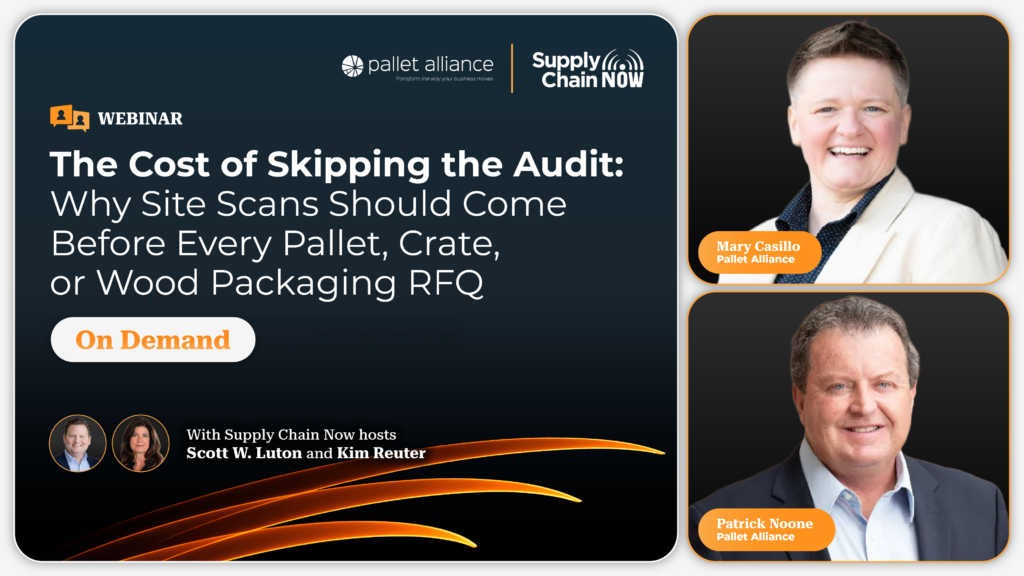
WEBINAR: The Cost of Skipping the Audit: Why Site Scans Should Come Before Every Pallet, Crate, or Wood Packaging RFQ

Share:

WEBINAR: The Cost of Skipping the Audit: Why Site Scans Should Come Before Every Pallet, Crate, or Wood Packaging RFQ

Audit first. Source second.

Many organizations start their pallet program evaluation with an RFQ or RFP. But without a clear picture of current operations, usage patterns, specification engineering, supplier performance, and site-specific needs, procurement teams often limit the value they can actually achieve.

Join Supply Chain Now & Pallet Alliance for a look at why an audit-first approach to pallet procurement and management outperforms traditional sourcing events. We’ll show how comprehensive site scans, operational benchmarking, and industry data uncover opportunities an RFQ alone will miss which are often significant ones.

During this webinar, we’ll show how Pallet Alliance helps companies identify:

  • Opportunities to standardize and optimize pallet specifications across multiple facilities
  • Redundant costs and operational inefficiencies hidden within existing programs
  • Site-to-site performance variations that impact overall spend
  • Freight and logistics optimization opportunities
  • Repair, recycling, and pallet recovery improvements
  • Supplier consolidation and strategic procurement opportunities
  • How benchmarking first turns those discoveries into sustainable, long-term value

Whether you oversee procurement, supply chain, operations, logistics, or packaging engineering, this session will give you practical strategies for turning pallet procurement from a transactional purchase into a data-driven initiative built on efficiency, cost reduction, and continuous improvement.

Before you ask suppliers for pricing, make sure you understand the full opportunity. See why leading organizations choose Pallet Alliance to audit first and source second.

More Webinars

digital supply chain
play-button-webinar
webinar-person
Webinar
September 26, 2022

Why Choose Between Reducing Risk or Optimizing Costs?

As supply chain chaos continues, one of the most difficult challenges for suppliers & manufacturers is identifying strategic sourcing opportunities and across multiple facilities. In addition, organizations have relied on excess inventory as an insurance policy at the expense of opportunities to balance working capital. What if you no longer had to choose between reducing risk and optimizing costs? Join us and learn how Verusen’s Trusted Network capabilities bridge the gap between procurement and operations initiatives and builds trust that your supply will meet your demand for the next generation of materials intelligence. Procurement and operations leaders need increased visibility into their data across their network, and to be able to trust their data is correct in real-time. That means changing how they approach their own systems and rethinking what an optimized and future-proof supply network is.
market
play-button-webinar
webinar-person
Webinar
August 30, 2024

Beyond Resilience: Capitalizing on Supply Chain Uncertainty

The only thing certain in life is that nothing is certain.” So said Roman philosopher Pliny the Elder nearly 2,000 years ago. For supply chain professionals this quote definitely rings true today. Unpredictable shifts in demand and disruptions to supply are becoming more frequent and more severe. Over the last few years, much of our focus has been on building resilient supply chains to prepare for the inevitable, unforeseen challenges ahead. However, some industry leaders are striving to go beyond resiliency to actually take advantage of future disruptions. They see the upside of supply chain uncertainty as an opportunity to capture share from slower competitors. In this Supply Chain Now webinar, hosts Scott Luton and Kim Reuter welcome special guests John DeSarbo and Bharathi Shankar from ZS to explore how industry leaders are capitalizing on uncertainty by building agility into their operations, rethinking traditional approaches to supply chain management, and utilizing AI and advanced analytics to uncover opportunities to capitalize on changing market dynamics.