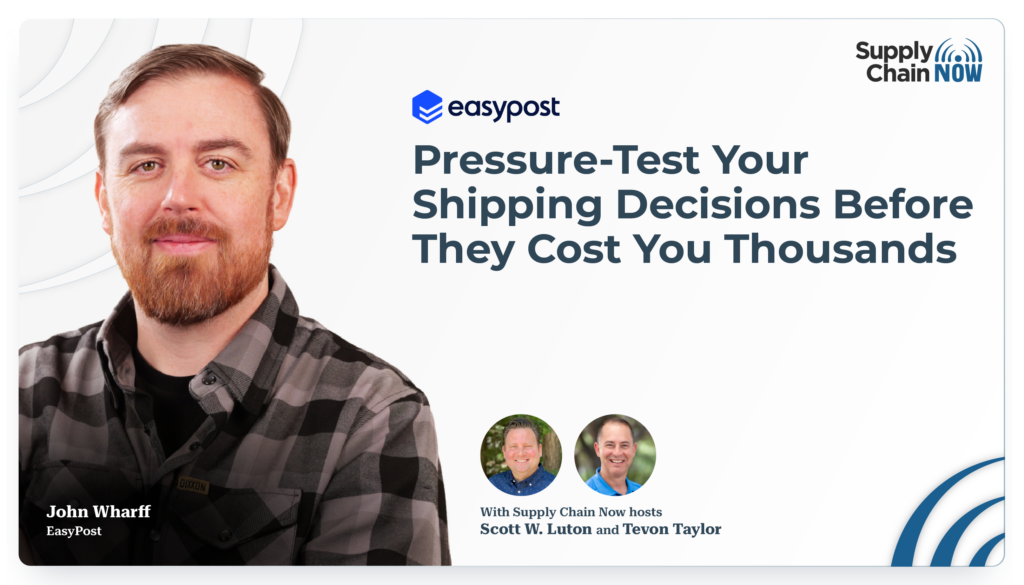
[00:00:00] John Wharff: Whatever your rule is apply it, see which service levels fit, and then compare that estimate of what that total bill looks like versus what you’re actually paying. You’re gonna see a difference, and It’s within that difference that you’re going to capture where you’re leaving money on the table.
[00:00:18] John Wharff: Is it service level? Is it, package size? Is it weight? Is it. dimmable issues? that is how you will find it. Multiply it out across all your volume, and you’re going to see the problem
[00:00:42] Scott W. Luton: Hey, good morning, good afternoon, good evening, wherever you may be. Scott Luton and Tevon E. Taylor with you here on Supply Chain Now. Welcome to today’s live stream. Tevon, how you doing, my friend?
[00:00:54] Tevon Taylor: I’m doing
[00:00:55] Tevon Taylor: great. Uh, just, uh, trying to
[00:00:56] Tevon Taylor: cool off down here in Texas. It’s still
[00:00:58] Tevon Taylor: hot
[00:00:59] Scott W. Luton: I’m with you. I cannot. But you know what? We got a week of upper 70 to lower 80 temperatures here in the Atlanta area. Football weather’s around the corner. And Tevon, as always, you’re bringing solutions and ideas to the conversation here today. So I love the backdrop.
[00:01:13] Scott W. Luton: And, uh, speaking of things I love, what a great conversation we got teed up here today, especially folks, if you’re responsible for getting products into customers’ hands without watching your margins disappear along the way. If that’s what you’re interested in, you’re in the right place, because even the most experienced shippers can know their contracts, audit their invoices, do all the things right, and still get surprised when their carrier bill shows up.
[00:01:38] Scott W. Luton: So today, we’re digging into where those hidden costs creep in, how to pressure test shipping decisions before they get expensive, and what shippers should be doing right now as we get closer and closer to the holidays and the end of the year. All that and much, much more. And Tevon, given your impeccable tr- uh, track record of making stuff happen in global supply chain, especially shipping and technology-wise, I’m looking forward to your take here today.
[00:02:03] Scott W. Luton: Should be a great show, huh?
[00:02:05] Tevon Taylor: It’s gonna be a great show. A lot of chaos out there right now, but that’s, uh, that is the supply chain as we know it today
[00:02:10] Scott W. Luton: It is. It goes with the territory. So I’m excited to get into this very practical conversation, folks. I wanna welcome in an old friend and an industry pro. John Wharff serves as senior director product management at EasyPost, and we’ve en- really enjoyed his practical perspective on really a variety of shows over the years, especially on all things shipping.
[00:02:32] Scott W. Luton: We get a ton of feedback from folks, and they appreciate the practical solutions and ideas that John offers back. So I wanna welcome in John Wharff with EasyPost Hey, hey, John. Welcome back. How you doing, my friend?
[00:02:45] John Wharff: Doing very well. How are y’all?
[00:02:47] Scott W. Luton: Wonderful. Wonderful. Tevon and I have been looking forward to this conversation, and it’s great to have you here, but we’ve got a unique, fun warm-up question to get to. So Tevon, John may or may not know this, but I’ve put the spies on him, and we dug deep into his background, and we uncovered something new about John.
[00:03:05] Scott W. Luton: He’s a bit of a daredevil, and he loves riding and investing in motorcycles. In fact, I think we’ve got a photo from the, the way back machine here. This is John Wharff on his first ever bike. So John, what is this bike you’re sitting on here?
[00:03:20] John Wharff: Uh, that is a 1998 Harley Davidson Sportster 883.
[00:03:26] Scott W. Luton: Oh my…
[00:03:26] John Wharff: vehicle I ever purchased with my… own money.
[00:03:29] Scott W. Luton: That is awesome. Uh, Tevon was your first vehicle, a motorcycle
[00:03:33] Tevon Taylor: No, I– it was one of those little toy
[00:03:36] Tevon Taylor: cars you, you drove around. But yeah, I’m not allowed to ride motorcycles. I’m, I was forbidden.
[00:03:40] Scott W. Luton: So I got to ask you, John, I’m, I’m intrigued. I’ll try not to make this a motorcycle hour, but two questions. What’s the fastest you’ve ever been on a bike, number one? And number two, what is your current bike of choice?
[00:03:52] John Wharff: Uh, okay. So theoretically, let’s talk about how fast maybe I would’ve gone because it may have been over posted speed limits. Uh, I got up to about 110 on that bike
[00:04:04] John Wharff: and the front end kind of started to wiggle a little bit and that’s when I decided that was fast enough and I never needed to go faster than that and then right now I own two bikes. I still have a Harley. It’s,
[00:04:15] John Wharff: uh, a, it’s called a Fat Bob, which is
[00:04:17] Scott W. Luton: Interesting
[00:04:18] John Wharff: Gotta love the Harley naming conventions. and then I have an off-road bike so that I can do my adventure, go up into the mountains, camp off the back of it, take some fishing poles, all that
[00:04:28] John Wharff: stuff.
[00:04:28] John Wharff: Just kind of go off on solo adventures
[00:04:30] Scott W. Luton: Man, that is awesome. And of course, uh, Tevon, the Harley-Davidson, which I’m not sure where it might s- might still be made in Milwaukee, I’m not sure, but of course it’s the iconic American motorcycle. You, you’ve ever ridden one of those, Tevon?
[00:04:43] Tevon Taylor: I have not. I’ve actually seen their supply chain though in, in Indianapolis.
[00:04:47] Tevon Taylor: So someone that was on your show actually
[00:04:49] Tevon Taylor: runs the 3PL for them, so it’s really cool stuff
[00:04:52] Scott W. Luton: Oh my gosh. All right. We’re gonna have to make a road trip. Uh, but I’ll probably be in a van, John. Uh, just f- I don’t trust myself on a motorcycle.
[00:04:59] John Wharff: to do the pilgrimage.
[00:05:02] Scott W. Luton: All right, we got a lot of stuff to get into, and folks, almost moving as fast as John on a motorcycle is global supply chain right now, right? We’re coming into holiday season, end of year, January, when all the returns go crazy.
[00:05:14] Scott W. Luton: So we got a lot to get into here today as we look to optimize shipping performance.
[00:05:18] Scott W. Luton: All right, so let’s do this. For folks that may have missed your earlier appearances with us, John, tell us briefly about, uh, yourself and what EasyPost does
[00:05:27] John Wharff: Yeah. So John Wharff, Uh, I’ve worked here at EasyPost, for about eight years, come from like the solutions engineering background. I’m very passionate about helping people find solutions to the problems that they have. Uh, EasyPost, we, uh, dip our toe into many different areas of the shipping realm. Uh, we started as a shipping API company and have rolled out to a bunch of other solutions that just help people get products from their warehouses, their DCs, their stores into consumer hands
[00:05:54] Scott W. Luton: Hmm. It is just that easy. No pun intended, but really appreciate, uh, how you all are working with so many companies, big, small, in between, to help navigate, uh, these crazy times that Tevon was talking about on the intro.
[00:06:06] Scott W. Luton: okay. So, uh, John and Tevon, shippers audit their invoices. They know their contracts. They’re careful, they’re savvy, they’re productive.
[00:06:16] Scott W. Luton: They’re people that c- you know, let’s face it, they make things happen, right? Yet, the carrier bill that shows up still seems to surprise a lot of folks almost every month. So John, as we get into kinda what we’re talking about here today, why does that happen?
[00:06:31] John Wharff: Yeah, I think that when people normally think about shipping, the first thing that they do and then what the majority of their time is spent doing with the carriers is negotiating a rate. But what they may or may not realize at that time is that the rate that they’re negotiating is the base rate, and that there’s a lot more that goes into the final charge for a package than just the base rate. It’s those surcharges that lurk under almost everything that we do within the supply chain constantly, where you start getting hit with things that you may not have even realized you qualified for. Um, and they change constantly. So even if you knew about what, you know, you had to avoid last year, it may be different this year and it may catch you unawares.
[00:07:12] Scott W. Luton: Um, uh, Tevon, uh, of course, anyone’s tuned into Supply Chain Now, we have talked about exactly the point John is making time and time again, yet it still bites people. That’s why we keep talking about it, right? Offering ways of, of m- making sure that doesn’t happen. Those surcharges sure are pesky, aren’t they, uh, Tevon?
[00:07:29] Tevon Taylor: Oh, they’re pesky, but, uh, it’s, it’s where the carriers make their money. because most people look at the base rate and they think That’s the rate, and then you get that final invoice, you’re not managing your accessorials and all the other charges that are added on. So he’s absolutely right on, you know, that’s, you know, you
[00:07:47] Tevon Taylor: got to look at the bigger picture. the total landed cost is
[00:07:50] Tevon Taylor: what you should be focusing on
[00:07:51] Scott W. Luton: That’s right. And here in the golden age of supply chain tech, of course, there’s better ways to fight through the fog of, uh, all those extra fees to know exactly, uh, how you’re shipping, what it’s gonna cost you, and we’re, we’ll touch on that later today. Um, all right. Let’s, let’s, let’s define the problem a little bit more, John, where teams actually get bitten.
[00:08:11] Scott W. Luton: Walk us through the shipping decisions that are most likely to quietly and not so quietly cost people money
[00:08:19] John Wharff: Yeah. I think that, uh, uh, w- the trap that a lot of people fall into is you set up rules and then you just kind of forget about them. Because they serve you at the time that you set them up right? As you’re y- getting things spun up, as You decide exactly which carriers and service levels You wanna be shipping with, you kind of set up your logic and then it runs.
[00:08:35] John Wharff: And for a while, that serves you. but the biggest things that are changing constantly are those underlying surcharges. Fuel surcharge, it’s the biggest by overall amount charge. Dimensional weight, that’s constantly changing. Each And individual carrier is going to change what exactly gets dimmed versus actual size, delivery area surcharges, residential address correction fees oversized additional handling. These are all things that the carriers are always looking at. Like Tevon mentioned, it’s how they make their money, so they don’t stay static.
[00:09:06] Scott W. Luton: Mm.
[00:09:07] John Wharff: the biggest way that you can get caught unaware by them, is by keeping your rules static when you’re dealing with an environment that’s not. It’s variable and it’s chaotic
[00:09:15] Scott W. Luton: All right. So Tevon react to that, uh, some of those common places that are costing folks money. Of course, I should point out the gas. I just pulled up AAA. Uh, as of this morning, diesel is 6.52 a gallon, national average. And get this, a year ago, 3.69. Oh my gosh. Tevon react to some of those common culprits
[00:09:36] Tevon Taylor: Yeah. He’s– John’s mentioning all the the, the right culprits, and there, there are two things. mentioned you have to be dynamic in your approach, right? Make sure the strategy is,
[00:09:47] Tevon Taylor: you know, you’re matching your actual
[00:09:48] Tevon Taylor: order profile to the needs. So that might change, but all those accessorials you can manage proactively. And one key thing to know is they’re all negotiable as well. So just because you get a bill that has these accessorials, make sure when you’re negotiating the contracts with the carriers, you’re negotiating the base rate and the accessorials, because those accessorials can wipe out any kind of savings or benefit you might think you have with that carrier
[00:10:15] Scott W. Luton: All right, so John, uh, more practical advice from you. If folks could only reexamine one of these things you mentioned, one of these culprits, uh, especially as we’re, you know, getting into holiday season, end of year, of course, peak is all kinds of, you know, defined all kinds of different ways, uh, these days it seems, but where would you suggest folks start?
[00:10:34] John Wharff: Yeah. So the way that I like to think about it is like, just like a lot of things in life, your shipping profile is usually a bell curve. And where people focus on is the average, the middle, right? Like their normal thing, what goes out the door 80% of the time. They usually base are the rules off of that.
[00:10:50] John Wharff: They’re looking at that to like kind of be the foundational part of their data that they’re looking into. Well, that’s not where you get caught. Where you get caught is on the edges, the stuff that you’re not planning for, those oversized, those really heavy. As you move into peak, chances are you have new bundles, new products, you’re using new box sizes because maybe you’re trying something new to appease your customers. You need to check the outliers because that’s where you’re most likely to get caught, not on your normal five by five by five two-pound shipment that you do 80% of the time. You can be totally set there, but as your shipment volume increases throughout the remainder of the year and well into next year, you’re gonna notice that those fewer shipments add up really, really quickly. and, with some of the fees that you get assessed on them, that’s even more like the magnitude of charge can go up really fast
[00:11:41] Scott W. Luton: Hey, John, really quick before I get to having the comment. In some of my stops in my journey, uh, some, especially some of the larger organizations, the folks reviewing the, uh, shipping invoices are in a different office, different facility, and they can be very disconnected from the folks who are actually making the decisions day-to-day of how to ship and which car, all that stuff.
[00:12:00] Scott W. Luton: But some things you’re talking about. Do y’all find that regularly, and then when you have a meeting of the minds, it’s like a eureka moment?
[00:12:06] John Wharff: Yeah. Look, those people need to talk, right? Because if anybody has ever worked a actual warehouse floor, what you really find out is that convenience is going to win out over almost everything every single time. A lot of the different warehouses that. We toured were, like, confused about a bunch of these, Like, oversized box charges, where it turns out that the warehouse operators were just grabbing whatever box was closest
[00:12:28] Scott W. Luton: Right
[00:12:29] John Wharff: because they’re trying to be the most efficient they can, and efficiency to them is, “How do we get all of this stuff out as quickly as possible?” so like, look, we all know data and insights are only as good as you
[00:12:40] John Wharff: can get the people actually doing the operations to follow them
[00:12:44] Scott W. Luton: Well said. Great call out. All right, so Tevon, uh, let me double-check my math, break out my abacus. Uh, yep, uh, assumptions still are very costly, uh, in 2026. What’d you hear there from John?
[00:12:55] Tevon Taylor: Yeah, assumptions and outliers. I mean, one of the things that always baffles me is like if you look at somebody’s spend and they’re spending a ton of money on, you know, in, in the FedEx/UPS world, the first overnight that’s not even discounted. Um, and then you find out– I’ll tie this to his warehouse comment. The person in the warehouse that’s a 3PL that’s, you know, running it, it’s the first dropdown for shipping, and they just click on that. brought this up on some other podcast, and even though it’s an outlier, you’re not paying or you’re paying premium service, the customer doesn’t
[00:13:29] Tevon Taylor: really need it. First overnight means Like 8:00 AM, 8, 8 AM,
[00:13:33] Scott W. Luton: Right
[00:13:33] Tevon Taylor: so if somebody shows
[00:13:34] Tevon Taylor: up at 8:00 AM with a package, it’s like, “Did I
[00:13:36] Tevon Taylor: really need It at 8:00?
[00:13:37] Tevon Taylor: Because I got no discount. it could have showed up at 10:30, and I, I probably still didn’t need It at 10:30. It could have showed up at 2:00 or 3:00 in the afternoon.” It’s just they, they strategically put that in the dropdown so the people in the warehouse, hey, it’s easy for them,
[00:13:50] Tevon Taylor: but it’s costly and you’re not managing it.
[00:13:52] Tevon Taylor: And it’s an outlier, so you might not notice it
[00:13:55] Scott W. Luton: It’s so true. And you know, look, folks, we all know, it goes without saying, that these hardworking members of warehouse, all these different facilities, they are working hard to deliver. The overwhelming majority, you know, 99%, right? They’re trying to make the best decisions to best serve the customer.
[00:14:11] Scott W. Luton: However, uh, you know, with technology and other best practices, we can help make, take that performance to the next level. Uh, Tevon mentioned, you know, some of the bigger carriers, right? And John, it gives me a great segue because I want to talk about carrier mix, service levels, you know, two of these big levers that, uh, any shipping team has.
[00:14:32] Scott W. Luton: How should shippers be thinking about those choices heading into a holiday season and, uh, hard to believe, but 2027?
[00:14:39] John Wharff: Yeah. Um, look, the carrier field is wider than it has ever been. We’re seeing huge growth in what historically has been called other carriers. We’re all very familiar with the big four. They’ve kind of ruled the roost historically. And then there’s been some big incumbents that have come in and, you know, have started z- uh, swinging around some pretty hefty weight in the industry. But the fact of the matter is, mix is something that you want to diversify just like you do anything else in your business. Um, I– Scott, you know, I come from a baseball background, played baseball for a long time, And, I always think about it, as like building your roster. Everybody has different strengths, different weaknesses.
[00:15:15] John Wharff: You can’t anymore have one player that kind of covers the entire spread. it doesn’t work that way, and you’re always leaving money on the table if you try to operate in that. And I mean, Tevon hit the nail on the head. We talk about service tier overbuying constantly. Like, it’s not enough to just look at your carrier mix.
[00:15:32] John Wharff: You also need to really understand the service levels that fall under those carriers and understand exactly what you. need to buy, understand time and transit, understand your commitment to your customers, so that you’re not accidentally falling into patterns that aren’t serving you or your customers really.
[00:15:48] Scott W. Luton: Hmm. Tevon, you’re always hitting that nail on the head, like John mentioned. Uh, and I lo- I do love a good baseball analogy, John. I’ll circle back on that. But, uh, Tevon, your thoughts on carrier mix, service levels, you know, as, for as many right choices we make, we make a bunch of missteps there
[00:16:06] Tevon Taylor: Yeah, he’s right. And the two things that are important, I mean, You don’t optimize for the cheapest carrier, and you don’t diversify for its own sake. You know, it’s not beneficial to do that. You optimize for the lowest total cost to fulfill the customer promise. Because, you know, when you diversify multiple carriers, it’s gonna create complexity.
[00:16:26] Tevon Taylor: You’re gonna have technology requirements, which EasyPost can help you with, but they’re operational costs as well. So you need to make sure you’re doing it.
[00:16:34] Tevon Taylor: The ultimate is fulfilling the customer promise. So as long as the customer’s your North Star and you back into that, then you diversify and fi- find the right carriers that way
[00:16:44] John Wharff: I love that. Yeah, I want to clarify. Adding carriers does not plug The leak. Like just throwing more carriers in your mix doesn’t solve the problem. It starts with you. It starts with your processes. It starts with your rules. It starts with your logic, how you get to a service level. Why are we choosing the labels we’re choosing?
[00:17:00] John Wharff: How are we best serving our customer? you could have every carrier that’s available in the world, but if you haven’t addressed those problems, it won’t help you at all
[00:17:08] Scott W. Luton: You know, John, I wanna illustrate your point, you and Tevon’s point. Usually I was gonna, I was gonna hold this resource to the end, but I think this is a great time to share, kind of to your point. Uh, there’s a case study that folks can download where one organization saved $2 million, right, in shipping spend, had 273,000 fewer late deliveries, and maybe even a bigger flashing lights, to your point, without changing carriers.
[00:17:34] Scott W. Luton: So it can be done, and you, folks, you all, y’all might be surprised at just how big the opportunity is right under your nose.
[00:17:41] Scott W. Luton: All right, coming back to carriers. First off, John, before I ask my question, this case study.
[00:17:45] Scott W. Luton: Is it, uh, it kind of illustrates your point, doesn’t it?
[00:17:48] John Wharff: Yeah, a-absolutely. I mean, oh, volume is such a huge lever, right? And, uh, it, it doesn’t matter where it?
[00:17:57] John Wharff: is in life, and we focus out in the supply chain world. But when you’re shipping out thousands, tens of thousands, hundreds of thousands of boxes, tiny little changes in what you pay per box are going to add up. But on the bad side of that, tiny extra charges add up just as quickly. So it’s all about really understanding the environment that you’re in and really fine-tuning it for what best serves you. And then once again, just to parrot off of Tevon because he’s a very smart man, customer customer satisfaction, right? what what is your promise? what are you trying to do? Because at the end of the day, what we’re doing here in the shipping world is just serving that how do I appease my customers? How do I get return customers? How do I make sure that people want to buy what I have on offer?
[00:18:41] Scott W. Luton: Hmm. Tevon, uh, you know, John, you know, Tevon E. Taylor is kind of like our Shohei Ohtani here at SupplyChain Now. He is, he really is that good. Uh, don’t tell him I said that though. Uh, but Tevon, really quick, your savings out there, it might not be the 2 million that this organization, there might not be 273,000 fewer late deliveries, but gosh, I bet most organizations would take a tenth of that.
[00:19:04] Scott W. Luton: Is that right, Tevon?
[00:19:05] Tevon Taylor: A-absolutely. A-and I think sometimes they, they, they don’t focus on transportation. It’s, it’s a cost center. And, and unfortunately, there’s a lot of savings that should be, uh, focused on in that area. I mean, at the end, you know, uh, David Ivan mentioned, you know, the cost of transportation is a cost. It’s an expense that we need to find a way to reduce. And the best way to do it is make sure you’re focusing on the right things and taking care of your customer. But there’s a lot of savings out there, and $2 million of savings and not switching carriers, that just shows you, uh, negotiate, focus, have the data analytics. It’s all at your disposal now. It’s not like you have to get paper copies of the invoices. You have the data. Go figure it out, right?
[00:19:48] Scott W. Luton: That’s right.
[00:19:49] Scott W. Luton: all right. So John, staying with carriers for a second here. Uh, you referenced this earlier, but I wanna get you to expound on it. Any new emerging carriers that you’re tracking that you see are, are getting more traction right now, and who else should shippers have on their radar?
[00:20:05] John Wharff: Yeah. So, uh, uh, it’s fun ’cause I always get to approach this problem from, like, the two facets, which is working in the indus- industry, but then also being a consumer.
[00:20:13] Scott W. Luton: Right?
[00:20:14] John Wharff: I’m always paying attention to, like, what carrier is actually dropping stuff off at my house. Um, there’s a lot of excitement happening in, like, the national And regional carrier space.
[00:20:23] John Wharff: Like I said, it’s like the fastest growing
[00:20:24] John Wharff: segment of carriers Right?
[00:20:25] John Wharff: now. We’re seeing huge increases with, uh, newcomers like, GoFo and UniUni, and then there are some of the historical regionals that are really gearing up to make a big splash, Veho and a couple others within the industry, where they are really starting to fine-tune what their specific, uh, uh, advertisement is to the market, like what they’re bringing to play against the big four. and I think that we’re going to see more and more of those names that used to be tied to, like, maybe a specific region, maybe West Coast, maybe East Coast, they’re going to be expanding their markets. They’re going to be really tightening up their offerings to make everything more viable for users from small to extremely large
[00:21:05] Scott W. Luton: Uh, Tevon, uh, Uni Uni, uh, Gofo, I think you said. Maybe FoSho. I think someone’s missing a great opportunity to have a carry named FoSho. Uh, but Te- Tevon, new players, old players, a big mix out there, lots of options. Uh, your thoughts?
[00:21:21] Tevon Taylor: Yeah, they– I mean, obviously Amazon’s a big one. Um, OnTrac, um, there’s, um, GLS, Speedy I’ve seen. Veho delivered my, my Lululemon yoga pants, so that was nice of them. Uh, but, uh, there’s, there’s– they’re filling a gap, right? And, uh, you know, they’re, they’re not– I, I, I always tell people, you know, “Hey, UPS, FedEx worried about that?”
[00:21:46] Tevon Taylor: That’s
[00:21:47] Tevon Taylor: not really– Don’t get me wrong, they’re take-taking some market share, but you’re, you’re seeing more of the, the local same-day delivery, and that’s, you know, a lot of these players in the consumer space, that’s what they’re filling for sure
[00:21:57] Scott W. Luton: Yep.
[00:21:57] John Wharff: Yeah
[00:21:58] Scott W. Luton: All right. So I wanna ma- I wanna, spreadsheets gotta make an appearance now, John. Uh, when I was in industry working for a, uh, privately held construction materials manufacturer, I would ship stuff, uh, m- mainly in the U.S., little bit of Canada. And I would have that master spreadsheet as I was comparing carriers and all this stuff.
[00:22:18] Scott W. Luton: So I’ve been there and done it. Of course, now, to be fair, gosh, that was almost 20 years ago, and things have changed a little bit since then. But, you know, as we plug in things in that master spreadsheet, ’cause everybody watching or listening, they probably have had that at some point. Some of them still have it.
[00:22:34] Scott W. Luton: And they, things look great, right? We’re proud of our spreadsheets. Plans look perfect. But when the, uh, when, when tho- those plans hit real shipment volume, volume, a lot of those things start to fall apart. Why is that, John?
[00:22:49] John Wharff: Um, I, I think I kind of alluded to this earlier, but the truth lives in the fringes,
[00:22:54] John Wharff: not in the usual,
[00:22:55] Scott W. Luton: உம்.
[00:22:55] John Wharff: in the day-to-day. Um, get really used to what’s normal and what the last, I’m gonna say six, seven peak seasons have taught us
[00:23:05] John Wharff: is that nothing is normal. Like, there, there is no home base to go back to. there, isn’t any usual. and that uh, where you’re really, really going to start seeing either bene- benefits or detriments is in kind of the fringe stuff that’s happening on the outsides. Uh, those things where, you know, maybe one day you said, “Oh, there’s only a couple of these. We don’t really need to worry about them today.” just the old fact that Tevon alluded to earlier, which is like, if you’re going to hard code in rules to accomplish your goals, eventually your goals are going to outgrow your rules.
[00:23:39] John Wharff: Um, because of the variability in the industry, because of the way surcharges change, because of the way shipping evolves in, in general. If you’re not rechecking what your overall goals are as a company and ensuring that whatever rules you have are in service of those goals, you’re gonna be left behind. you have to recheck it
[00:23:58] Scott W. Luton: Tevon, we got to be dynamic. We got to be dynamic. Uh, it, it, it’s, it’s, it’s so prevalent in our technology options out there. What’d you hear from John?
[00:24:07] Tevon Taylor: Well, you know, it’s
[00:24:08] Tevon Taylor: funny, every time he says, “Hey, truth is in the fringes,” the problem is
[00:24:12] Tevon Taylor: everybody looks at– You look at a bell curve, they’re
[00:24:15] Tevon Taylor: looking at the average,
[00:24:16] Tevon Taylor: and they’re not focused on the fact that actual weight dimensions, you know, they change, changes, residential mix changes, surcharges change, minimums kick in. All these things change. So, you know volume doesn’t behave uniformly, and that’s, that’s when the spreadsheet didn’t work because that’s what you’re trying to look at versus the distribution of shipments, not just the average shipment cost. So that’s, that’s the big change I think people get hit with. But it’s because those fringes aren’t being managed, And you’re trying to manage to that middle and say,
[00:24:51] Tevon Taylor: “What’s the average look like?”
[00:24:53] Tevon Taylor: Well, that’s– You got to manage those fringes to make sure it’s a–
[00:24:56] Tevon Taylor: you get closer to the average and those tails kind of come close to the middle
[00:25:00] Scott W. Luton: Outstanding, Tevon. And you know, I’m not gonna use my favorite, probably a lot of folks’ favorite Mike Tyson quote, uh, about the perfect plan and a punch to the face. But a little baseball analogy, John, since I bet you’ve been there. It’s one thing in batting practice as a, as you know, in your earliest of leagues to, you know, get that underhanded throw from the coach and hit, hit those things, hit home runs, feel good, have a good swing, and then you get at the plate, and you get a, you know, 80 mile per hour fastball at that age group, and oh man, it’s chin music.
[00:25:29] Scott W. Luton: Everything can change, kind of to your point. Those perfect spreadsheets, when operational reality hits, a lot of times they can melt away. All right. So John and Tevon, you know, depending on how you look at it, peak season has been extended this year. Get this, the latest National Retail Federation/Hackett Associates Global Port Tracker, that is a quite a name.
[00:25:51] Scott W. Luton: It forecasts that major U.S. container ports will handle 2.31 million TEU in September, right? 20-foot equi- uh, equivalent units, if I’ve got that acronym right. That’s up 9.6% year-over-year, so almost 10 percentage points over last year. That would put September slightly ahead of July’s 2.3 million TEU and make the month the busiest import month of 2026.
[00:26:16] Scott W. Luton: So related to peak, John, where do costs pile up between now and January, and how can a team spot the problem in their own data before that invoice shows up along with all the added costs and risks, and you name it?
[00:26:33] John Wharff: Yeah. Um, it, it’s funny. I mean, you kind of hinted at this, but peak season is such a nebulous term and it gets more and more nebulous every single year. Like peak is here. We’re already there, and it will last until February. And something that we hear a lot of times, uh, in the industry is people saying like, “Oh, we’ll, we’ll put this off, like, but we’ll fix It before peak.
[00:26:52] John Wharff: We’ll fix it before peak.” At its smallest, peak is three months. It’s a long time, and it gets way longer If you have some sort of bad rule charging you a lot of money throughout those three months. Peak fees have jumped up, and, uh, one of the biggest things that I think people kind of lose sight of and that Tevon and I have both talked about is those fringes and where they can really bite you is you start suffering from your own success.
[00:27:17] John Wharff: Uh, what everybody wants in a peak season is to see a huge swell of volume, a huge influx of new customers. you’re selling stuff like hotcakes. Things are going well. Well, what goes along with that? Residential fees. You’re shipping to places you’ve never shipped to before because of your popularity. So do you know your zones?
[00:27:37] John Wharff: Do you know where you’re going? Do you know what carriers you’re using to get there? Oversized. Once again, your package profile is probably different during peak season than it is the rest of the year. What are people buying? What boxes are you putting them in What sort of bundles are you doing together?
[00:27:51] John Wharff: Do you know what the new thresholds are for oversized package handling for your FedExes, your UPSes, your USPSes? And then trying to do those reactive upgrades when things are delayed, when, you know, things don’t go really well, you start falling back into the old habits. One that I always talk about constantly is, uh, you know, it used to be whenever someone needed something in two days, a lot of carriers specifically name service level two-day, so you just default to that.
[00:28:18] Scott W. Luton: Right?
[00:28:18] John Wharff: it, without really understanding time in transit, how long these service levels are taking to get there, and the fact that you could probably actually downgrade the service level, save a bunch of money up
[00:28:29] John Wharff: front, and still get it– to
[00:28:30] John Wharff: your customer in time
[00:28:31] Scott W. Luton: John, uh, you’re absolutely right. And clearly you’ve been there and done it. You’ve seen lots of different organizations as they look to address many of the opportunities you’ve mentioned and helped them do it. Um, but I go back, Tevon, uh, uh, one of the things that John mentioned, and this is a tired old example, but it’s so true because it sa- it’s, it’s, a big part of it is, uh, if customers don’t care about two days, why spend the money to get it to them in two days or one day or whatever?
[00:28:59] Scott W. Luton: You know, when I order some stuff from said online e-commerce site and, uh, I can extend it out a week or even in some cases longer than that, um, you know, socks or whatever it is, I love it. Sometimes I get an extra rebate point or whatever, but I have no need for that stuff same day, one day, two days. Now, for every one of mes,
[00:29:23] Scott W. Luton: I’m gonna name her.
[00:29:24] Scott W. Luton: There’s an Amanda out there. Just kidding, my da- that wants everything same day, baby. Tevon, weigh in though with what John said. Uh, th- there’s a better way
[00:29:33] Tevon Taylor: Well, a- and
[00:29:34] Tevon Taylor: I love what John
[00:29:35] Tevon Taylor: said. You take all those factors. I’d, I’d kinda add to the tail end of that is, you know, build a weekly cost to serve dashboard showing, you know, what’s your
[00:29:44] Tevon Taylor: cost per order, what’s your cost per package, what’s your average zone, average weight dimms, service levels, carriers, accessorials, returns, all those buckets.
[00:29:55] Tevon Taylor: that and model it out to say, “Okay, what are we expecting? What’s the
[00:29:59] Tevon Taylor: original transport- transportation model?” And then you kind of manage it proactively. Don’t wait for the carrier invoice and go, “Oh, crap. We’re shipping everything the wrong way,” or within the packaging that, you know, we’re, we’re overpacking. I mean, there, there are things you need to just proactively manage. And to me, you can do that before the package is even outbound because you can manage everything you’re doing, um, with, with the order data. So I’d build that dashboard and make sure you’re proactive about it, because the problem is everybody waits till the end of peak and those invoices flow in and they’re like, “Wow.”
[00:30:33] Scott W. Luton: Right
[00:30:34] Tevon Taylor: we just, we,
[00:30:35] Tevon Taylor: we had, I call it. you know, revenue leakage, cost leakage, whatever you wanna call it. It’s just you’re wasting money. your sales are going up, but your costs are going up and sometimes crossing the wrong boundary
[00:30:45] Scott W. Luton: Hmm
[00:30:45] John Wharff: It is funny. If you’re holding an invoice in your hand, it’s too late to be mad about the invoice.
[00:30:51] Tevon Taylor: Because they’re not gonna give you that money back. “Oh, you, you dimmed out? That’s your fault.”
[00:30:55] Scott W. Luton: Uh, you know, that is such, uh, a such great advice. Um, so we, we can’t wait. We have an opportunity right now, and yes, it’s almost October, but there’s still, uh, terrific opportunities you can act on right this minute. Um, John, I want, you know, I think we included, I think, pressure testing into the kind of the name of this episode, and I want you to tell us about what that means when it comes to pressure testing a shipping decision.
[00:31:20] Scott W. Luton: But Lori Boyer, who’s now traveling the world, told me to make sure we challenge John to tell us what that means concretely enough so that folks could listen to your definition on a Monday before they had their first cup of Folgers coffee. So John, l- tell us about pressure testing.
[00:31:41] John Wharff: If they’re drinking Folgers, I can’t help them. No, uh, look, I, I think it, it– I will try to make it as simple as possible. What a pressure test is, it’s a re-rate. It’s taking a Look, at your operations, taking a look at why you’re buying the carriers and service levels that you are, and then extrapolating that knowledge out to your entire volume. So you talked about earlier, Scott, juggling tons of spreadsheets, we’ve all been there, everything like that. We’re gonna start small. we’re gonna do a small exercise, and then we’re gonna try to understand what that means for our entire volume. So I recommend pull a bunch of shipments, about 100 to 200.
[00:32:14] John Wharff: But like Tevon mentioned earlier, don’t fall into the trap of only grabbing your usual ones. You want an actual cross-section of your real volume, everything that you’re doing.
[00:32:25] John Wharff: Once you have those one to 200 shipments, what you wanna do is you want to compute the billable weight on them. You wanna look at size, you wanna look at weight, you wanna look at packaging, you wanna see exactly what their profiles are. there. Then look at where they’re going. Attach the zone. Look at any surcharges that may apply to where they’re going, all those delivery area surcharges, extended delivery area surcharges. Understand all of that. all of the services that meet your commit date. Scott, you mentioned this earlier, but maybe your commit date’s two days, maybe it’s seven days, maybe it’s 12 days. it doesn’t matter. Whatever your rule is apply it, see which service levels fit, and then compare that estimate of what that total bill looks like versus what you’re actually paying. You’re gonna see a difference, and It’s within that difference that you’re going to capture where you’re leaving money on the table.
[00:33:18] John Wharff: Is it service level? Is it, package size? Is it weight? Is it. dimmable issues? that is how you will find it. Multiply it out across all your volume, and you’re going to see the problem
[00:33:29] Scott W. Luton: Hmm. Tevon,
[00:33:33] Scott W. Luton: John’s gonna bring it here today, and, uh, he’s been doing it all show, but that last response might take the cake. Your thoughts, Tevon?
[00:33:41] Tevon Taylor: Absolutely. I mean, pressure testing, does it work? Does the model work? So everything he mentioned, you’re taking your, you know, your, your data, all
[00:33:50] Tevon Taylor: of it, taking a great cross-section, running it through, and then you see, okay, where is this not working? Where are the costs that we don’t need to have in, in, in our business?
[00:33:59] Tevon Taylor: So I, I, I love the example. I,
[00:34:02] Tevon Taylor: you know I’ve actually never… This is sad. I’ve never heard people pressure testing, which is kind of smartest thing you can do because otherwise you’re reacting. And he, he said it, you got the invoice in hand, you’re not pressure testing, you already screwed
[00:34:16] Scott W. Luton: That’s right.
[00:34:17] Scott W. Luton: That’s right. Uh, and you know, folks, you can stop doing that too. Uh, the fate’s in your hands. Uh, so John, I got, I got, I got to revisit something though on, on the coffee thing. I’m not sure why I said Folgers. We drink Costco coffee in our household, right? And that’s a good buy and it’s good quality, we think.
[00:34:35] Scott W. Luton: But John, so you, you’re obviously not a Folgers fan. What’s your go-to coffee?
[00:34:40] John Wharff: Uh, I’m pretentious, so I’m just gonna warn everybody ahead of time. Uh, there’s a company out of upstate New York called Death Wish Coffee, and They won my loyalty years ago. They advertise themselves as, like, super highly caffeinated, and maybe it just tickles my brain the right way, but I like it
[00:34:57] Scott W. Luton: Okay. Death Wish Coffee
[00:34:59] Tevon Taylor: you’re bougie. I like
[00:35:01] John Wharff: Exactly. I, I’ll admit it. I’ll own it.
[00:35:03] Scott W. Luton: Well, you know, I think you may have hurt Tevon ’cause, uh, Tevon’s feelings, ’cause I think he might just drink Folgers. Tevon, what do you drink?
[00:35:10] Tevon Taylor: I, my, my grandmother introduced me to Folgers when I was younger, and I love Folgers, man. But I’ll
[00:35:16] Tevon Taylor: drink
[00:35:16] John Wharff: Look,
[00:35:17] Scott W. Luton: Yeah.
[00:35:17] John Wharff: I’ve drank plenty of Folgers out of a Ziploc bag in the middle of a mountain ’cause it d- it’ll get you where you need to go when you’re out in the middle of nowhere
[00:35:24] Scott W. Luton: I’m with you. I’m with you. Uh, all right. So I wanna ask you, you know, AI. I, I don’t, I think we’ve had this whole conversation, I think, and I bet we might have mentioned AI once or twice. That is such an oddball, and I love it, right? Uh, and now we’re gonna bring AI into the conversation. There’s a ton of noise about artificial intelligence, really across global business, but certainly in the logistics game, John.
[00:35:49] Scott W. Luton: So I wanna ask you kind of a, a two-part question here. Where does AI genuinely, if I said that right, help with logistics? And what do you think is a bunch of hot air, crazy talk, whatever you wanna call it, John?
[00:36:02] John Wharff: Hmm. So I think what we’re talking about is a very good application for AI simulation theory, right? Uh, what AI is really good at doing is taking in a bunch of data, running it through a bunch of operations, and telling you what the results are. I think people kind of fall flat on AI or maybe are intimidated by it or scared, is that it’s not a cure-all.
[00:36:22] John Wharff: It’s one of those things where you– it’s only as good as the data you feed it as good as the model that you train it you also still need knowledgeable people to test it before you trust it. Um, it’s one of those things where I’ve always said everything that you do within the shipping realm always has at least two operations, and it’s doing the thing, but then validating that you did the thing the way you wanted to do it. Um, and that’s where AI can be really, really beneficial, is doing these sort of pressure tests, doing these sort of evaluations about what you’re doing, and also pulling in all the data to confirm that you’re actually accomplishing the goals that you set out to do in the first place. It’s really, really easy to just kind of set it And forget it like I mentioned before. But if you do that, there are chances that you’re leaving huge gaps. It’s not going to fix something that is wrong, that is an error, that is, that is broken. Instead, it’s going to magnify whatever you are already throwing at it.
[00:37:23] Scott W. Luton: Mm.
[00:37:23] John Wharff: you have to be real confident that You know that what you’re doing is the right step, and AI may just help you do those pressure tests to know, to kind of reinforce your rules, catch up to modern, uh, shipping rules, regulations, everything else, and kind of fill in any gaps that you may be missing
[00:37:39] Scott W. Luton: Hmm. All right, Tevon, uh, weigh in on what John said or what else you’re seeing out there that AI’s doing really well in logistics and where it’s, it’s not quite ready yet
[00:37:48] Tevon Taylor: Yeah, I mean, AI is amazing at finding patterns humans can’t see across millions of shipments. I mean, I love that about AI. You can plug something in, it’s gonna look for patterns, it’s gonna help you maybe with forecasting, perhaps optimization. But in the end, John’s spot on. It’s not a substitute for understanding your customers, your operation, or your network.
[00:38:11] Tevon Taylor: So it’s not gonna replace your transportation strategy or your operational judgment. That’s still your job. It’s just gonna help you with the big numbers and the crunching and looking for pattern recognition
[00:38:22] Scott W. Luton: Well said, Tevon. And Brian is also kind of sharing what both of you are talking about. Brian says, “AI won’t fix a broken process. It will highlight what needs fixing, and it’ll do so fast.” Good stuff, Brian. Uh, all right. Let’s see here.
[00:38:39] Scott W. Luton: I wanna go back to pressure testing for a minute, John. Uh, because if I’ve got this right, I think you and the EasyPost team kind of built this pressure testing right into your platform, right?
[00:38:50] Scott W. Luton: Uh, right? The simulator that’s inside Luma AI, right? So, so AI front and center. So tell us w-w– kind of walk us through what it does and how a shipper would use it and use it effectively
[00:39:03] John Wharff: Yeah. So this goes back to kind of the case study that you alluded to earlier and what people can link out to and see. But what the Luma Analytics AI does is it, you can a- the, sorry, the Luma Simulator AI, what happens is you can actually upload all of your shipment data to it And have it analyze, “Hey, if I were to add this carrier, or if I were to remove this carrier, or if I were to add these service levels to my rule set, if I were to relax my time in transit rules, what decisions would you make and how much money could that save me?” what it really gets down to is, another thing that Tevon mentioned earlier is cost per package. Everybody knows, and that if you can identify what your cost per package is to actually serve things out to your customer, what We’re all trying to do is get that cost per package down. So you upload all of your shipments, you tell us what carriers you want to analyze within that, uh, data set, and we will spit back, “Here are exactly the decisions that we would’ve made and why, where the savings live, what you can do today to kind of serve that up to you And we liked it so much, and we got such good results from our internal users that we actually published an external, uh, version of it that you don’t even have to, be an EasyPost user. you can actually answer a few questions on our website. you can upload some PLD, and We will do the same type of analysis for you and tell you what kind of savings are hiding within your data today.
[00:40:24] Scott W. Luton: Tevon, uh, what’d you hear there with that practical pressure testing, um, uh, function and capability baked into the platform?
[00:40:33] Tevon Taylor: Well, I didn’t realize you didn’t have to be a customer. I love that. I mean, that’s a good way to test out the system, right? Um, but
[00:40:39] Tevon Taylor: really the, the important part, you talk about pressure testing something, you know, historically in the past you had to have analysts and spreadsheets, and it took we- weeks and weeks and weeks. Now the shipper can just do it, and they, they can do it, uh, for free as well to start off with. So I– hey, I’m on board with that
[00:40:55] Scott W. Luton: all right, so John, we’ve already answered this a little bit, and we’ve shared, of course, the case study that folks can download with the really big results. But any other results you wanna mention that shippers are seeing when they run their volume through that estimator?
[00:41:08] John Wharff: Yeah. I, I think that, uh, it’s really easy to get caught up once again in like the, the really big picture stuff that can seem overwhelming like, “Oh man, there’s so many carriers. Where do I start?” Everything like that Instead, start with yourself. Start with your rules. Start with where you’re coming to it from. And then what these large simulation devices allow you to do is to start to wade into those deeper waters, right? Start throwing new carriers into the consideration. Start taking in additional service levels that maybe you didn’t even know existed. Maybe these carriers have added them since you started with them.
[00:41:41] John Wharff: You didn’t even know it was an option. But what you’re doing is you’re slowly adding into your competency. you’re slowly becoming even more and more of an expert of your domain. But at the end of the day, that’s what it is, is it’s your domain. We’re not trying to take it from you. We’re not trying to convince you to do anything different.
[00:41:58] John Wharff: We’re trying to help you harden your own rules so that you, are accomplishing the goals that you have as either private business owner to, you know, logistics guy in a comp- a huge th- uh, you know, uh, Fortune 500 company. It doesn’t matter. We want to help everybody equally because we’re all suffering from the same problems
[00:42:19] Scott W. Luton: John, I love that. And I want to re, um, reiterate, uh, something I think we shared on the front end. You know, I’ve, I’ve been fortunate to rub elbows with John and Lori and other folks from EasyPost, Tevon, who’s s- who’s making up logistics companies as we talk. Um, they work with companies across the spectrum, sectors, sizes, you name it.
[00:42:38] Scott W. Luton: So if you think you’re not, if you think you’re out there too small to benefit from some things John’s talking about, let me tell you, you’re not. Um, Tevon, John talked, touched on some of the outcomes and the benefits, uh, that folks are seeing. Uh, I think you have used the EasyPost, uh, platform before. Does that square with what you’ve experienced?
[00:42:59] Tevon Taylor: It’s absolutely square. It’s a great tool, especially when you’re, you’re onboarding new business. Um, you know, everyone uses different carriers. When you have EasyPost, it makes it very easy. But what it does, it, it helps me identify like economic changes to the model as well, especially with specific shipment profiles. So when customers– You know, I’m a warehouse guy, so when I add new customers to my warehouse, they give me their shipment profile. I can use EasyPost and kind of figure out those economics, and I can do it really fast, and it makes me look smart. So, and I’m not as smart as y’all keep on saying I am, but EasyPost makes me look smarter.
[00:43:34] Tevon Taylor: I love it.
[00:43:34] Scott W. Luton: I, disagree. That’s the only thing I’ll disagree with what you said all day. Uh, but good stuff, Tevon. I appreciate that. Um, all right. So John, if folks, if someone watching or listening here today is making a big shipping decision, or a small one, uh, this week that could potentially reshape the rest of the year and into the new year for the organization, I guess all those would be big decisions.
[00:43:58] Scott W. Luton: What’s one thing, John, you would tell them that they gotta do?
[00:44:03] John Wharff: I would say, once again, start with your goals. Start with what you’re trying to do as a company. Start with your commitments to your customers. Start with overall what you’re trying to accomplish. then what you wanna do is you wanna take a look at your rules, right? These are, uh… And what I mean by rules is any logic that you have that gets you to a label.
[00:44:22] John Wharff: Why are you choosing the, carriers that you are? Why are you choosing the service levels that you are? Are they helping you to accomplish your goals? do the pressure test. Get in there, grab a s- a subset of shipments, try to analyze exactly what you’re spending, why you’re spending, where these hidden surcharges are hitting you. Look at those invoices that you wept over, get the tears off of them, figure out exactly why those charges are coming, and then use that to change your rules, to adapt, to be dynamic, like you have said several times, Scott, those gaps to fill, identify the rules that no longer serve you update them, work with partners that can help you do it.
[00:45:02] John Wharff: It’s always really, really important that you’re moving forward because the second you kind of get complacent or stagnant in this industry, you are left behind
[00:45:10] Scott W. Luton: Hmm. Tevon, I like that call to action. It’s a bit of a bene- supply chain benediction from John Worf there. Um, and but there’s no crying in supply chain, is there, Tevon?
[00:45:21] Tevon Taylor: No, n-
[00:45:22] Tevon Taylor: whatsoever. Come on.
[00:45:24] Scott W. Luton: There probably is a lot of, lot of, uh, grief and a lot of tears, especially what we’ve been through, uh, the last few years. Uh, but Tevon, you know, John was prescribing a specific action, a couple of them there.
[00:45:36] Scott W. Luton: What’s one thing you would urge people to do, shippers to do right now, Tevon?
[00:45:41] Tevon Taylor: I mean, understand what, what does it cost you today, right? I, I mean, are your costs? And it’s not one thing, it’s really three. It’s what’s it cost today? it gonna cost under the proposed strategy? And he mentioned earlier your gaps. You pressure test that, find the gaps, and you know, what happens when that reality doesn’t match the assumptions, and what are you doing to change it?
[00:46:03] Tevon Taylor: So of set up the… I guess really the, the, if, if it’s to say, “Hey, what’s the one thing?” It’s to set up that mechanism where you’re asking yourself those questions and identifying it, and be proactive about it. Like, don’t wait for the invoice. Do it proactively. Understand what it’s costing, what it should cost, and where there’s a disconnect.
[00:46:22] Tevon Taylor: Fix it before peak for sure
[00:46:24] Scott W. Luton: You know, and I would just add, both y’all build a great list there. Um, I would just add, especially for folks that may be into data but not be close to operations, what assumptions are in your blind spot that you’re making every single day that you need to revisit, right? Even if it was just something that you, maybe you, y- a rule or so you set up, you know, a month ago.
[00:46:46] Scott W. Luton: Things change so fast. And then secondly, don’t let it live in the spreadsheet, right? We’ve already beat that, uh, all to death. But go out and find an estimator, a simulator, you name it. If you don’t use EasyPost, go out and find another one. Got to. Uh, all right. So we’re going to have a fast and furious finish here to a great and a, a, a, a…
[00:47:06] Scott W. Luton: As I said, practical may be boring, uh, may mean boring to some people. I love practical stuff, John, and you bring practical been-there perspective like few do. So I’ve really enjoyed the conversation. For folks that have tuned in and they’re recognizing themselves, they’re like, “Oh my gosh, he’s talking about me and my operation.
[00:47:27] Scott W. Luton: Oh, g- I gotta jump on this opportunity.” How can EasyPost help, number one, and how can folks reach you, John?
[00:47:33] John Wharff: Yeah. One of our biggest passions, honestly, is just helping people understand this world a little bit better. Whether you’re a user, whether you’re not, this is why we try to make a bunch of our tools free and readily available to people who aren’t within our own, uh, you know, platform. Really, I think the, the best thing that you can do within this world is find people who are passionate about what you’re doing. Uh, there are tons of people out here like Scott, like Tevon, that they care a lot about fixing these problems. They care a lot about helping people get better at what you do. So listen, collaborate, uh, try to help each other. Uh, you can always come to easypost.com. We have a bunch of resources that are linked right there, a bunch of case studies, a bunch of everything else. Uh, you can reach directly out to our sales team. They forward questions to us because we love being consultative. Once again, even if you’re not a user, you can find me on LinkedIn. Definitely just reach out, ask questions. We’re all in this together. We might as well help each other
[00:48:29] Scott W. Luton: That’s right. Tevon, he dropped a, a couple of words there, and I thought he was going to a music analogy ’cause he mentioned collaborate and he mentioned listen. kidding aside, Tevon, there is, i- it’s really…
[00:48:41] Scott W. Luton: Look, it is really tough. I’ll just kinda, we were all kidding when we talk about, you know, no crying, no tears, uh, in supply chain. It is tough. Some days are much tougher than others. Uh, and I, and when I was in it, right, Tevon, it was easy to just, man, focus on getting the job done today, right? And I, I can empathize with that.
[00:49:00] Scott W. Luton: But when we do that and we don’t work, what’s the saying? Um, when we work too much in the business, not on the business, man, sometimes we can kinda wallow in, uh, the turmoil of how we’ve always done things and just completely ignore how we can really change, not just our life at the facility, at the warehouse, at the office, but more, much more importantly, the, the hardworking people, the workforce, how can we transform their day in and day out?
[00:49:28] Scott W. Luton: Tevon, uh, are you tracking the same thing?
[00:49:30] Tevon Taylor: I’m tracking the
[00:49:31] Tevon Taylor: same thing?
[00:49:31] Tevon Taylor: I mean, it comes down to strategy versus tactical. You
[00:49:34] Tevon Taylor: know, it’s, we all love action-oriented and the tactics of the job. I mean, who doesn’t like the, the day-to-day just let’s, let’s get through stuff. But when you do that and you’re not stepping back from it and having a strategic view of how can you improve what you’re doing, how can you make it better for everybody, that’s where you’re failing, right? Um, and it– And this is, I’m speaking at a broad level. It could be, this could be for anything, right? But we’re talking about shipping today. Um, you, you can’t just, just muscle through it. You can’t do things the way you used to do it the
[00:50:08] Tevon Taylor: old way. You’ve got to find a smarter, better way to do it. And that’s what John’s been sharing with us today
[00:50:14] Scott W. Luton: That’s right, ’cause if you’re not, your competitors are, right? all right. So John and Tevon, I wanna share a couple resources.
[00:50:21] Scott W. Luton: Uh, one we’ve already shared, but I wanna make sure we put that out there again, and that’s that case study that we referenced earlier. And, and a big part of the value, I mean, yeah, don’t, you don’t sneeze at two million in savings. You don’t sneeze at 273,000 fewer late deliveries. But the big part here is without changing carriers.
[00:50:43] Scott W. Luton: That means it’s a current opportunity sitting right now where your operation is. So folks, go check that out. And then secondly, uh, John, we got EasyPost card, and we got an example and a case study where it helped one merchant stop writing off stolen, lost, and damaged shipments, and it recovered, in this case, almost half a million, uh, yeah, almost half a million dollars.
[00:51:05] Scott W. Luton: That is, uh, that’s something. And now that brings us, John. Uh, we posed some tough questions to you, but I’m gonna pose the toughest question to Tevon. Because of all that you shared, John, right, all of you shared, Tevon’s got to give us his patented key takeaway.
[00:51:21] Scott W. Luton: Tevon, what’s the thing?
[00:51:22] Tevon Taylor: I’m thinking it’s this. You know, shipping decisions shouldn’t be based on averages and assumptions. Look at the fringes. know, they should be tested against actual shipment behavior and the conditions the business is likely to encounter. So pressure test, pressure test, pressure test.
[00:51:38] Scott W. Luton: Tevon, I like it. That is really good.
[00:51:41] Scott W. Luton: Really have enjoyed our conversation. John Wharff, you gotta come back. In fact, one of these days, we’re gonna get you and Lori on an episode.
[00:51:49] Scott W. Luton: We’re gonna need three hours, and we’re gonna solve all of global supply chain’s ills. How’s that sound, John?
[00:51:54] John Wharff: Uh, it sounds good. I don’t know if there’s a, a webinar big enough to carry both Lori and I’s egos, but let’s try
[00:52:01] Scott W. Luton: We got to
[00:52:02] Tevon Taylor: lot of energy. That– You don’t need coffee that day with you
[00:52:05] John Wharff: Nope
[00:52:06] Scott W. Luton: Well, it is good practical energy, and I love what y’all bring from all of y’all learning across your portfolio of business and, and got your finger on the pulse of industry like few do. So come on back soon. And, Tevon E.
[00:52:21] Scott W. Luton: Taylor, really enjoyed your perspective as always. You’ve been there and done it in so many different ways, and it’s great to have you here with us as well
[00:52:28] Tevon Taylor: Thanks for having me, John. Great job. Enjoyed talking to you
[00:52:32] Scott W. Luton: That is right. That is right. All right. So folks, hope you enjoyed this conversation as much as I have. It’s, it’s tough for
[00:52:39] Scott W. Luton: me to hide my, uh, my glee when we’re having a great conversation, and John and Tevon really made this a lot of fun and practical, and hopefully consequential, right? There’s lots of nuggets for shippers of any size to, uh, to, to, you know, jump on really. And you know, earlier I mentioned you may not be too small.
[00:52:58] Scott W. Luton: Well, on the other side of the coin, John, I probably should say, if you think you’re too big for EasyPost, ch- think again, ’cause y’all work with some of the titans in the industry. Is that right?
[00:53:05] John Wharff: That’s, that’s correct. Yeah. And, uh, I’d like to always say, like, nobody has a problem that somebody else hasn’t had in this industry.
[00:53:13] John Wharff: So, uh, if it applies to one of us, it usually applies to all of
[00:53:16] Scott W. Luton: That’s right. Well said, John. Well, a big thanks to John and Tevon. Big thanks to Amanda and Tevon and Tricia behind the scenes. you got homework, folks. As much as my kids hate homework these days, and I had a lot more of it when I was in school than they, they, they come home, no homework, John and Tevon.
[00:53:33] Scott W. Luton: Oh my gosh. Anyway, our audience, our SC&Global fan, you got homework. Take one thing between what John and Tevon shared here today. Take one thing, put it into action. Your team, your customers, your suppliers, your ecosystem will be grateful that you ch- that you did. Deeds not words. That’s how we’re gonna keep transforming this incredible space.
[00:53:52] Scott W. Luton: And with that said, on behalf of the whole team here at Supply Chain Now, Scott Luton challenging you to do good, give forward, be the change that’s needed. And we’ll see you next time right back here on Supply Chain Now. Thanks everybody.