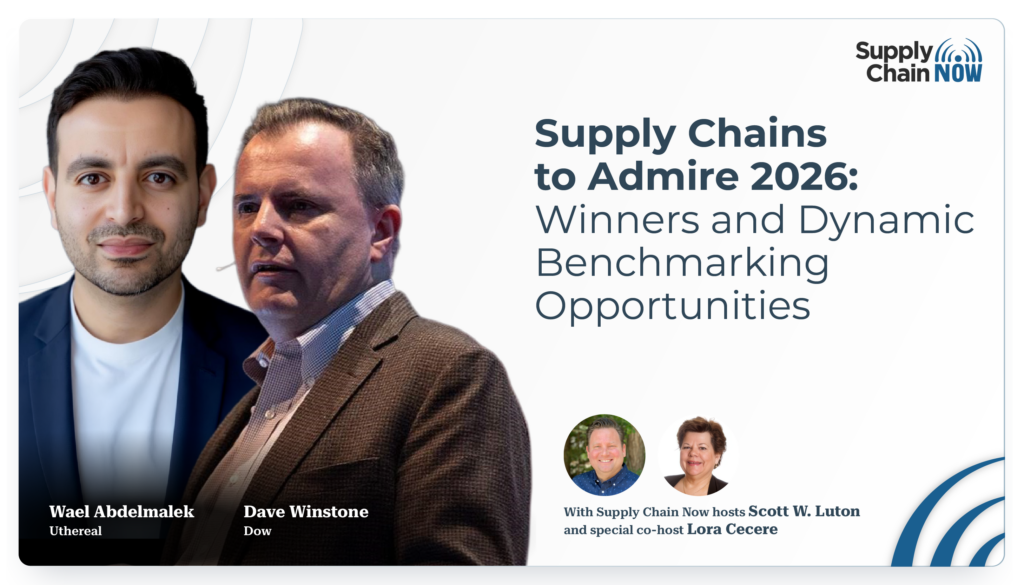
[00:00:00] Lora Cecere: Gartner Top 25 is well known, but it’s 50% opinion, and the focus on the financial data is much shorter, and it’s not as transparent on the data analysis, and it doesn’t have the industry sector rigor.
[00:00:16] Lora Cecere: In the Gartner Top 25, you put all companies in a spreadsheet and shake them up, so you don’t see the patterns of, say, the chemical industry or the, you know, broadline apparel industry. All these companies have fought different headwinds.
[00:00:31] Lora Cecere: And so the question in the Supply Chains to Admire is: Can you, within your organization, align, drive strategy and innovation to be able to overcome those challenges? And that’s really the power of the Supply Chains to Admire.
[00:00:48]
[00:01:01] Scott W Luton: Hey, good morning, good afternoon, good evening, wherever you may be. Scott Luton and special guest host Lora Cecere with you here on Supply Chain Now. Lora, how have you been? How are you doing?
[00:01:13] Lora Cecere: You know, I am doing great. I’m very excited for our launch today, and thank you so much for having us on your show
[00:01:21] Scott W Luton: Hey, uh, we’re delighted, uh, the band’s getting back together, and we got so much good stuff to share here today, folks. We got a very special show. As Lora’s alluding to, we’re gonna go, uh, unpack the 2026 Supply Chains to Admire. Not only will be, uh, will we be sharing how 32 companies were recognized through data-driven research for their supply chain performance, we’re also gonna discuss what truly separates top-performing supply chains from the rest of the market. Plus, in addition to Lora, which, hey, that’s plenty, we’re also gonna be jo- by a few other guests, uh, one longtime supply chain leader who has tested and used the methodology behind Supply Chains to Admire for years, and one tech guru who’s joining us to provide a quick product demonstration of Ask Lora, which offers a tremendous opportunity for dynamic benchmarking.
[00:02:12] Scott W Luton: So stay tuned for all that and much, much more. And Lora, it’s great to have you back on Supply Chain Now. This is gonna be a big show here today chock-full of opportunity for the market, huh?
[00:02:23] Lora Cecere: Well, yeah, I hope, you know, I, I hope people enjoy the work we’ve done
[00:02:29] Scott W Luton: You know, a- and, and it’s been a big, um, a, a, a laborious project, right? It didn’t just happen overnight. We were talking about, about this in the pre-show, and a lot of folks came together to deliver, uh, one of the big things we’re gonna be talking about, which is ask Lora, and I can’t wait to share that, as I bet you can’t wait either, huh?
[00:02:48] Lora Cecere: I can’t. I, I’m excited for people to take Wael’s challenge, Wael’s the developer. And I said to Wael, “Let’s test scalability.” I hope lots of people around the world test the dynamic benchmarking, and we can see how scalable Wael’s system is. So I look forward to that
[00:03:06] Scott W Luton: I do too.
[00:03:07] Scott W Luton: So, uh, as we move into this next chapter and really get down to business, wanna welcome in one of our two featured guests here today. So he has spent almost 40 years in global supply chain serving as a truly a visionary leader that has driven all sorts of transformation and innovation. He is well known for bringing practical optimism to the table, as well as a profound ability to simplify even the most complex of issues. I wanna welcome in Dave Winstone, supply chain director at Dow Hey, hey, Dave. How you doing today?
[00:03:39] Dave Winstone: I’m doing well, Scott. Thank you very much. Thank you for having me. Hi, Lora
[00:03:43] Lora Cecere: Hey, Dave
[00:03:44] Scott W Luton: And Lora, we have been– We’re excited to hear, hear from, uh, Dave and Wael. But, uh, we heard some news from Dave in the green room, Lora, because it’s, uh, the World Cup, the most popular, biggest sporting event in the world, I wish I had a ticket to a game. Lora, I bet you wish you had a ticket to a game.
[00:04:04] Lora Cecere: Yeah
[00:04:05] Scott W Luton: I think we’re both O for, uh, O, uh, O for, is that right, Lora?
[00:04:09] Lora Cecere: Exactly.
[00:04:10] Scott W Luton: No tickets. But Dave recently took in a game. tell us about it.
[00:04:17] Dave Winstone: Yeah, I was, I was there. England’s opening game, if you can’t tell by the accent, is a English fan. Um, and this is football, right? It’s the one you play with your feet and kicking it rather than throwing it as well. Uh, got to see them beat Croatia in the opening game and getting ready to cheer them on this afternoon in the next game.
[00:04:36] Dave Winstone: It’s been an awesome tournament. All of the games have been fantastic. All of the teams, even the underdogs, the smaller teams have done fantastic. So some great positive energy coming from everywhere on this. So thrilled, thrilled to be a part of watching it
[00:04:47] Scott W Luton: Dave, I love that. And Lora, his, w- some of his comments there. First off, congrats to, um, uh, England for knocking off a giant beater in Croatia. They’ve had an incredible, uh, record in, in recent World Cups. But secondly, he touched on something that you touched on in the green room. And yes, I was gonna bird nerd out with you in my fun warm-up question, but I’d rather touch on something a bit more serious.
[00:05:11] Scott W Luton: He talked about the positivity and the passion, and you made some comments in the pre-show. I’d love for you to kind of re-share those here, Lora
[00:05:20] Lora Cecere: Well, I think we have so much negative energy in the world that I love what’s happening, uh, you know, kicking the ball because it’s positive passion. And I love celebrating sports where we have a great demonstration of teamwork and a lot of learning about the people that got there. Everybody on that field, it took a village.
[00:05:42] Lora Cecere: It took a parent taking them to practice. It took a coach. It takes, you know, lots of training, and I just love the energy, positive energy
[00:05:53] Scott W Luton: I’m with you, and there’s some, there’s some great supply chain analogies. We’ll have to write about that later. But one more thing to add to your comments. You know, f- fervor and the passion and just the humanity in Atlanta just over the last week or so and, and how we’ve seen it documented and experienced it, it has been, um, so unique and so palpable.
[00:06:14] Scott W Luton: And I tell you, I wish we could play the World Cup every year, uh, to make that happen. So Dave and Lora, thanks so much for your comments there. And, uh, Dave, good luck. Or good luck to everybody’s teams out there. How about that?
[00:06:26] Dave Winstone: Thank you. Yeah
[00:06:27] Scott W Luton: Uh, so Dave, um, you know, three people out there may not be familiar with your background. I know I shared just a couple bullet points. I could’ve been here for an hour kinda sharing all the things you’ve done in your, um, in your career. Would you, and for the sake of s- doing some level setting, would you tell us a more about yourself and your background, Dave?
[00:06:45] Dave Winstone: Yeah. Thank you, Scott. Appreciate that. So you mentioned nearly, uh, just over four decades in, uh, in industry, uh, across purchasing, manufacturing, supply chain. Thirty-nine of those years have been with, uh, with Dow. First ten in, uh, in Europe, and the last twenty-nine or so in the, in the US. The first twenty-nine years of my career was really working, um, in a business unit in, in Dow, big, big multinational, um, and that was the Dow AgroSciences business unit, now, now part of Corteva going forward.
[00:07:18] Dave Winstone: But that gave me the chance to sort of work at different levels throughout the, throughout the business units where I first met Lora. We first started doing, uh, doing some benchmarking and some work together on, uh, while I was at Dow AgroSciences. And then the last ten years or so of my career, I’ve been with, with Dow in middle of Michigan, uh, working on the, on a corporate supply chain role, um, leading a number of major projects and transformations that we’ve, that we’ve been doing.
[00:07:44] Dave Winstone: Um, and most recently, I’ve been leading what we call our supply chain excellence efforts, um, a-across the organization. So, uh, a lot of years, a lot of breadth, a lot of experience in major projects, um, and, and using benchmarking and some of the, uh, the ideas and the concepts that we’ve worked on and asked Lora as well
[00:08:04] Scott W Luton: Outstanding, Dave. Thank you very much. Lora, before I ask you for some context around the research, I know you’ve got a lot of– You hold Dave in high regard based on not just what he’s done in the industry, but how y’all have collaborated. Would you comment on that, Lora?
[00:08:18] Lora Cecere: Dave has been a great friend and collaborator through this process. You know, in 2012 when I first started Supply Chain Insights, we did divisional benchmarking of Dow AgroSciences, and that really helped me to hone some of the methodology. And, um, he was a tester for this product and he gave great insights.
[00:08:43] Lora Cecere: We had, you know, a great group of testers. We worked through 300 and features, and he’s been a great collaborator all the way
[00:08:54] Scott W Luton: Outstanding. Outstanding. Thank you, uh, Dave for what you do, and Lora, appreciate that, uh, those insights as well.
[00:09:01] Scott W Luton: Lora, we think about the supply chains to admire, as you just mentioned, it’s been around for quite some time.
[00:09:07] Scott W Luton: You built an incredible body of research, but folks that may be newer to it and the methodology that drives it, would you shed some light on that?
[00:09:16] Lora Cecere: The methodology was started in 2013, and I worked at a company called AMR Research that got bought by Gartner. And when I was at AMR, we did two things that was really very early in my thinking. One was we did benchmarking, which took us about Four weeks to actually benchmark a company. And when we got done, we had that benchmarking, but it was very hard to have a relevant sample. And I worked with Deborah Hoffman on that, and Deborah’s now retired. And then we started the AMR Top 25, we were sitting around a table and we were talking about, you know, the concepts of the AMR Top 25, and it became the Gartner Top 25, you know, the discussion around, you know, opinion and voting, and I watched that really work.
[00:10:06] Lora Cecere: And right before Gartner bought AMR, I was really questioning of, think that I know enough to have, you know, a relevant opinion on all of these companies, nor do I think the industry has enough knowledge, and I don’t think this is data-driven. I don’t think that it goes over a period long enough for us to see a trend, and I think there needs to be a different methodology.
[00:10:34] Lora Cecere: So Gartner bought AMR. I had previously worked at Gartner and didn’t wanna work at Gartner again, so I left and started Supply Chain Insights, which then started the work on the Supply Chains to Admire. There was a person at Intel by the name of Manny who introduced me to Arizona State University, and we began the work on metrics actually have the highest correlation to market cap, and market cap per employee with our later work with Georgia Tech. And we started looking at the trends and the orbit charts, which I’m a big fan of orbit charts to understand the patterns of are we driving improvement, are we resilient, and how are we doing against the industry sector. And my first work with Arizona State University was the foundation of the Supply Chains to Admire. It’s based upon YChart data, which is the source for financial analysts, which allows us to synchronize all of the public reporting. So for example, Unilever reports in 24 different public markets with different currencies, and then you have a lot of restatements, so YCharts allows us to do that. we had to develop sectors and industry groups, and NAICS codes and SIC codes weren’t sufficient, so we started interviewing companies, uh, we built sectors, and we would interview supply chain leaders and say, “Does this look like a good peer group?”
[00:11:59] Lora Cecere: And so we built the peer groups, and that took us about two years to build the peer groups. And then we started looking at what are the for measuring improvement. So in the Supply Chains to Admire, if you’re driving improvement faster than two-thirds of the peer group, you get a check mark and you need to go to the next step, which is are you outperforming the peer group on the metrics that matter, that have the correlation in aggregate to market cap, which is growth Inventory turns, operating margin, not gross margin and not cost, and return on capital employed.
[00:12:36] Lora Cecere: And we changed from return on invested capital, ROIC, to ROCE two years ago. Now, the study between improvement and performance is really interesting to me because it’s like going to the gym. When you first are out of shape and you go to the gym, it’s really easy to drive improvement. But as companies become more mature and they get larger, it’s hard to drive improvement and actually have performance.
[00:13:06] Lora Cecere: So the 32 companies have outperformed their industry sector in improvement performance and driving value
[00:13:14] Scott W Luton: Uh, outstanding. And Lora, um, did you say it’s easy when you first start going to the gym?
[00:13:21] Lora Cecere: Yeah, you may hurt like heck, but you know, it’s a lot easier to drive improvement when you first go to the gym, you know, we all gotta go there this afternoon,
[00:13:30] Scott W Luton: Uh
[00:13:30] Lora Cecere: if, you know, you’ve got rippling muscles. You know, you know, if you think about athletes, at some point in time they have to change what they’re doing.
[00:13:40] Lora Cecere: Maybe it’s, uh, changing their handlebars in biking or changing their training regimen, but can’t just do the same old stuff. And it’s important to be disciplined and be very clear on definitions in the journey of supply chain excellence
[00:13:54] Scott W Luton: Well said, Lora. And, and I, I, I was only kidding. I get what you mean. And, you know, once that low-hanging fruit is gone, it is tougher and tougher, especially to continue, our gains from that point in time. Uh, well said, Lora. Um, all right. So Dave, uh, I’d love, you know, especially for someone like you, an industry leader like yourself that’s been, you know, collaborating in a lot of what Lora has described for years, would you share some of your perspective, um, on the value of the research and maybe touch on how you’ve been able to leverage it within your organization?
[00:14:26] Dave Winstone: Yeah. Um, I mean, I think the first thing I would say about it is it, it measures what matters. And, you know, Lora’s done a lot of work to actually sort of prove statistically that this is what drives value in a company. It’s not just about cost, it’s about dri-driving value in an organization. Um, a-and I think it’s, it’s about the data that supports that, not, not a popularity contest.
[00:14:50] Dave Winstone: And, and so you focus back on the data and you start thinking about what do you have to do to be able to move the needle on, on those elements of the data. Um, a-and I think Lora introduced this idea of a, of an orbit chart, so you’re able to see across a couple of metrics traded off against each other what the performance is over, over time.
[00:15:10] Dave Winstone: I found that a really powerful tool to be able to show the performance that we’ve had in, in, in my company or my division when I was working in a division over time against a benchmark for the industry. And I think that relevant benchmark is also important. It’s not against any and every other company.
[00:15:29] Dave Winstone: You, you take an industry benchmark, which I think is really important in being able to interpret whether or not your company is performing well against its peers
[00:15:38] Scott W Luton: Dave, well said. And folks, if you’re new to Orbit Charts, gosh, do we have a tool for you. You’ll have to, uh, we’ll have to get you connected with Lora because I wish I was introduced to Orbit Charts back in college, uh, because it does to, kind of to Dave’s point, it allow, it c- it communicates information and context that a lot of other charts do not.
[00:15:58] Scott W Luton: Lora and Dave, I wanna pick back up as I’d mentioned, and w- and we’re about to share some good news, folks. The 32 winners, data-driven, uh, performance winners from the research, so stick around. But first, I wanna really compare and contrast things a bit, uh, from what makes supply chains to admire and the methodology, all that you just described, Lora and Dave, and what it, um, you know, compare and contrast with what we s- uh, other things we see out there. You know, you got the Gartner Top 25, which, which, um, is popular.
[00:16:26] Scott W Luton: You got other things out there that, that organizations use. Lora, if you would, compare and contrast, uh, these different bodies of research, uh, for us.
[00:16:36] Lora Cecere: Well, first off, there are a number of benchmarking efforts that is like a spreadsheet, and you can’t really see the patterns in the spreadsheet. So if you’ve got a benchmarking exercise where you’re just looking at the spreadsheet, you’re m- gonna miss the pattern. of all, you know, Gartner Top 25 is well unders- well known, but it’s 50% opinion, and the focus on the financial data is much shorter, and it’s not as transparent on the data analysis, and it doesn’t have the industry sector rigor.
[00:17:13] Lora Cecere: In the Gartner Top 25, you put all companies in a spreadsheet and shake them up, so you don’t see the patterns of, say, the chemical industry or the, you know, broadline apparel industry. All these companies have fought different headwinds. The other thing that I think is really interesting in the Supply Chains to Admire is look at the power of the orbit chart to understand the headwinds of what that industry was going through. are 27 sectors, and 80% of the sectors were actually regressing after the pandemic at the intersection of operating margin and inventory turns. there’s a belief that if I just keep putting the power to the metal, that I’m going to drive improvement. But these headwinds of what is happening and shifts in demand and markets and the complexity that’s going unchecked in the organization is causing these industry sectors to actually move backward.
[00:18:14] Lora Cecere: And so the question in the Supply Chains to Admire is: Can you, within your organization, align, drive strategy and innovation to be able to overcome those challenges? And that’s really the power of the Supply Chains to Admire.
[00:18:31] Scott W Luton: Um, all right. So Dave, we’re talking about comparing and contrasting supply chains to admire from other, uh, resources out in the marketplace. What are your thoughts, Dave?
[00:18:39] Dave Winstone: Yeah. I mean, I think I, I, I said about earlier that it measures the things that matter. Um, and, and it’s really important that, that you get data that’s, that’s true. It’s, it’s not always easy or convenient. I mean, trust me, I’ve interpreted the Dow stuff, and it doesn’t always make good, good reading when you, when you look at that.
[00:18:58] Dave Winstone: Um, but it is the right things that matter. And when you really dig into understanding why and what it is you would have to do to, to move the needle on that consistently over time o-on, on all of the metrics, not just picking one of them and having a single, uh, single focus initiative on it. You know, we as a company have had a number of inventory-focused initiatives, but it’s not just about inventory.
[00:19:21] Dave Winstone: You’ve got to be able to add value and improve margin as well. And again, I’ll use that Orbitz example. When you can see how you make the, the pattern on both of those over time, uh, you really start to see about what, what is it you ask the right questions about what you’d have to do to be able to move the needle on that over time, and I think that’s the, that’s the power of it.
[00:19:43] Dave Winstone: It makes you uncomfortable, but it makes you think
[00:19:45] Scott W Luton: Well, and we gain, it’s like going back to the gym example. We gain when we are uncomfortable. It’s not fun. It’s a little bit of painful. It’s kind of, um, uh, fish out of water sometimes, but that’s when we gain.
[00:19:59] Scott W Luton: And one more thing, Lora, before we reveal the winners, um, you and your team have done a good job of rooting out as much subjectivity, uh, that we find. I mean, folks, I love a good list like anyone else. But so many lists that are out there are chock full of so much subjectivity that it really diminishes the value. Um, Lora, I’m not picking on anyone in particular, but speak, you know, we got to be objective about so many things these days. Speak to the power of objectivity and, and that emphasis on supply chains to admire.
[00:20:36] Lora Cecere: I totally embrace what you’re saying. There are lots of companies that want to know how we’re doing on social responsibility or how we’re doing on customer service. is no good data source that I can find for that. I’d love to include it, but I just don’t find anything that allows us to measure and benchmark demand, forecast value add, inventory value add, customer service, or corporate social responsibility. Would love to include that stuff, but I don’t find a good data source. So very, very, uh, rigorous in the data source and scrubbing the data, making sure we have 10 years worth of data for everybody in the Supply Chains to Admire. thing about the Supply Chains to Admire is we don’t limit it by company size.
[00:21:27] Lora Cecere: And so I found three things about the report to be really interesting. Small companies outperform large companies, so Monster outperforms Anheuser-Busch. Uh, Church & Dwight outperforms Procter & Gamble. Secondly, you look at the industry profiles and you look at the fact that 80% of the sectors are performing worse than pre-pandemic, it really makes you scratch your head saying, don’t think we have best practices.
[00:22:02] Lora Cecere: I think we have historic practices that we need to evolve.” And one of the things that makes me crazy is when I see all of this talk about AI from the bottom up, but we’re not really establishing that balanced scorecard at the strategy level and engaging the finance team to have a different discussion, because only about 20% of the flow in today’s supply chain can be really managed by a focus on the lowest cost.
[00:22:29] Scott W Luton: And the third thing that I find really interesting in the data is when you boil it all down, there are about 50 companies that bounce in and out of the Supply Chains to Admire, and those are the companies that I think we really need to learn from. one of my issues was I didn’t have a way that people could easily access the data about those companies, build their own orbit charts, compare it to their orbit charts, understand what they’re doing.
[00:23:00] Lora Cecere: When I was at AMR, people would call me and they would say, “What technologies does the AMR Top 25 use?” And I’m like, “That’s the wrong questions.” It’s really about leadership, it’s about strategy, it’s about alignment, and it’s about the movement from functional metrics to really driving the balanced scorecard
[00:23:18] Scott W Luton: So, so, so, so Lora, we got some great news to share, Lora and
[00:23:24] Lora Cecere: We do.
[00:23:25] Scott W Luton: We
[00:23:25] Lora Cecere: Bring it on, Scott
[00:23:27] Scott W Luton: unveil the 32 companies that have been recognized and that, uh, from their data-driven performance by the 2026 Supply Chains to Admire research. So Lora, tell us more
[00:23:41] Lora Cecere: I love these companies. Many of these companies have driven process innovation. When you look at the medical device industry and you look at how they’ve changed their business model to get information from the hospitals and information on usage, uh, it- they’re great stories. When you look at the work on, you know, the evolution of the process industries, I remember working with Beiersdorf back when they were private and, you know, the fact that they’ve made the supply chains to admire is great. When you look at CCL and PCA and the containers and packaging industry, it’s remarkable to see how much they’ve pulled out ahead. Now, the chemical industry is one that I think people should really pay close attention to because the chemical engin- industry goes into every other value chain, and the lack of growth in the chemical industry has caused some unfortunate dynamics. Same thing with the semiconductor industry. Both of those industries are very fragile when we think about value chains. there’s a lot to learn, and in the report, I try to tell you the insights of what I found from each company in each sector so that people can think about their business processes and drive not just technology innovation, but process innovation and business innovation to better serve customers
[00:25:07] Scott W Luton: Hmm. All right. So folks, uh, if you’re listening to us, you’re missing the visual where we have all 32 winners, uh, laid out, um, in a retail, a process, and a discrete manufacturing, uh, buckets. You– But, uh, you can access all the information, all the winners via downloading the report, so make sure you do that.
[00:25:27] Scott W Luton: Two quick asides before I get Dave’s comments. Completely subjective. Quote, I’m talking out both sides of my mouth. As a longtime Lowe’s customer, I love to see them included in the 32. And my dear father-in-law, uh, Fred Midkiff, spent over 30 years with John Deere, and John Deere is also one of the 32 recognized for their performance.
[00:25:48] Scott W Luton: I can hear him doing cartwheels, from the upstate of Sout- South Carolina now. Um, all right. So Dave, I’d love to get your observations on the winners or, you know, any common themes or other particular items that you think folks should take away from this year’s research
[00:26:05] Dave Winstone: Yeah. Well, c-congratulations to all the companies that are on there. Know-knowing the methodology really well, I realize how, how hard it is to be able to get on there and how you have to have that consistency of performance to do that. So that would be the first thing. I think this really is about consistent performance over the years.
[00:26:22] Dave Winstone: And, and, and what I see with the, the companies that I do know on there, there’s a focus on things like portfolio rationalization and network design as some of the key things that they go after. And if you end up on mergers and acquisition and divestitures stuff or big ERP implementations, those tend to be distractions that, uh, make it difficult to be able to perform consistently against these metrics on an ongoing basis.
[00:26:48] Dave Winstone: So, uh, that, those would be my observations, Scott
[00:26:51] Scott W Luton: Dave, well said. And we have way too many distractions across
[00:26:54] Lora Cecere: We do. I just want to add one other thing, Scott. If you looked at the overlay between the Supply Chains to Admire and those other, uh, pieces of information, there’s only two companies on this list that are also on the Gartner Top 25, which is Apple and TSMC. And I think it’s really important because lots of people that are on stages all around the world talking about supply chain excellence aren’t really driving the goods. And I think we’ve got to be accountable in a data-driven way to make choices that drive value
[00:27:31] Scott W Luton: I agree. Well said, Lora and Dave.
[00:27:34] Scott W Luton: Um, I mentioned With That Said, Lora, I love this quote, right? Uh, we, I purposely selected this quote. Uh, Lora said, uh, quote, “I would like to help spark a different conversation to help supply chain leaders drive value and sidestep the stupidity of existing conversations,” end quote. And then secondly, Lora, is, and then this is a little snippet from the interview with you that we published in With That Said, and Dave and Lora, as y’all both were talking about observations, well, I think the research identified five important things that the winners have in common, and we’re showing this, but folks listening, uh, those five things were customer focus, leadership alignment, clear strategic direction, balanced performance measure, metrics rather, and a culture of process innovation. And those belie the point or support, I’m not sure if I used the word belie correctly, support the point that Lora said earlier when she was getting calls about the technology. It’s not the technology. quick comment before we swi- switch over and dive into Ask Lora
[00:28:40] Lora Cecere: Well, I wanted to help people to really think hard about those concepts of what is clear strategy? What is a balanced scorecard? What is customer-centric process innovation? It isn’t just ask sales what they’re gonna sell. And in the supply chains to admire, there are many stories around business innovation, around not just operations teams doing something different for the customers, but really the alignment of commercial operations and engineering teams to be able to define new products, to be able to use data in different ways to sense markets, to be able to listen and learn from e-commerce, to be able to market sensing.
[00:29:28] Lora Cecere: And so I want to encourage people to think out of that traditional supply chain box, where we’re focused on demand error and risk management’s only about supply. People aren’t looking at demand and market shifts market to market. it’s my hope that we can do that, and the next section where we’re gonna talk about dynamic benchmarking is my effort to use large language models and agentics to try to help people to test their maturity, process organizationally, technology, AI readiness, financial results, and have a hard conversation at the board level about what is supply chain excellence
[00:30:15] Scott W Luton: Lora, you’re reading my mind and you’ve
[00:30:17] Lora Cecere: Good
[00:30:18] Scott W Luton: my next question I’m gonna ask you. Uh, when, before we bring in Wael, and
[00:30:23] Lora Cecere: Yes
[00:30:24] Scott W Luton: Wael and, uh, Dave’s, uh, perspective here today. Um, ask Lora at a high level, what is it beyond what you’ve shared?
[00:30:32] Lora Cecere: Ask Lora is a large language model that sits on top of my research from 2015 to 2025. it allows people to ask and answer around the research. The dynamic benchmarking is based upon the Y chart data and the maturity models that I’ve built, and the maturity models for process organization and technology maturity are based upon my quantitative research that I’ve done for the past 10 years. And they’re the questions that I’ve asked over and over and over again, so four to five times in the industry. And initially, the model will bounce against those research answers. Over time, I want to get hundreds of thousands of answers that will bounce not only against the research, which was 200 to 500 responses, but also bounce against industry sector, regional information, and help people learn.
[00:31:30] Lora Cecere: And I want the model to learn of what factors make a difference in driving the metrics that matter, that improve market cap per employee or price to tangible book
[00:31:41] Scott W Luton: All right. Quite a mission y’all have been on. And, uh, I want to bring in a very special guest that has helped push that mission forward, ’cause askLora was built in partnership with Wael Abdulmalik and the team at Eutherial, where he serves as CEO. He has held p- previous leadership roles with companies such as PwC, Credit Suisse, Swiss rather, and Amazon Web Services. Let’s bring in Wael with Eutherial Hey, hey, Wael. How you doing today?
[00:32:18] Wael Abdelmalek: Great. Thank you very much, Scott. All good. All good. Thank you very much for inviting me. Good to see you and Lora and Dave as well
[00:32:24] Scott W Luton: You, uh, well, great to see you as well. And really quick, so we know Dave’s allegiances for the World Cup. Uh, me and Lora and we’re, we’re, we’re hope- holding out some hope the US team might do something. Wael, I think you’ve got three horses in this race. Before we kind of unpack your background, would you share your three teams with us?
[00:32:42] Wael Abdelmalek: Definitely. So, uh, it would be Egypt where I’m from, uh, the UK where, where I grew up, and then now Switzerland is where I live. So, uh, they’re all doing well. So let’s see.
[00:32:53] Scott W Luton: All right. Well g- best of luck to all three. Dave, it’s not fair. He’s got three teams, we’ve got one. Is that fair, Dave?
[00:33:00] Dave Winstone: I, I have two.
[00:33:01] Scott W Luton: have to– Oh, what’s your, what’s the second one, Dave? I missed the second
[00:33:04] Dave Winstone: England and the US where I live now, so
[00:33:07] Scott W Luton: okay. Good. Good, good,
[00:33:08] Dave Winstone: both doing well
[00:33:09] Scott W Luton: All right. So, uh, all right. So Wael, I shared, again, much like Dave, y’all been doing big things in the industry for a long time.
[00:33:16] Scott W Luton: You deserve a, you know, two-hour introduction, but for the sake of time here today, uh, I had to share a couple bullet points. But would you, for the folks out there, share a little bit more about your background and, uh, that’s one A. One B is your role in helping to develop Ask Lora
[00:33:31] Wael Abdelmalek: Absolutely. So, uh, my background is, is mainly is in AI and data architecture. So I used to be an enterprise architect at, uh, Amazon Web Services when I was helping Amazon’s cloud biggest customers actually build data and AI platforms in the cloud. And two years ago, I decided to leave and build my own, uh, bui- build my own startup, and this is where Kana Ethereal was born. Uh, we wanted to, to create a way where Humans organizations can partner with AI for mutual benefit, learning, and acceleration. Personally, I don’t necessarily buy too much into this, uh, uh, AI completely is gonna replace us. I actually think I’m more on the side of we’re gonna work alongside with AI to scale. And, uh, this is really the, the, the, the, the, the vision and the culture we, we, we, we wanted to build here at Cerian. Cerian is an AI, uh, deep tech startup. We’re based in Switz- uh, based in Zurich here in Switzerland, and we focus on building, uh, private AI systems for organizations, mainly knowledge-heavy organizations, uh, because we want them to turn their own expertise into AI systems, first of all, they own, but they can scale and actually reach more audience and, and, and maximize their impact.
[00:34:50] Scott W Luton: And, uh, the relationship, uh, and the collaboration with Lora started about a year ago, maybe a bit more now, where we met through an introduction from a mutual contact that we met at a conference. And when we first sat down with Lora, uh, really the challenge was clear. Her brain is an absolute treasure trove of methodologies, frameworks, you name it.
[00:35:10] Wael Abdelmalek: You know more than I do. And, uh, we– if we can make the supply chain leaders constantly able to pick her brains and then really get some of her, her insights twenty-four hours a day, that would be great. So when we started working together, we immediately started, uh, building Ask Lora, and then the mission was really simple: How do I– how do we accelerate Lora’s expertise and delivery?
[00:35:33] Wael Abdelmalek: And we didn’t want this to be some sort of, uh, a search bar on a, on a bunch of PDFs, uh, or some generic answers by a chatbot that pulling stuff out of the internet or basically, uh, what the large language model happened to believe on that day. We really wanted to make, um, uh, her expertise as the center of it. And Lora also shared the same, the same, uh… cared about the same thing as us. She wanted, she, she wanted it to be right. She wanted it to have her research expertise, to be at the center of it as well. So is where kind of, uh, we started building this, uh, private AI, where, uh, Lora’s knowledge at the center of it.
[00:36:13] Wael Abdelmalek: And not only this, grounded to the data and research she believes is verified and, uh, but it’s clever enough to pull data from the outside world when it needs to. And this was really kind of the, the, the, the, the key here. And building Ask Lora is, is, uh, has been a super exciting exercise because, uh, I, I personally believe is that the journey is kind of the beginning of something big.
[00:36:38] Wael Abdelmalek: Because now Lora’s part– Lora now has a partnership with her AI in a very interesting way. Her be out in the world interacting with users, collecting a bunch of data, bringing back insights in volumes, and Lora’s almost gonna be the engineer behind it, where she’s gonna almost puts a, a lot of judgment into what she’s seeing from a data perspective, and then continues to push the AI to be more smart and more advanced.
[00:37:04] Wael Abdelmalek: And I believe this partnership is where great innovations are gonna come from the next wave of AI. Um, and, uh, if I may, I will… I’m obviously a, a tech guy, so I, I, I want to dive a little bit deeper on the tech, but I’m, I’m just gonna keep it light. So, um,
[00:37:21] Scott W Luton: Thank you, Wael. Thank you because I am… You’re a lot- You’ll, you’ll know more about technology than I’ll know in my entire life, so thank you very much
[00:37:32] Wael Abdelmalek: Fantastic. So, uh, yeah, I mean, the technology behind it is basically, uh… It all, it all starts with, um, proprietary algorithms that really good at understanding knowledge. Um, so for AI to interact well with knowledge and not to hallucinate and make up stuff, it needs to have, uh, almost a trusted source to interact with and, and, and pull information from.
[00:37:55] Wael Abdelmalek: So the, the technology almost always starts by, let’s get that knowledge, let’s break it down. let’s build structures on top of it so we can find it easily. And then let’s build advanced algorithms that instead of trying to understand what the user is looking for, it tries to understand what the user want to know. there’s a big difference, uh, here, because when you know– when you ask a question, not necessarily that’s what you’re looking for, maybe there’s something behind the question. And, and this was like kind of, uh, an approach that we worked on a lot through research to really understand user intent and really combining the two together.
[00:38:29] Wael Abdelmalek: So you, you understand what the user intent is. You have the data stored in, in a, in a, in a accessible structure to the AI. Now you can put an AI on top and say, “Hey, you need to focus on the research and make sure you, you, you use that in, in, in, in, in all your interactions with the user.” But we also went a step further.
[00:38:47] Wael Abdelmalek: We, we, we deployed agentic behaviors, and these are more capable processes that instead of retrieving just information, it’s able to execute tasks and, and, and, and, and, and apply this judgment throughout a really long process. that’s what the benchmarking is built on. This, these agentic behaviors that, again, use Lora’s expertise, research data, use its own, uh, knowledge base, which is now coming from Lora as well, and be able to provide these, these, these kind of board-level reports and insights. I kept it light just like I promised I would.
[00:39:22] Scott W Luton: No. Hey, Wael, really, I mean, you know, there’s gonna be a lot of questions, I’m sure, w- w- with folks who wanna dive in deeper after today into a lot of, uh, of the stuff you were touching on. So I thank you for the, for the, uh, I used to say “Reader’s Digest version.” I’m gonna s- upgrade that to TikTok version, I think. But Lora, really quick, and, and Wael, it’s great to have you join me and Lora and, uh, and, and Dave. Uh, we’ve got a quick demo we’re gonna be sharing. But Lora, before we share that demo, ’cause it’s three to four minutes, um, a- anything else that you want to level set with before we play that demo, Lora?
[00:39:56] Lora Cecere: There are three things I think are important for the user. One is all of the are confidential. We verify that a user is actually associated with a company by their email, but we never reveal that response. So the responses are confidential. Two, it’s a learning engine that over time will learn about the relationship between these models value, and we will publish twice a year for people all around the world through open research to learn.
[00:40:31] Lora Cecere: So when people fill this out, they’re actually contributing to the industry. we’re not done. So in July, we’ll add all public companies in the world. Today, the only companies that are in the model are in the Supply Chains to Admire, which are about 450 companies. But in July, we’ll have every public company in the world in this model. And the other thing is in July, people can compare their results to the top performers, these 50 companies in the Supply Chains to Admire that outperform, and also Gartner Top 25, and they can pick and choose. There’s no perfect methodology for benchmarking, but the discussion’s what’s really important
[00:41:17] Scott W Luton: Lora, I’m with you. Uh, I’m with you. All, every, every report we’ve mentioned here today offers some valuable nuggets, anecdotes, and fodder for discussion. Some discussions are different than others, but that’s a great point you finished on there, Lora. Um, okay.
[00:41:32] Lora Cecere: I just want to add one other thing, Scott. It’s quick. see in this video that you can get the benchmark in five to six minutes, which is certainly a lot quicker than any other methodology I’ve ever used.
[00:41:45] Lora Cecere: Welcome to Ask Lora. Ask Lora is a large language model with my research that I’ve been working on for fifteen years to help people to understand supply chain excellence. Now we’ve added agentics to help you dynamically benchmark your supply chain.
[00:42:02] Lora Cecere: We start by collecting your demographic data. We always hold your information securely. We’ll never report on your individual data, but we’re getting information about where you are in a region, what your industry is, your revenue, and whether you’re an early adopter or a late adopter. Then we’re going to gather information about your technology satisfaction.
[00:42:27] Lora Cecere: Just fill out by each category which technologies you use, and if you’re satisfied or not. Don’t spend a lot of time. First response is great. Give us all of your information about the technologies you use. This helps us with perspective on your company. Now we’re going to look at who do you want to actually measure against, and what are the metrics that you would like to use in your measurement and peer group assessment?
[00:42:55] Lora Cecere: Then we’re going to look at your organizational design. How do you define organization? How do you describe your organization? Are you aligned? Then we’ll move to process. Let’s focus on sales and operations planning, your center of excellence, how easy it is for you to get to data. Then we’re gonna ask you some technology questions, and then we’ll answer and analyze your data.
[00:43:20] Lora Cecere: Look, it doesn’t take very long, and you get a report. This is for the Novo group. We start with high-level company insights. This is all the large language model information coming in on you and your peer group. Then we look at how mature are you organizationally, process, technology, how do you describe your attributes versus the research peer group, looking at your process data, sales and operations planning, your market sensing, your ability to get to data.
[00:43:53] Lora Cecere: And this is really key because as you think about AI readiness, getting to data is really, really critical. Now, the model is populated with Y chart data, which allows you easily to compare on the metrics to the peer group. So just toggle over those. And then you’ll look at, you know, your information around your descriptors and your operating margin versus inventory turns on orbit charts.
[00:44:20] Lora Cecere: You may have seen these in my blog, but an orbit chart allows us to look at the pattern of two metrics over time and against the peer group, and to be able to analyze how you’re doing against that peer group for a specific period of time on the metrics that you would like to choose. So spend some time, play around, see how you’re doing, and get a feel for what your pattern looks like and what your opportunity is.
[00:44:48] Lora Cecere: Then we’re going to actually give you some information about your river of demand, which is a descriptor around your headwinds, your barriers, your rocks, and how you and your organization can work together to improve performance. I hope you enjoy your benchmarking.
[00:45:08] Scott W Luton: Outstanding. Okay. So folks, for the sake of time, we were very quick with that demo, right? If you want an expanded version, because there’s a lot more there, you can reach out to Lora, and I’m sure her and her team can make that happen.
[00:45:23] Scott W Luton: But I want to go back to Dave here for a second. I’ll circle back around to W.L. and Lora in just a second. Dave, in the industry for quite some time. You’ve seen, uh, flavors of the month come and go. You’ve seen those fluffy vanilla chatbots that W.L. was saying we’re not gonna create, and you’ve seen some things that stuck and create value. Uh, your thoughts on the value that Ask Lora poses to the market?
[00:45:49] Dave Winstone: Yeah. Thank you, Scott. You know, I mean, I spent some time actually testing this and working with the, uh, with, with the model. And, you know, for me, it, it felt like you got fifteen years’ worth of wisdom and learning and collaboration with Lora in thirty minutes. It was that fast, and, and that helps you frame and ask the right questions about where you are with your, with your company.
[00:46:12] Dave Winstone: So the speed with which you can capture all of that stuff is, is amazing. Um, so I… It, it was, it was truly enlightening. I, I really felt like I was going back in time and re-rethinking about everything that I’d done with Lora over those last fifteen years in such a short period of time
[00:46:29] Scott W Luton: I love it. And time, of course, is one of our biggest constraints. I, I love that. Uh, all right, so Steve, uh, tuned in from, uh, uh, Lagos, uh, Lagos in Nigeria. Hey, you’re not in the World Cup. you’ll be there the next go around. Who knows? Ask Lora may be at the World Cup soon. Who knows? But Steve, great to have you here today. And the Corinne Bursa is with us here today. Corinne, hope this finds you well. The supply chain industry needs this valuable industry specific benchmark information. I’m with you, Corinne. Good stuff. Great to see you here, my friend. Um, okay, and we’re also dropping… Oh, there we go. Thank you. We dropped a link, folks, I mentioned this just a minute ago, Ask Lora, and that’s L-O-A, uh, I’m sorry, Ask Lora, L-O-R-A, and that’s how we spell Lora. askLora.supplychaininsights.com, and we’ve dropped the link right there in the chat. Um, okay, and Dave, really quick, um, what was it like to be a tester? And then I’m gonna get Wael’s experience working with all the testers. Dave, what was it, what was it like being a tester?
[00:47:36] Dave Winstone: Yeah, it, it was, it was awesome. And you got to see all of this stuff, and you got to be able to really contribute. You know, we were cutting and pasting and showing the things that worked and the things that didn’t work, and Wael took all of that stuff and worked his magic, and what comes back is something that, that really works.
[00:47:52] Dave Winstone: So, you know, not just, not just the output, but the process of actually getting it fixed and getting it better worked so much smoother as well. So I, I’m really excited about this and where it’s gonna go and where it’s gonna conti- keep getting better as we go forward as well
[00:48:07] Scott W Luton: And Dave, you weren’t alone. Uh, I’ve got a list. I bet I’ll butcher some names, Lora, but, uh, I know you want to give a shout-out to all the folks that were with you on this journey. Uh, testers like Alex we shared earlier, uh, Bram, Christine Barnhart, the supply chain whisperer, uh, Christian and the EY, E&Y team, of course, Dave, Lora, uh, Lucas, Margot, Matthew Spooner, uh, Nicole and Peter Boellstorff.
[00:48:33] Scott W Luton: Great to see you, Peter. Uh, were, I think, were they all the testers, Lora?
[00:48:37] Lora Cecere: They were. And I couldn’t have had a better group of testers. They really put it through its marks. I just want to say that Ask Lora is free and open to everyone in the world today. I know Wael has put a lot of server power on the back end, but I’m hoping you put Wael’s tool to its test, and I would love to see hundreds and thousands of people hitting Ask Lora and really testing the scalability today.
[00:49:11] Scott W Luton: So we’re gonna go from 10 testers to a million testers, folks. Take Lora’s
[00:49:16] Lora Cecere: hope.
[00:49:18] Scott W Luton: Take Lora on– uh, take up the challenge that Lora just posed there to the industry. And really quick, before we get, uh, we’ll go back to Lora’s vision in a second, but Wael, uh, you work- working with all these testers and all the folks that were early, uh, you know, kicking the tires on it early, what was it like Y- and, and especially coming from someone that, you know, you’ve, you’ve created meaningful technology throughout your career.
[00:49:41] Scott W Luton: What was this like, Wael, compared to that?
[00:49:45] Wael Abdelmalek: Um, I’ve learned something very important is never challenge the testers because and this was the biggest mistake I made, I guess. I think when we were demoing this, I were really, really challenged and be like, “I, I… Please, I dare you, break it.” And then they did. So, uh, so, there was quite a lot of, uh, really good, uh, really good insight.
[00:50:08] Wael Abdelmalek: And, and it wasn’t just about, uh, breaking it. Uh, we, we, we had… The, the part of the testing was suggesting, uh, features and giving feedback. It’s not just about bug reporting. So what was very surprising is that, uh, we received almost half of the feedback was around features and around, uh, new things that, that people wanted to see. But also i- uh, it, um, it gave us, um, very good insights that where AI is in the center of any tool, the user experience in terms of interacting with it is also needs to be changed or need to be, you know, more advanced. And, and this is, this is one of the things we brought into two of Ask Flora and then it’s gonna be version three and version four.
[00:50:52] Wael Abdelmalek: So, uh, yeah, uh, never challenge the testers. That would be the biggest, uh, learning for me.
[00:50:57] Scott W Luton: So we’re breaking that rule because we’re challenging all the testers
[00:51:01] Wael Abdelmalek: Yes.
[00:51:02] Scott W Luton: uh, global industry to check out askLora. All right. So Lora, uh, I’m glad you mentioned, um, y- the free version is out there. There’ll be other versions as well, folks that want a more robust, uh, greater value experience, I guess, for lack of better phrase. Uh, but, you know, we’ve touched on this a couple times already, but before I, I kind of move into the, let’s speak to the so what crowd, your vision of how you see and how you see organizations leveraging askLora, let’s just put a fine point on that, on that pencil. Your thoughts, Lora
[00:51:33] Lora Cecere: I think Ask Lora is a great example of working in partnership with AI. know, I know a lot of people are scared of AI, and you know, I had a bright guy, Wael, help me. He mentored me to understand large language models, agentics, and it’s a great example of AI informing what we do. think it’s also a way that executives can have a different dialogue around not just cost, not just functional metrics, but what is value and where are they currently performing, which is so essential because when I used to try to help companies in my previous jobs to be able to look at information, I couldn’t gather information quick enough. I– And this allows us to get the process, the organizational, the technology insights for companies for maybe that year-end meeting where you’re setting strategy or maybe a center of excellence discussion about what is excellence or maybe it’s to benchmark, am I driving value through a large program, or perhaps how are different divisions working and how can we measure performance? I’m excited to see what people learn, and I’m excited to be able to publish on it as a research learning model. And I really appreciate everyone that’s helped, and I appreciate people that are going to test the scalability hopefully this week
[00:53:04] Scott W Luton: Outstanding. All right, Wael, buckle up. Hang on to your socks, okay? Uh, so folks, hey, take up the challenge, test it out, let us know what you think. Um, also, uh, really quick, again, I wanna make sure folks know, uh, beyond Ask Lora, which definitely take that out for a spin, check out the research, right? We’ve got a link that we shared earlier. You can download Supply Chains to Admire 2026, uh, chock full, including those orbit charts that I’ve been nerding out about. And of course, you’ve got, um, a lot of, of helpful visuals in the deck that you can also download and, and peruse, uh, via the same link. Um, okay, so we’ve shared the, the links for both Ask Lora and for the research and, and, and the other, uh, accompanying material. Um, I wanna ask this, the whole, whole panel here today, kinda goes back on a little different spin of a question I posed to Dave, right? Because this isn’t our first rodeo, and there’s folks out there that have lived through a lot of these ty-types of things, and they’ve got their arms crossed, and they’re, they got their, their, they’re saying their harumps, right?
[00:54:10] Scott W Luton: And their, and their so what’s. So I wanna ask this whole panel, and Dave, I’m gonna start with you, then go to Wael and then Lora. You know, speak to that so what crowd out there. Why is this consequential, and why does it matter, Dave?
[00:54:22] Dave Winstone: Yeah. So for me, this is about… It, it gets you asking the right questions and helps ground you on where you really are in your company, in your division, and that allows you to get really quickly onto the much harder questions about, so what do you do about it?
[00:54:37] Scott W Luton: Hmm. Okay, Dave, I tell you what, you know, I use 5,227 words when I should use 27, and you use exactly nine words if you need nine words. You need to teach me the succinctitude, Dave. Can we arrange a session after today?
[00:54:54] Dave Winstone: We’ll work on it
[00:54:55] Scott W Luton: Okay. Thank you, Dave. All right. So Wael, we’re talking about, uh, building on Dave’s response there, speaking to the so what crowd.
[00:55:02] Scott W Luton: Why does this matter?
[00:55:04] Wael Abdelmalek: Um, I think it opens new, uh, doors to be really good at what you do because, uh, I, I mean, if you think about it, there is… Before AI, I always used to think I’ve just finished a task or a job and I, and I wish I had more time to do it. Like, you know, I wish I had more time to get it really there and to, to, to, to, to, to really push forward.
[00:55:28] Wael Abdelmalek: But now with AI, you c- can really do that. You can really scale yourself. And, uh, I think it’s gonna be that the, the organizations that are gonna utilize it really well, they’re gonna, they’re gonna see some huge benefits. And I, I think it does matter because it’s, uh, it’s an application that’s gonna be out in the wild, and it’s gonna show value, and it’s gonna collect, uh, and it’s gonna learn from the user.
[00:55:48] Wael Abdelmalek: And we can’t wait to see what it brings back
[00:55:51] Scott W Luton: Outstanding. Well, I appreciate what you and the Ethereal team are doing, to make AI more, um, more usable, more scalable, and, uh, and ce- while we celebrate and lift up and empower the unique human superpowers that still drive so much incredible value across industry. All right. So Lora, looking forward to this. Uh, your response to the so what crowd, why does this matter?
[00:56:16] Lora Cecere: I think it matters because we have to have a different conversation across the organization about what is the value of a supply chain. I think many people in finance still believe that the supply chain can be efficient and the lowest cost, and that we can drive reliability at the same time, and that’s not true. And as we look at issues and answers around form and function of inventory, or we look at organizational alignment, I think the real power of this tool is for a cross-functional leadership group to take the benchmarking, compare the results, and have a hard conversation about what is the right definition of supply chain what is value, and how do we get started. And I look forward to those conversations
[00:57:09] Scott W Luton: Well said, Lora. Well said. Um, all right, so as we start to wrap, I wanna make sure folks know how to connect with our panel.
[00:57:15] Scott W Luton: Really appreciate y’all’s time here today. Uh, Dave, let’s start with you, Dave Winstone. If you’re not at a u- uh, an England game in the World Cup or a US game or glued to the TV, if you’re not at the game, uh, you’re doing big things in global industry, how can folks track you down, Dave?
[00:57:31] Dave Winstone: U- use LinkedIn, Scott. Use my LinkedIn profile. You can contact me and message me through LinkedIn, and I’ll be more responsive than I have been in answering them
[00:57:40] Scott W Luton: Outstanding, Dave. I appreciate that and that honesty. Uh, all right, uh, Wael, uh, Abdulmalik with Eutherial. Uh, Wael, how can folks track you down, my friend?
[00:57:52] Wael Abdelmalek: Uh, LinkedIn probably the best, or use Ask Lora and break it and then call me.
[00:57:59] Scott W Luton: Oh. here we go. Here we go, Wael. Uh, folks, you can also learn more. We’ll drop his link to, uh, Uthereal, but it’s uthereal.ai, and that Uthereal is spelled U-T-H-E-R-E-A-L.ai. We’ll see if we can drop that there. And Lora, uh, I’m sure folks can, can find you. You’re one that picks up, answers the phone and answers emails. Uh, Lora, how can folks track you down?
[00:58:25] Lora Cecere: I answer every message on LinkedIn, and I look forward to hearing what people think
[00:58:31] Scott W Luton: Outstanding. I do too. I can’t wait.
[00:58:33] Scott W Luton: but I want to thank the entire panel here today. Dave Winstone with Dow, really appreciate what you’ve done for, for decades in industry, and thanks so much for taking time to share your perspective here today Uh, and Wael, uh, really appreciate your, uh, your perspective, your work, and your challenge you’ve dropped here today. Uh, don’t be a stranger. We look forward to having you back, my friend
[00:58:56] Wael Abdelmalek: Thank you
[00:58:57] Scott W Luton: And Lora Cecere, it is great to have you back. Uh, I really, uh, I love what you’re doing here. I love the research. It’s public. Folks can, can jump on it and read and do, you know, act with it. They can also take Ask Lora out for a spin, uh, for free. I think there’s a ton of value for industry, so thanks, uh, for re- thanks for doing what you do, and thanks for being back here with us, Lora
[00:59:20] Lora Cecere: Thank you for hosting the show, Scott
[00:59:22] Scott W Luton: You bet.
[00:59:23] Scott W Luton: Uh, folks, uh, hope you enjoyed what a heck of a conversation with Lora and Dave and Wael. Even more importantly, which is tough to top, go check out Ask Lora, go check out the research.
[00:59:34] Scott W Luton: We wanna hear from you. Give us your take. You may agree on some things, you may disagree on some things.But folks, as we start to wrap here today, hope you enjoyed the show as much as I have. Uh, big thanks to Lora, Dave, and Wael for joining us. You know your homework, right? You know your homework. Take one thing, there’s so much actual perspective and tools that we walked through over the last hour. Take one thing, do something with it.
[00:59:57] Scott W Luton: Deeds not words. We’ve had enough of lip service leadership. Deeds not words. And with all that said, Scott Luton here on behalf of the Supply Chain Now team, challenge you, do good, give forward, be the change that’s needed. We’ll see you next time right back here on Supply Chain Now. Thanks everybody.