[00:00:00] Taylor Wilkerson: Our mission is to really help improve these supply chains so they can reach as many people as possible. it’s not about turning profit or how much revenue the supply chain can make. It’s about given your budget, how many people can you reach?
[00:00:14] How much medicine can you deliver? Doing that in an equitable way, so you’re not just delivering in the urban areas, you’re not just delivering to people who have resources, but really making sure that an entire country, entire community is getting access to those medicines.
[00:00:43] Scott W. Luton: Hey, good morning, good afternoon, good evening, wherever you may be.
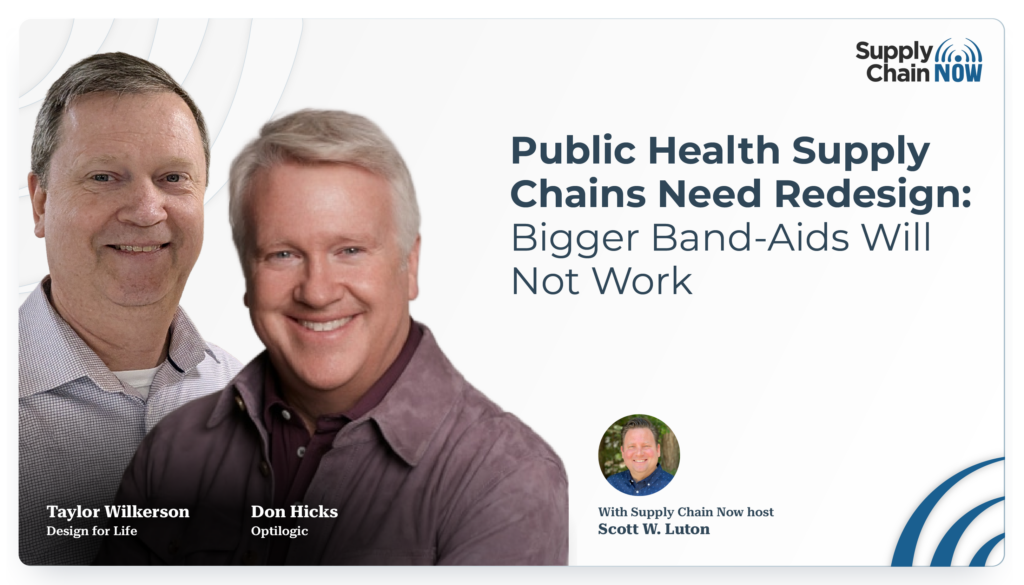
[00:00:47] Scott Luton with you here on Supply Chain Now. Welcome to today’s show. Folks, we have got a wonderful show teed up here today, where I’m gonna be talking with two industry leaders that are part of a noble mission to ensure that families around the [00:01:00] world can live healthy lives. Today’s conversation’s gonna certainly showcase what we already know, the power of global supply chain to truly change the world. Now, we’re gonna be diving into the mission, including how we can make an even bigger impact by z- uh, by designing a
[00:01:17] better system rather than just applying a bigger band-aid. We’re also gonna take a look at how AI and modern technology continues to play a bigger role in the NGO and healthcare delivery space, which is helping to scale efforts to help those families in need.
[00:01:31] All this and much, much more. So stick around, folks, for a great conversation that’s gonna offer up tons of actionable insights by the truckload, and including how you can jump in to support the mission. So I wanna welcome
[00:01:43] in our esteemed guests here today. First up, Don Hicks, who has been moving mountains in supply chain for years.
[00:01:49] Many of you will know that Don founded LLamasoft in 1998. Uh, but he started a variety of consequential companies, including Optologic, a leading organization when it comes to [00:02:00] supply chain design, uh, where Don serves as CEO here today. Joining Don is Taylor Wilkerson, who has also been active in global supply chain for quite some time. Uh, Taylor
[00:02:12] has served in a variety of leadership roles, including with, uh, ASCM and CSCMP. He also serves in intriguing roles in both the supply chain tech space as well as the nonprofit world. You’re gonna enjoy learning from Don and Taylor’s perspective here today. I wanna welcome in Don Hicks, CEO of Optologic, and Taylor Wilkerson, Executive
[00:02:31] Director of Design for Life. Don, how you doing today?
[00:02:36] Don Hicks: Scott, I’m doing better now that I get a chance to talk to you and you’re get- and, uh, all of your audience. It’s great. Thanks for having me back
[00:02:42] Scott W. Luton: You bet. You’re way too kind. It’s great to have you back. We really enjoyed your appearance on The Buzz. We’re gonna have you back on there as well. And you’re bringing friends.
[00:02:51] Don Hicks: I am.
[00:02:52] Scott W. Luton: great to see you today. How you doing?
[00:02:55] Taylor Wilkerson: doing well. Thank you for having me today
[00:02:57] Scott W. Luton: You bet. Uh, I, I really [00:03:00] appreciate, uh, all kidding aside, the, the, the work y’all do in industry, but of course, uh, how you support, um, noble causes that are challenging some of the, you know, i- issues of our time. So it’s great to have y’all both here today to talk about that. So, but let’s do this. Don, you know how we do things around here, and Taylor, you’re gonna find out how we do things around here.
[00:03:20] We’re gonna
[00:03:21] Don Hicks: Say what? You’re gonna find out how easy it is
[00:03:21] Scott W. Luton: a fun warm-up question, right? And so Don, I tell you, we could take this in a million different directions w- uh,
[00:03:28] Don Hicks: Sure
[00:03:28] Scott W. Luton: talking pre-show about some of your passions, but you shared something with me, with us a few minutes ago. Tell us about
[00:03:36] Don Hicks: Find out what your loved ones are using and bring
[00:03:38] Scott W. Luton: uh, to maybe a new endeavor.
[00:03:40] Tell us
[00:03:40] Don Hicks: Yeah. So, so it’s, it’s a combination of my love and interest of music, of great food, and bad business decision-making. And it’s, uh, where we got going was, uh, you were kind of poking around at how do we warm things up, and, uh, and I’d mentioned that I was practicing trumpet in the back room over [00:04:00] there.
[00:04:00] You said, “Do, do you play in a band?” And I said, “I– More than that. It’s not well-known, but I’m the proprietor of the Blue Llama Jazz Club & Restaurant in beautiful Ann Arbor, Michigan, which over the last seven years has become one of the finest jazz venues in the world.” It’s my pleasure to work with that team, and we get to meet great musicians, and we get to eat great food, and, uh, we’re making it happen for, uh, for folks both Ann Arbor and now regionally and nationally.
[00:04:29] Blue Llama Jazz Club. It’s at bluellamaclub.com. Go check it out
[00:04:34] Scott W. Luton: Man, that is awesome. Uh, we’re going to have to make my first trip up to Ann Arbor soon, and, uh, that is fantastic stuff. You can’t go wrong when you mix good music, good people, and good food. I mean, that’s like the perfect intersection, so good
[00:04:46] Don Hicks: you can go get it. You can get that wrong as it turns out, and we’re continuing to try to get it right. So, uh, that’s… Just trust me, if, if you take one, one hard thing like make a jazz club work and then [00:05:00] another hard thing like a restaurant, and then my theory was two wrongs really do make a right.
[00:05:05] And so we put it together with, with love of food and love of music with the two capital Ls
[00:05:10] Scott W. Luton: Don, I love it. Love it. Uh, all right. So Taylor, uh, you know, we went on a fact-finding mission in the pre-show, learned something new about both of y’all. And one of the things I learned about you was even though you grew up in Alabama, where it’s much like Georgia, we don’t get much snow and ice, you have found a love for hockey later in life.
[00:05:31] And I think you’ve got two kids that are playing hockey, uh, in leagues and whatnot. Tell us more, Taylor.
[00:05:37] Taylor Wilkerson: Yeah, it’s, uh, you know, when we moved up to Nashville when I went to school there, had some friends drag me out to, uh, a few of the minor league games there before the Predators were there, and
[00:05:49] I caught the bug. And so, uh, since we’ve been up in the Washington, DC area, my, my wife’s a big hockey fan too, so we get to go to of games here and, and [00:06:00] watch the Caps win the Cup one year, and then also suffer through many years of disappointment since then. and then I, my, our, uh, a daughter and a son that are playing hockey. I, I think my daughter is the one that impressed me the most. She, uh, didn’t even ice skate, and her freshman year in college decided to join the, the women’s hockey club, went in, learned how to skate, learned how to play hockey, and it’s been her, uh, her main hobby since
[00:06:26] Scott W. Luton: Okay. Well, you know what? when you say, uh, Washington, you’re talking about Washington, D.C. At least they left your hockey team in town. Uh, my home city of Atlanta, we’ve lost, I think, two teams over the years, I guess because we stunk up the joint so bad. So, but it sounds like regardless, when you go to a game, folks, I don’t watch a whole bunch of professional
[00:06:47] Don Hicks: Which would be those analytical ones, if professional
[00:06:47] Scott W. Luton: when you go to a game, it is such an awesome experience and, and Taylor was hooked from the very beginning. Um, all right, so Don and Taylor, of good stuff. We gotta, we gotta take a hard right turn and, and no more [00:07:00] music and sports ’cause we got a, a big Noble Mission to dive
[00:07:02] Don Hicks: Sir
[00:07:03] Scott W. Luton: But I wanna do this. Um, and Taylor, I wanna start with you or, and stay with you for a moment. I think y’all’s backgrounds is really important for our audience as they, um, um, learn about the mission and, and really where your roles and your superpowers are, are, are playing a role in the Noble Mission. Taylor, would you give us a high-level overview maybe of, of your background and your professional journey?
[00:07:25] Taylor Wilkerson: I, uh, started life as a, did, uh, mechanical engineering in school, and as an environmental engineer for several years. And when I decided that wasn’t what I wanted to do with my life, I went back to business school, really had, um, a great professor, uh, Kurt Grimm at University of Maryland, who, uh, I spent, spent
[00:07:47] Don Hicks: Let’s spend a bunch of time with
[00:07:49] Taylor Wilkerson: as, you know,
[00:07:49] Don Hicks: this
[00:07:50] Taylor Wilkerson: figure out what part of business I wanted to go into, and he really directed me towards, uh, supply chain and, and can’t thank him enough
[00:07:57] Don Hicks: So budgeting is kind of backed up for
[00:07:58] Taylor Wilkerson: he did doing that for [00:08:00] me. since graduating, I’ve been working in supply chain primarily with, uh, public sector. So looking at supply chain as, you know, whether it’s defense or healthcare, areas that really serve the public. And, and that’s where I got my start, getting into healthcare supply chain and then working at, uh, Global Health Supply Chain.
[00:08:21] I had the opportunity to, do some work with the
[00:08:23] Don Hicks: Market-based competition instead of looking at those 10x gains. How does it change the dynamic of what’s a better investment?
[00:08:24] Taylor Wilkerson: as they were looking at introducing new vaccines and how that changed the dynamic of the vaccine supply chain when you’re going from inexpensive, widely available vaccines to expensive, not widely available vaccines, and how that changes your whole operation.
[00:08:40] from there, had the opportunity to do work in a lot of different countries, and, and it really, changed my perspective on supply chain to think about how does supply chain serve people, and, and how does it improve the lives of people if you can improve the supply chain?
[00:08:58] And that’s been a main focus [00:09:00] of my
[00:09:00] Don Hicks: It puts us in the right position
[00:09:01] Scott W. Luton: Taylor, I love that. I didn’t gather all that from you in our last conversation. Now it all, all the dots are getting connected now. And of course, you serve as executive director for Design for Life, which we’re gonna talk more about in just a minute. Uh, now Don, as I was introducing you, I think a lot of folks will, will recognize you for, you know, founding and, and, uh, growing Llamasoft and the impact it’s had on industry.
[00:09:24] But what else do you, would you like folks to know about your professional journey?
[00:09:27] Don Hicks: Sure. So, um, you know, the, the, the Llamasoft stuff is out there. I started that in 1998, ran it for about 20 years. Uh, thought I was kind of done with commercial work and, uh, and supply chain and got into jazz clubs. And within a few years later… You know, I, I, I’ve always been, uh, into operations research. I love it.
[00:09:48] so the, the connection running through this is actually my relationship with OR. So I studied, uh, operations research at, uh, the US Military Academy at West Point. That was my– where I got my degree back, that was during the Rutherford [00:10:00] B. Hayes administration and actually, while I was at West Point, my junior– between my junior and senior year, I did a, uh, uh, a sort of a external internship called, uh, Crossroads Africa, which was the forerunner of the Peace Corps. I got to spend a couple of months on the ground in Liberia and, uh, a little bit less in Côte d’Ivoire and Ivory Coast.
[00:10:21] And, uh, out there working in a rural area, I had the, uh, misfortune to, uh, both get malaria and dysentery, and I got to live through all of that. And so I got to experience the healthcare system, uh, in Monrovia, Liberia, and I got to know, you know, how things are done there a little bit. And, uh, the struggles, I was shocked when I went into the, the hospital there, and they don’t have any medicine there.
[00:10:47] they tell your family, “Hey, uh, you’re gonna need this, this, and this,” and then they’d send them on out to go buy it and bring it on into the hospital. And I never forgot that experience and, and as, as well, uh, the experience of the [00:11:00] incredible healthcare delivery people that were there.
[00:11:03] And, uh, years later, Llamasoft had started to grow and started to be, uh, become the leader in, supplying supply chain design, network design kinds of tools and technologies. And we had an opportunity to work with this, this incredible organization called John Snow Inc. And JSI was working with the, uh, the US Deliver project to do logistics and supply chain for, a lot of struggling, uh, health ministries throughout sub-Saharan Africa.
[00:11:32] They, they were kind of everywhere, but focused on where people needed it most. And so over at Llamasoft, we just started this little practice of trying to help people, trying to take what we knew about supply chain design, make sure we were there for JSI. We worked with the World Bank. We had a, a beautiful relationship with an, uh, with an organization I loved called USAID May it rest in peace.
[00:11:58] we put it in the wood [00:12:00] chipper apparently about a year and a half ago, and, um, as a result, a lot of people around the world are no longer getting antiretrovirals and essential medicines. So at Llamasoft, we had this lucky… We, we had this practice as part of the for-profit side, and later on with OptiLogic, as it started to grow, I had wanted to find places to back.
[00:12:24] And a, a good friend of mine, Carlos Valderrama, he and I shared this passion and this vision, and he got this organization going. and sadly, Carlos passed away last year. and he wanted this organization to continue. So, you know, Taylor is here to pick up the torch.
[00:12:43] I’m here to keep backing it with technology from OptiLogic. But Design for Life is a nonprofit, and what it really means is it’s just out there to help. There’s no such thing as competition. There’s no such thing as sales or revenue. [00:13:00] It’s about making impact, and I’m, I’m getting into a little bit into, to Taylor’s side.
[00:13:03] I’m sure he’s gonna share with you more about that organization
[00:13:06] Scott W. Luton: we wanna help you hit more eyeballs and more eardrums, right? If you could share with us, Taylor, in your view, the problem that you’re trying to solve that unfortunately folks in the world just don’t see it
[00:13:18] Taylor Wilkerson: Don touched on a bit of just that experience of being in a, a healthcare system in, in a country that doesn’t have a well-developed healthcare system. For me, it was the, one of the first projects I did in this area in Pakistan. and I was used to what a, a lot of us in the supply chain community are used to.
[00:13:38] You go into a warehouse and/or a facility, there’s technology, there’s communications equipment. I went into
[00:13:46] Don Hicks: Oh, I see
[00:13:46] Taylor Wilkerson: a regional distribution center, and they had one room that had electri- electricity, and that was the office. They had a phone on the wall. They had an IBM desktop computer that looked like it probably belonged in a [00:14:00] museum versus there in, in a distribution center And it really made me rethink what supply chain means and put into context of what medicine in a, in a country where the infrastructure is limited like. it’s a challenge because when we talk about things like visibility and technology, putting that into
[00:14:24] Don Hicks: Taking that as context for
[00:14:26] Taylor Wilkerson: ask somebody for their inventory records, they pull out a big logbook, uh, or ledger book. it creates a, a different view of what can be done in those supply chains and, and how to improve those supply chains in the way they deliver. And that’s really our core mission. I think, you know, since that time there’s been a lot of advances in mobile technology and mobile communications that have brought the technology capabilities to, uh, most places in these supply chains. And what we see is that sort of an intersection of there’s this capability [00:15:00] out there, but a lot of these supply chains are still running on that was designed back when everything was manual,
[00:15:07] Scott W. Luton: Right
[00:15:08] Taylor Wilkerson: there wasn’t a lot of information. And so our mission is, is to really help improve these supply chains so they can reach as many people as possible. it’s a bit of a different perspective in that it’s not about, turning profit or how much revenue the supply chain can make. It’s about how many… Given your budget, how many people can you reach?
[00:15:30] How much medicine can you deliver? doing that in an equitable way, so you’re not just delivering in the urban areas, you’re not just delivering to people who have resources, but really making sure that an entire country, entire community is getting access to those medicines. the way we do that is through, providing these design tools and optimization tools that are allowing the people running those supply chains to rethink how their supply [00:16:00] chains are designed, to find those efficiencies, find those improvements, and to go through the process of implementing them.
[00:16:07] Take ownership of their supply chain,
[00:16:09] Don Hicks: If the origin was blockchain paper
[00:16:10] Taylor Wilkerson: of how they can continue improving and growing their supply chain, and again, making a difference in terms of, um, the, the healthcare being delivered in country
[00:16:20] Scott W. Luton: Taylor, that’s very, very helpful. And a- as I’m hearing you and Don talk about Design for Life,
[00:16:26] Don Hicks: Where’s the fictions at the low
[00:16:27] Scott W. Luton: element at play here, right? And, and you, you kind of spoke directly to it, Taylor. How can we use the power of design and, and meeting all of these, uh, incredible healthcare professionals where they are in their communities help them serve more
[00:16:41] Don Hicks: Sort of books that have reached more people
[00:16:43] Scott W. Luton: in need?
[00:16:44] Don Hicks: than me. Um
[00:16:44] Scott W. Luton: before I continue, and, and by the way, we should also, um, I didn’t realize, uh, Carlos Valderrama, who’d passed away last, last… Let’s let this, uh, you know, want to give him a, a moment.
[00:16:55] Don Hicks: Not mentioned. Yeah
[00:16:56] Scott W. Luton: appreciate what he contributed and his leadership
[00:16:59] Don Hicks: Yes
[00:16:59] Scott W. Luton: I [00:17:00] think what you all do today honor his legacy, Don, right?
[00:17:03] Don Hicks: We love him, we miss him, and, uh, the world was better off for having him be here, and, uh, his legacy continues
[00:17:12] Taylor Wilkerson: his, his vision is what created Design for Life. And,
[00:17:15] Scott W. Luton: Hmm
[00:17:16] Taylor Wilkerson: um, it is, it’s just, you know, a, a pleasure to be able to continue that vision and continue, you know, what, what he had started here
[00:17:24] Scott W. Luton: let’s do this, Taylor. I’m gonna stick with you for a second here. You know, a lot of organizations, a lot of individuals respond after a crisis occurs, right? And, and we all appreciate that, right? But as they say, I think it was Benjamin Franklin, don’t chat me on that, Don. It wasn’t Brother Rutherford B. Hayes. I know it wasn’t that, but I think it was Franklin that said, “An ounce of prevention’s worth a pound of cure,” right?
[00:17:45] Don Hicks: So Taylor, if it’s not the mic
[00:17:46] Scott W. Luton: what I’m hearing and learning, seems really focused on preventing those crises through better
[00:17:51] Don Hicks: Better system
[00:17:53] Scott W. Luton: If
[00:17:53] Don Hicks: that’s online
[00:17:54] Scott W. Luton: true, and tell me if I’m wrong, but why is that shift so important, Taylor?
[00:17:57] Taylor Wilkerson: first of all, it, it is true. I think, you know, I’m a [00:18:00] big believer that the, best way to respond to a crisis is to have a, a good supply chain and a good system to build that response on. Um, I think especially with- within healthcare, though, there’s, another aspect to it, which is if you are giving people preventative medicines, if you are keeping people healthy in general, then you have a community that’s going
[00:18:21] Don Hicks: Yeah,
[00:18:21] Taylor Wilkerson: be more resistant
[00:18:23] Don Hicks: that’s a good one.
[00:18:23] Taylor Wilkerson: uh, a health crisis, whether that’s a natural disaster or disease outbreak. But the second part is if you have designed your supply chain to reach as much of the community as possible, and you’ve designed a supply chain with agility in mind so that if there is a surge in, in demand, that you, have the flexibility
[00:18:43] Don Hicks: somebody in the street.
[00:18:44] Taylor Wilkerson: from multiple locations, uh, reroute supplies, et cetera, then you have a really much better foundation to build that response on top of. you know, a great example that we saw several years ago was Ebola outbreak in West Africa, [00:19:00] and what you saw was a lot of, uh, a lot of the problem with the response is healthcare systems and the supply chain just got overwhelmed with the demand. they weren’t designed with that,
[00:19:13] Don Hicks: That second case really works fine
[00:19:14] Taylor Wilkerson: They weren’t designed with the agility in mind. That’s what we want to help countries, to build, is that robust supply chain that you can meet the needs of, of people every day, but also provides a foundation of when there is a crisis, you can rely on the capabilities of the supply chains, the people, the infrastructure, the communications and visibility and, and data management the way through to support the response so that getting the product there isn’t the problem or, or isn’t the thing you’re worried about.
[00:19:46] It’s getting out and, and working with the people, treating the people that are being impacted
[00:19:50] Scott W. Luton: Well said,
[00:19:51] Don Hicks: Tailride and, and not only humanity chosen for our unique
[00:19:51] Scott W. Luton: and Don, what would you add? I mean, Taylor’s describing a very robust foundation, wanting to build that with all those, uh, on the front [00:20:00] lines, uh, you know, serving folks in need. What would you add
[00:20:02] Don Hicks: Yeah
[00:20:03] Scott W. Luton: this shift we’re talking about?
[00:20:04] Don Hicks: You may not be aware, uh, for the folks that are out there, you know, the US has a sort of public-private hybrid. There’s a, a, a robust role for healthcare, uh, in the US healthcare system for private insurance, for, for this, you know, for HMOs, for, uh…
[00:20:20] You can go out and purchase a lot of medicine. But there’s also a system, and your, your healthcare is generally paid for if you’re employed through these insurance schemes. In the poorest parts of the world, where there are literally billions of people who live, there is no private healthcare system at all.
[00:20:39] All healthcare comes from largely the public sector. The government employs, uh, doctors. The, the government is responsible for acquiring and procuring all the medicine and then distributing it, and it’s never enough. So we’re really talking about in the, the, the places with the, the, the folks [00:21:00] who are, who are the worst off economically, their, their health is entirely dependent on the, their country’s public healthcare system.
[00:21:09] And so when we’re talking about where can you make the biggest impact on these things, uh, for, uh, you know, on, on human health, it’s the public healthcare network. And so one thing that also might surprise people is that the supply chains that these people are managing, they’re not any less sophisticated than complex supply chains anywhere else in the world.
[00:21:32] they are still logistical networks where you procure and you distribute, and you have to forecast, and you have to plan. So the s- the level of, of sophistication and complexity in the decision-making is the same here, uh, here or there or in the public health network. So that also means that they have the same issue that all supply chains have, which is a need to both manage and optimize my current network but also [00:22:00] redesign and change that network.
[00:22:02] You’re constrained by your current network, and we might call that current network a design, and you can make the best of it. But you can’t make breakthroughs unless you change the actual design of the system itself, and you push that efficiency frontier further on out. And folks who’ve tuned into your show in the past have heard some of this stuff before.
[00:22:24] It still applies. It’s still spot on with public health. So when Taylor’s talking about, you know, the changes they need to make, how can I make these systems more robust? You have to have the basic system of managing these things and making the best of them. But they, these guys still have the, the task as well of analyzing and changing the system.
[00:22:44] And so Design for Life is specifically focusing on what we would think of as analytics and design in these public health spaces, and it’s, it’s even more critical there than any- anywhere else. They have so few resources. [00:23:00] If they can push their efficiency frontier on out there, you get so– you’re saving human lives from the design of the software or from the design of the system.
[00:23:09] So Design for Life is trying to bring all the best from the commercial world, from best practices and not… And, and we bring it over there not because the, these public health supply chain operators, they’re not unsophisticated. They’re wicked smart. They are making the best of a really, really difficult situation.
[00:23:29] But we can help them by bringing in what we know from optimization, simulation, and now from AI
[00:23:36] Scott W. Luton: there’s a lot– There’s a whole series of both y’all’s responses there. we all have finite, resources, right? And we all have… Every system has its own constraints, and I really appreciate your comment there about sometimes we gotta start over and, and redesign these systems, and that’s the only way we can get around some of the inherent constraints. Let me ask y’all this, and, [00:24:00] um, I’ve learned that one of Carlos Valderrama’s, um, points of view was that he saw way too many public health studies sitting on shelves collecting dust rather than driving action. Taylor, when it comes to, I don’t know if we call that the policy side, I’ll defer to the experts, but how, how do you see Design for Life changing that dynamic?
[00:24:23] Taylor Wilkerson: Yeah, and that’s really an important thing that, that I know Don and I have both seen, uh, over the years working in, uh, global health, is that are a lot of studies, some of them, uh, even veered towards sort of academic studies, that had a lot of good ideas. But you, you end up at a point where you’ve done this study, you’ve created a, a set of recommendations, you’re leaving it there for, the local team to implement.
[00:24:52] And this…
[00:24:53] Don Hicks: It’s going to.
[00:24:53] Taylor Wilkerson: as Don said,
[00:24:54] Don Hicks: It’s
[00:24:55] Taylor Wilkerson: it’s not a lack
[00:24:55] Don Hicks: not like
[00:24:56] Taylor Wilkerson: it’s usually a lack of time. Uh, the, a lot of these [00:25:00] supply chains, the, the staff is spread pretty thin, they don’t have the time to say, “We’re gonna try… We’re gonna do something new. We’re gonna do a big new project.” you know, as, as I’m sure a lot of folks have seen with studies like this, you get into the implementation and you say, there’s another piece we need to analyze.
[00:25:19] There’s another piece we need to model, or a different idea we need to model.” But what’s been left behind is recommendations, not the tools to do that next piece of analysis, not the tools to support the implementation as the environment changes. a lot of those studies had good ideas. They had a lot of really good recommendations. It was just that handoff and transition to implementation that was the gap. what we wanna do is we want to not be just
[00:25:49] Don Hicks: 6sense
[00:25:50] Taylor Wilkerson: the analysis. We want to help people running the supply chains in country to do the analysis. We want to give them the tools, the [00:26:00] capabilities they need to understand their supply chain so they can use
[00:26:04] Don Hicks: So can you
[00:26:04] Taylor Wilkerson: tools on a repeated basis, so that as they against new problems, as they look at refining and implementation, have the tools that are available to them. and that’s really where our, our philosophy is that we don’t wanna be
[00:26:20] Don Hicks: We don’t want to be the ones doing the process. We want to support these teams so they can take a more strategic approach to blockchain
[00:26:20] Taylor Wilkerson: doing the analysis. We want to support these teams so they can be taking a more strategic view of their supply chain so that they can easily
[00:26:29] Don Hicks: Usually ask those questions of what happens if I change my workforce this time? What happens if I
[00:26:29] Taylor Wilkerson: questions of, what happens if I change my network design? Uh, what happens if I wanna open a new facility?
[00:26:37] Where should I put it? shouldn’t have to rely on an external donor or external consultant to come in and, and answer some of those questions when the tools are available. So our goal is to make the tools accessible, both from a usability standpoint and from a, a cost standpoint, to support those teams and, and really make that an, an internal capability. And, you [00:27:00] know, I think Don could a lot about how many Optologic customers that I work with have an internal design team of people who are doing this kind of analysis. And, and that’s really what we wanna help to create, is not necessarily a full team, but that internal capability to ask these questions and, and rethink the design of the supply chain
[00:27:22] Scott W. Luton: Don,
[00:27:23] Don Hicks: Ja
[00:27:23] Scott W. Luton: what Taylor shared there, do I have it right? It seems like to me that one of the many things that Design for Life is doing helping these organizations on the front line doing this, uh, uh, carrying out this noble mission, helping them operationalize the studies that have been sitting on the shelves or the, uh, the outcomes that analysis tells them they should be doing.
[00:27:44] It’s helping them that happen. Is that right, Don?
[00:27:48] Don Hicks: Yeah. Well, there’s, there’s two massive earthquakes that have completely changed this field and this industry that have happened basically in the last year and a half. Okay? When, when [00:28:00] Taylor’s talking about the sort of studies on the shelf or, or Carlos was referring to them, most of the time over the last, and at least in my last thirty years of experience in this place, a lot of these studies and analytics are done from outside agencies, okay?
[00:28:14] They bring in the funding, and then they ha- the funding, and then they also have the strings attached that say, “Well, we’re gonna do a study.” And so they bring in external consultants ’cause people from outside wanna help. And there’s been a, I think, a, not a, not a lot of empowerment of the people in country, not a lot of trust to bring them along.
[00:28:35] They said, “Well, we’re from the outside and I’ve got a fancy degree and I’m gonna trust my own consultants.” So a lot of these studies, they’re, they’re… it’s fine work that’s been done, but it’s been dropped on on top of things. But those two earthquakes are changing everything. And earthquake number one was the destruction of USAID, because now they’re just not getting aid from the United States anymore.
[00:28:58] The United States has [00:29:00] said, “Screw you, we’re not gonna pay for anything. You can take care of it yourself.” It’s a, that’s some serious tough, I wouldn’t call it love. I would say it’s a, it’s a crisis because these countries don’t have a choice. And, you know, The Lance- uh, The Lancet is predicting that there’ll be about fourteen million excess deaths.
[00:29:22] Two million of those will be children due to our government choosing to no longer fund these public health efforts. It’s a, Armageddon And if you’re gonna look at a bright side in this one, it is that these health ministries are now… They know they’re not gonna get help from the United States.
[00:29:41] They have to do it themselves. And so the need has never been greater. It’s, it’s tremendous and, and huge and scary. And they have no choice. They have to rise up. Sink or swim, and for them, sink means millions of deaths. The other [00:30:00] earthquake, though, is AI. And if we were thinking that we were gonna get folks in these public health ministries to set up and learn modeling and learn optimization and data processing and all this kind of stuff, th- they just don’t have the time to do it.
[00:30:17] They don’t have the, the, the setup and the infrastructure, and they’re firefighting. But they still have design questions. That’s where AI comes in, and I am absolutely AI crazy, AI bullish about what it’s doing for design and analytics. What we see is combining AI with the availability of data, with LLMs that can actually interact and understand what you mean, and then turn around and use tools It is an extreme democratization opportunity where people with– who think about public health but don’t have any data training should be able to go back and forth and ask [00:31:00] questions and analyze and say, “Show me my network,” and, “What if this happens?”
[00:31:04] and, “What about this change?” And AI can be employing and managing and, and using supply chain technology. This is coming to the commercial world, but it may even get to the public health world first. And then hopefully it is clear then where I’m coming from, which is Optologic as a technology vendor has said, “For non-commercial use, everything’s free.”
[00:31:30] This is– We are– We, we’re a partner of Design for Life who’s out there on the front line getting these projects and working with these teams. Optologic takes its commercial technology, we donate it all. We want people to use it, and there’ll never be a charge for any of that stuff. And as AI gets deployed later this year, we think we’re gonna see a change where people who are on the ground in Rwanda, uh, people who are on the ground in Zambia and Tunisia and in Côte d’Ivoire and in [00:32:00] Kenya and in Tanzania, they’ll be able to have access to the same cutting-edge technology for design and anal- and analytics that Coca-Cola and Walmart and Nike and IKEA and General Motors and these guys can do.
[00:32:14] it’s a scary, terrifying time to see the human cost, but it’s also a tremendous opportunity to change this and have all of these countries and their– the, the people in these countries empowered and enabled to push their supply chains ahead and make them sustainable and resilient.
[00:32:33] Scott W. Luton: Hmm. Well said on a variety of levels there, Don. Uh, Taylor, I wanna, I wanna circle back though, ’cause Don really… I wanna circle back to AI in a second. I wanna back up for just a second because Don really answered a question I was gonna pose to both of y’all when it comes to when healthcare supply chain fails in, in some of these places that are truly are at risk and are, and, and can be overwhelmed, you know, what, what does that look like?
[00:32:55] I think both of y’all are in a unique position to have seen that, and I think that drives a lot of y’all’s [00:33:00] mission and, and what you do today. Taylor, in your view, when we can’t meet, the demand of the situation, you mentioned a couple of, of, um, moments in time earlier in earlier response, what happens?
[00:33:15] I mean, Don’s talking about that first earthquake and the, the, the 14 million, which is just heartbreaking, and a lot of children, which is even worse. But Taylor, what would you add to the, um, know, the, the cost if we do nothing?
[00:33:27] Taylor Wilkerson: in a few different levels. First is that immediate cost. You know, somebody shows up at a clinic, they don’t have the medicine they need. That’s a missed vaccination for a child who’s now at risk at a, for catching an easily preventable disease. That’s a missed treatment from somebody who has a chronic condition that could make that condition worse. that’s missed maternal care for, uh, an expectant mother. So, so there’s that immediate cost of you have somebody who’s not getting the healthcare they need. [00:34:00] There’s a secondary cost to that. If it’s, you know, somebody misses a medication that prevents the transmission of HIV, you’re now putting people around them at risk. so there’s sort of… And, and same if you’re missing a, a medication that’s going to, cure their TB, now that they, they’re still, uh, contagious with the people around them. So there’s that secondary cost of somebody missing healthcare has an impact on the community around them. And it has a larger impact on the community when people aren’t healthy, they’re not a- able to care for their families, they’re not able to support their communities, whether it’s in agriculture or, or other jobs. They’re, they’re not able to contribute the way they should if they were healthy. And there’s also a piece that, that I think a lot of people don’t recognize, which is in a lot of these countries, clin- the, the clinic is not like your, um, you know, minute clinic
[00:34:56] Don Hicks: influence business decisions based on
[00:34:58] Taylor Wilkerson: people travel a full [00:35:00] day to get to a clinic to get treatment. if you travel a full day and get there and, and they say, “I’m sorry, we don’t have what you need,” you’ve wasted a day. You’ve taken a day away from your family, from, from your life. It makes you less likely to go back a second time. so there’s an erosion of trust in the healthcare system itself, leads
[00:35:22] Don Hicks: is
[00:35:22] Taylor Wilkerson: fewer people seeking out care on their own. So there’s, there’s sort of this ripple effect of it’s not just about one person missing one dose of medication, it’s what happens to that person, what kind of risk do you put them and what kind of risk do you… What happens to their community? happens to the trust in the overall system? So that’s why, you know, when I look at it, it’s really important to do every- everything we can so that any time somebody walks into a clinic, needs a medication, needs a treatment, needs a test, they get it because it’s available.
[00:35:55] These are… And, and, you know, most of the time these are not expensive products.[00:36:00]
[00:36:00] Scott W. Luton: Right
[00:36:00] Taylor Wilkerson: about vaccines that are less than a nickel a dose. We’re talking about antibiotics that are a penny a pill. It’s not the cost of the product, it’s getting it there and putting it ha- in the hands of the clinicians and the patients that need it
[00:36:15] Scott W. Luton: as we get towards the end of today’s conversation, we’re gonna make sure y’all know out there if you’re in a position to help, uh, address and support Design for Life and, and what the, the team is doing, changing lives, saving lives in many ways, not being dramatic. we’re gonna let you know exactly how you can do that. Um, all right. So going back to AI. I’m not sure, Taylor, but I kind of gathered that Don’s a bit passionate about the power of AI. I don’t know, I don’t know if you gathered that too. Um, almost
[00:36:42] Taylor Wilkerson: conversations with him about it, yes
[00:36:44] Scott W. Luton: But Taylor, I’m gonna start with you, and then I’m gonna get what else Don wants to add. When you think of the power, I mean, look, it goes without saying in this golden age of not just supply chain tech, but just life tech, right?
[00:36:57] AI has been an incredible [00:37:00] transformational tidal wave of change, right? There’s
[00:37:04] Don Hicks: There’s two more production backlot films out there, and there’s some folks.
[00:37:08] Scott W. Luton: of noise and, and fluff and it, and it confuses, I
[00:37:11] Don Hicks: I think creates a lot of chaos in the marketplace. But for the sale
[00:37:13] Scott W. Luton: But we’re gonna stay on,
[00:37:15] Don Hicks: people
[00:37:16] Scott W. Luton: power, powerful force, powerful side of AI. So how do you see, uh, Taylor, AI democratizing supply chain design for these
[00:37:25] Don Hicks: Tell people, maybe you should do that.
[00:37:28] Scott W. Luton: and others,
[00:37:29] Don Hicks: That’s good. So especially
[00:37:30] Scott W. Luton: to what the point what you’re illustrating, that don’t have
[00:37:34] Don Hicks: Hopefully it’s not the largest technical
[00:37:36] Scott W. Luton: but they don’t have the large technology wherewithal, like, know, the, the warehouse you were talking about you visited earlier, earlier, Taylor.
[00:37:43] How do you see AI changing the game there?
[00:37:46] Taylor Wilkerson: the way AI allows us to interact with these tools. So year ago, if you were, you know, using modeling software or design software, you had to have somebody who the tool and to set up a scenario, [00:38:00] knows which buttons to click, what numbers to put in where to be able to kick off that scenario. We did a, a prototype using the Aptologic, uh, Ada agent in creating a, a modeling tool, it takes all of that and puts it into, uh, a chat box where you can say, “What happens if I remove this warehouse?” That’s all you have to do. It runs the scenario, and then when it comes back with the answer, you can ask follow-up questions.
[00:38:29] Why is inventory lower in my baseline than this, uh, scenario where I removed the warehouse? And it will tell you exactly why.
[00:38:38] that’s really where we see this huge opportunity because the learning curve, the, the training needed to get people up to speed on using design tools is almost flat at this point. You know, you, you need to– There’s some, some need to understand how design fits into the, the supply chain strategy and, and [00:39:00] what these tools do and don’t do. But general, not a lot of training needed in terms of the model’s up and running, do you get answers out of that model? The other piece that’s really exciting is that the front-end piece of how do you build the model to begin with? Uh, again, a year ago, the answer would’ve been you need somebody to look at your data structure and, be able to convert that data structure into the, the format that’s needed and, uh, to, to be able to upload into the model. We’re now at a point where if you know the data structure coming out of, the logistics system you’re using, it’s almost push a button, pull it, and it pulls that data in to
[00:39:46] Scott W. Luton: 嗯。
[00:39:46] Taylor Wilkerson: create a model. and so it’s really taking the need for specialized technical knowledge out of the equation, and that’s where I get really excited about the ability [00:40:00] for, the, the managers in these countries to be able to quickly grab these tools and get results from using them
[00:40:08] Scott W. Luton: Taylor, thank you for, um, your approach there. I can be a little bit slow to the, to the ballgame sometimes, but all of that makes perfect sense to me, especially when I think of the speed to action and speed to decision. And, and if we can limit the learning curve to how we use this powerful technology, we can be helping people so much faster.
[00:40:28] And that was just part of the equation you shared there. Don,
[00:40:31] Don Hicks: Mm-hmm.
[00:40:32] Scott W. Luton: gets you excited. It kind of
[00:40:33] Don Hicks: It does. It does
[00:40:34] Scott W. Luton: you add to what we heard there about the power of AI in this noble mission?
[00:40:38] Don Hicks: there’s a lot to fear out there regarding AI, but on, on balance, I view the opportunities way outweigh that. in these specific application areas, what’s… You know, one of the struggles, and Taylor touched on it a couple of different, a couple of different times e-exactly correctly. We have to teach people, we have to train people, but to what?
[00:40:59] Think about [00:41:00] supply chain? No, they think about supply chain all the time. We have to train them how to use a stupid tool, or how do I click on this button, or how is this user interface? The best user interface is none And what LLMs have done is to make it that that’s the next generation. You can skip over all the user interface crap and get straight into, let’s have a conversation.
[00:41:23] And, and what’s more, let’s have a confirmation– a conversation in Swahili or Portuguese or Spanish or French or, you know, you, you name it. There’s so many languages in Africa. and we get all of that now through this LLM technology, and it’s not just a push button, but it goes back and forth. Now, it’s wrong to think, in my view, that AI, the platforms we see, have supply chain expertise.
[00:41:52] They don’t. What we see is an emerging, architecture as using LLMs to do this human interaction, to do that [00:42:00] white-collar work, but they turn around and then that LLM layer is gonna partner up with a deep supply chain expert. LLMs go broad, but these niche areas like supply chain, you gotta go deep. So what we’re doing and what we’re focusing on at Optologic is going deep, The reason we name it Ada is Ada’s the supply chain expert, okay?
[00:42:21] And it’s there to back up all of this layer up here. That means you don’t really use software anymore. It is a tremendous, tremendous breakthrough here, but you have to put the right tools with the right job. And, you know, the training, for what it’s worth, Scott, I think in the future shifts away from how to use tools to where it should be.
[00:42:45] How do I think clearly about supply chain issues? know, Taylor, I was, I was wanting to to say, “Preach it, Brother Taylor,” because he’s talking about, you know, if there’s a moment of truth, patient’s there, they need some medicine, the [00:43:00] medicine’s not there. Why? Is it on a truck? Is it stuck in a warehouse?
[00:43:06] Is it someplace else? Is it that the coun- it’s not in the country ’cause they couldn’t afford it? All of these tasks in the future, I believe, start shifting towards thinking about the system itself, thinking about the integrated supply chain, and that’s where it should be. And I think these public health networks are gonna get there maybe faster than anybody, and Design for Life is out there pushing that ahead and, and leading the way.
[00:43:32] Scott W. Luton: Y- you know, as you were sharing some of your perspective there, I thought of like a modern-day approach to the five whys, right? Uh, where instead of reacting and fixing the, the problem as it happens today, Wednesday or whatever day it is, building a different system so it doesn’t happen anymore, right?
[00:43:53] Don Hicks: For sure.
[00:43:54] Scott W. Luton: to root cause and transforming how we can serve this massive need. I mean, it really is, it’s [00:44:00] overwhelming to think about, uh, what both of y’all have been sharing. So let me,
[00:44:02] Don Hicks: For sure.
[00:44:03] Scott W. Luton: as we kind of s- we’re starting to come down the home stretch, I want to, uh, I want to get
[00:44:07] Don Hicks: I will want you to get your own systems
[00:44:09] Scott W. Luton: one of you mentioned earlier on, to revisit it for a second.
[00:44:12] So one of
[00:44:14] Don Hicks: What have you got?
[00:44:15] Scott W. Luton: aspects of your, your aim, your mission, your strategy is to put these sophisticated planning tools into the hands of people closest to the problem. I love that. And I love that T-shirtism you shared, Don. The best user interface none. That’s a good one. and Taylor, I’m gonna circle back to you here, why is empowering these local decision-makers so much more effective
[00:44:36] Don Hicks: In the line of these concepts, I think
[00:44:39] Scott W. Luton: experts?
[00:44:40] Taylor Wilkerson: two things. One is anybody who’s worked with consultants before knows that outside ex- outside experts get expensive quickly. And so if you’re doing, a big end-to-end review, maybe it makes sense to bring in outside experts, but you’re not gonna have… want, want to bring in outside experts [00:45:00] for, you know, your weekly S&OP planning, your weekly, uh, you know, your monthly design relook at your supply chain, or quarterly relook at your supply chain, because it’s expensive.
[00:45:11] And second piece I think Don alluded to is the- these are people coming from the outside who don’t necessarily have the same context and connection with this healthcare supply chain and with the people it serves. And third, the people who are doing this every day, who are, immersed in what are the, the challenges of the supply chain, what are the locations that do things well versus locations that need a lot of improvement, locations that have modern infrastructure versus locations that may be aging and need repairs, are the people best suited to take these tools, ask the questions, look at the results, and interpret the results in terms of what’s possible. when you put it in the, the hands of the people who are doing [00:46:00] the job, they can do this kind of strategic analysis more frequently. They can ask questions and follow-on questions as they get through implementing changes. And
[00:46:11] Don Hicks: And as they get
[00:46:13] Taylor Wilkerson: crisis,
[00:46:14] Don Hicks: bigger prices
[00:46:14] Taylor Wilkerson: to earlier, They have the tools available to say, “Okay, I’ve got an outbreak of malaria in whatever district. Can I run a model that has a 50% increase in demand for malaria goods and test my supply chain to see if I’m gonna be able to respond or if I need to start doing something differently?” That’s not something you have time to find an outside expert to, to come in and help with. something where you need those people to have the ownership, have the tools available, have the expertise in those tools, that they can, you know, quickly run it, and it becomes a, a 10-minute question that they can go back up to leadership and say, “Yes, we’re good,” or, “Look, we, uh, we have a problem. We need to rethink how we’re gonna respond to this if it gets any worse.”
[00:46:58] Scott W. Luton: Don, what would you add [00:47:00] in terms of the value of empowering these local decision-makers that are, um, you know, that, that, uh, are
[00:47:06] Don Hicks: are the local subject matter experts what
[00:47:08] Scott W. Luton: need is and, and how to, how to meet it?
[00:47:11] Don Hicks: the fact is they know the systems better. they live in these places. When they get sick, they are get- getting treated from their own healthcare system. That creates a natural accountability.
[00:47:24] empowerment doesn’t mean I tell you what to do. It means I can do it for myself. You can do it for yourself. And, you know, the development world has needed some wake-up calls. It, it, it didn’t need to be destroyed, but it absolutely needed a lot of reform. And what’s happening now is the opportunity… I, I mean, there’s no other way around it.
[00:47:46] There is no help coming. So these folks who are running these public health networks, they are not dumber than the consultants that come in. They are as smart or smarter and certainly more resourceful. But they know the system. [00:48:00] They have more skin in the game. And what we need to do is, in a support role, give them access to the technology that we’re selling here in the West and selling in the more developed countries, um, because their need is greater, and it’s the right thing to do
[00:48:16] Scott W. Luton: Well said. Uh, all right. So let’s, let’s, let’s make sure we’re really crystal clear for our SC&Global fam out there that y- you know, there’s so much goodness, there’s so many different ways that supply chain leaders in this powerful global community answer the call. And I’m hoping that we can generate some more support for this incredible work that you all are doing. So, uh, Taylor, how can organizations or individuals support Design for Life and its mission?
[00:48:42] Taylor Wilkerson: You can go to our website and there’s the ability to donate to our mission directly there. Uh, you can also reach out to me, director@designforlife.org, uh, i-if you have other questions about how you, you are w-wanting to support the organization or questions about our mission. [00:49:00] Um, we’re also always looking for partners to help us to, take our mission further, whether it’s companies who think you have a technology that could, complement what we’re doing, we’d love to talk about that. Or if you’re, uh, an organization that is working in some of these countries and, and thinks we can help to accentuate your mission, to talk
[00:49:21] Don Hicks: Let’s talk about that as well. And then it also
[00:49:21] Taylor Wilkerson: as well. you know, always looking for volunteers who, um, want to help to contribute. Um, always happy to talk to folks about that as well
[00:49:31] Scott W. Luton: Outstanding. And Don, what would you add?
[00:49:33] Don Hicks: designforlife.org. Go to the website. You can donate now. They take donations through the website. Designforlife.org is a 501[c][3] US charity. Yes, that’s tax-exempt. You get, you get to get a tax ex- a tax write-off while you’re doing good. Uh, Design for Life takes money from donor-advised funds. It can work and partner with [00:50:00] charitable organizations and commercial companies.
[00:50:03] And indeed, if you’re a logistics supply chain professional and you wanna get on this, go there, sign up, start following them, start interacting with Taylor, and you’ll get the call, man. We’ll get you involved with something. So money, time, get the word out. Designforlife.org, go check it out
[00:50:20] Scott W. Luton: Outstanding, Don and, and Taylor, I really appreciate it. Folks, designforlife.org. I’m staring right now several options on the site of how you can get involved, at, at a, at a, a smaller level or at a grand level, right? You heard Taylor and Don both speak to some very practical ways and what they’re looking for. So, uh, the need is great, and it requires action, not lip, lip service leadership,
[00:50:47] Don Hicks: You bet
[00:50:48] Scott W. Luton: I hope that, uh, we can generate some of that here today. All right, so Don and Taylor, I got two final questions for you,
[00:50:54] Taylor, I’ll start with you here. How has, what you’ve done, and Taylor, here in your professional [00:51:00] journey in, in healthcare and NGOs, I mean, this has been something you’ve been doing for quite some time, but specifically with Design for Life, how has your involvement your life?
[00:51:11] How are you, how are you better off today?
[00:51:13] Taylor Wilkerson: I’ve always been a big proponent that supply chain can do good in the world, and at Design for Life, that’s certainly what we’re trying to do. But think the difference is at Design for Life, goal is really to work directly with the people running the supply chains, and really is much more of a direct impact, uh, that I see of what we do, because it’s not, know, a couple of stages removed from the impact.
[00:51:40] We’re working with the people who are running the supply chains. We’re helping them answer the questions that they have. We’re helping them reach more people. And, you know, for me, it’s, you know, every day when I’m done with work, I can look at what I’ve done that’s gonna help one more person get the medicine they need,
[00:51:58] Scott W. Luton: Hmm
[00:51:59] Taylor Wilkerson: more person [00:52:00] get the healthcare they need. And, and that just is, is something that can look back on and, it has really been just really meaningful for me as, as I’ve been taking on this role.
[00:52:11] Scott W. Luton: that really resonates, um, really resonates. And Don, uh, I’ve got a sense of, of how this has shaped your life in a lot of your responses here today. But to put a really fine point on that,
[00:52:23] Don Hicks: Yeah
[00:52:23] Scott W. Luton: are you better off from your good work?
[00:52:25] Don Hicks: Well, look, um, this isn’t something separate. This is part of it. Uh, one of the things we say at OptiLogic is we don’t live to work, we work to live.
[00:52:35] And this area, trying to help, trying to get involved, supporting Design for Life, which is then supporting people in need, it, it provides an answer to the most important question that we face in work, which is why?
[00:52:51] Why do we work? Why do we do things? What’s meaningful? I think we’re making a terrible mistake when we say, “It’s [00:53:00] important for me to put myself first and, you know, I’m not gonna worry about you.” It’s a mistake to think that that makes you stronger. When you put other people first, you learn about service, and serving somebody in need makes you better in every way.
[00:53:16] And so it answers the question why. Why do we work? Why does this matter? The why is because you can affect human health. And the question then is, is really why not? Why wouldn’t you go do it? Why wouldn’t you do the right thing? it makes it all go in line. When we go out there, we work hard, we make profits.
[00:53:35] We love it. We lo- we love making money, but why do we do this? We do this for our families, but we’re here to make the world better. It’s not just a trite cliché. You can do it. And this, for all of us at OptiLogic, we love partnering with Design for Life. It reminds us why we’re doing this. ‘ ‘Cause we can
[00:53:57] I am with you, uh, Don and Taylor. [00:54:00] What a, what a great conversation. Better yet, what a, what a incredible mission. And there’s so much more we can do, and I, and I’m hoping that members of our audience is going to, uh, heed the call and jump in and, and help, um, amplify and grow your mission.
[00:54:14] Scott W. Luton: So let’s do this. Taylor Wilkerson, executive director, Designed for Life. Uh, we’ve mentioned your URL a couple of times, designedforlife.org. Folks, go check it out. But how can folks connect with you, Taylor?
[00:54:27] Taylor Wilkerson: So I’m pretty easy to find on LinkedIn, uh, and also director@designforlife.org. Um, send me a note. Happy to talk with folks
[00:54:37] Scott W. Luton: Outstanding. And I got to tell you, I, I enjoy Taylor’s perspective regularly on David Schilling. David Schilling for drop something on LinkedIn that’s thought-provoking just about every day.
[00:54:47] Don Hicks: Yeah, we love David
[00:54:48] Scott W. Luton: yeah, he really is. Um, you can find Taylor adding his two cents in some great comment conversations.
[00:54:55] So folks, if you can’t find him,
[00:54:57] Check that out. But Taylor, good stuff. Uh, [00:55:00] and Don Hicks, beyond
[00:55:02] the, uh, Blue Llama in Ann Arbor. Is that the Blue Llama? Is
[00:55:06] Don Hicks: Yeah, i-i-if, if you want to give me an earful, stop by the Blue Llama Jazz Club on Main Street in Ann Arbor, and I will buy you a drink, and then I will listen to everything you’ve got to say about supply chain
[00:55:18] Scott W. Luton: Love it. And other than that, uh, where else can folks find you?
[00:55:22] Don Hicks: You can find me on LinkedIn. You can hit, hit me up through the website at optilogic.com. know, I work closely with Taylor in Design for Life. Anything that you reach out to him, uh, we’ll, we’ll find my way. And, and Scott, I wanna say you’re one of my supply chain heroes ’cause you are putting this out there and you’re getting the word out.
[00:55:39] Not everybody does that. I wanted to thank you ’cause you’re doing your part today
[00:55:44] Scott W. Luton: Don, I appreciate that, and, and we have an incredible team. Um, uh, you know, Joshua’s handling production today, and, and, uh, we’re a lot of what you and Taylor described. You know, um, I sign off with a little cliché to some, you know, each and every episode, but it [00:56:00] really, there’s a ton of action and intent behind that, and I think you and Taylor both embody it. And I hope in some way, shape, or form when folks, you know, long after we’re gone here at Supply Chain Now, folks, um, will appreciate that we have put our, our actions where our mouth is, at least that’s the intent. So we’ll see. We’re all measured in some ways, shapes, and forms. But hey, a great conversation here today, folks.
[00:56:25] Uh, Designed for Life, what an incredible story. Big thanks to our guests here today. Don Hicks, come on back. Next time, bring your trumpet and the whole band, uh, we’ll make some different music. But great to have you here, Don
[00:56:38] Don Hicks: Thanks, and we’re all remembering Carlos at this moment as we are going forward and his family. Scott, Taylor, it’s great to talk with you guys. Appreciate it
[00:56:47] Scott W. Luton: Well said, and I appreciate how y’all are supporting his powerful legacy. And Taylor Wilkerson, thanks so much. You know, um, I’m so glad we connected and you said, “Hey, we’ve got this great nonprofit [00:57:00] mission. I’d love to come on.” And it was like, hey, it made perfect sense, and I’m, I’m better off from really hearing the story and the why and what you’re doing and how folks can, can jump in to support it from both y’all here today.
[00:57:11] So Taylor, thanks for being here
[00:57:13] Taylor Wilkerson: thank you, Scott. And, and as Don said, thank you so much
[00:57:15] Don Hicks: See merchant
[00:57:16] Taylor Wilkerson: bringing us on the platform and, and highlighting the work that we do. It’s,
[00:57:19] uh, it’s important work and, and I’m a, a supply chain nerd through and through, and will will always love talking about it, but I think it really is, uh, it’s fun being in a place where you can see the supply chain work really doing good in the world
[00:57:34] Scott W. Luton: Well said. So folks, uh, big thanks to Don and Taylor, to our SCN Global fam. y’all enjoyed this conversation. A lot of
[00:57:42] Don Hicks: about
[00:57:42] Scott W. Luton: moments, invigorating moments. If you’re in position, I know there, there’s lots of needs out there, but I tell you, if you’re in position to support the noble mission at Design for Life, we welcome your involvement. Uh, you can learn more at designforlife.org. And let me throw this out there. Folks never take me up on this. If you [00:58:00] support, a monetary donation, let’s say more than $5,000, right? Let’s set the bar high. Or if you bring your ne- network or technology, and, and I’ll let Don and Taylor, they’ll be the, the judges.
[00:58:13] But if y’all get behind the fight, let me know and we’ll, we’ll, we’ll put a show around it, okay? I’ll throw that challenge out there.
[00:58:20] So, but, but more, more importantly, we’ll see if that happens. No one ever takes advantage of that. We’ll see if that happens. But you got homework. Take one thing. I tell you, Don and Taylor shared a lot of good stuff.
[00:58:31] Uh, a lot of, you know, stuff behind what we do, you know, why we do what we do, right? Take one thing, do something with it. Deeds not words. That’s how we’re gonna continue fighting the good fight and helping a lot of folks and saving a bunch of lives. So with all that said, Scott Luton challenging all of our
[00:58:46] wonderful audience members out there.
[00:58:48] Hey, do good, give forward, be the change that’s needed. Be just like Don and Taylor. The world will be a better place. And we’ll see you next time right back here on Supply Chain Now. Thanks, everybody
[00:58:58]