[00:00:00] Eric Olson: Our pricing team at TQL has completed 30% more bids this year than last. Our legal team is doing about 25 to 40% more contracts we see coming through. So as shippers react to the market, as they react to uncertainty, as they react to different things that happen in the courts and things that happen on the road, I just expect to see rates continue to be up even if demand doesn’t move.
[00:00:30] Voice Over: Welcome to Supply Chain Now, the number one voice of supply chain. Join us as we share critical news, key insights, and real supply chain leadership from across the globe. One conversation at a time.
[00:00:42] Scott W. Luton: Hey, good morning, good afternoon, good evening. Wherever you may be, Scott Luton and Karin Bursa right here with you live on Supply Chain Now. Welcome to today’s show. Karin, how you doing today?
[00:00:52] Karin Bursa: I’m doing great. It’s great to be with you.
[00:00:54] Scott W. Luton: It’s great to be with you.
[00:00:55] Karin Bursa: For this special event?
[00:00:58] Scott W. Luton: Very special. We’re right here in Atlanta. We’ve got a wonderful audience, our SCN and global fam out there around the world, and we’ve got a wonderful bevy of leaders right here in the room with us here in Atlanta. Great to see y’all. Man, I could get used to this. This is awesome. But Karin, if there’s one thing we know about the freight market, we know that it is never ever boring. And right now, right at this very moment, we’ve got fascinating and challenging dynamics playing out across the country, from shifting freight volumes, tightening capacity, rising transportation costs, changing regulations, and of course, my least favorite, ongoing economic uncertainty, right? Got that by the truckload. That’s a ton for shippers and carriers and supply chain teams to work through. But here’s the big question. How can supply chain leaders help their teams, but not only better plan, but make better and faster and more confident decisions?
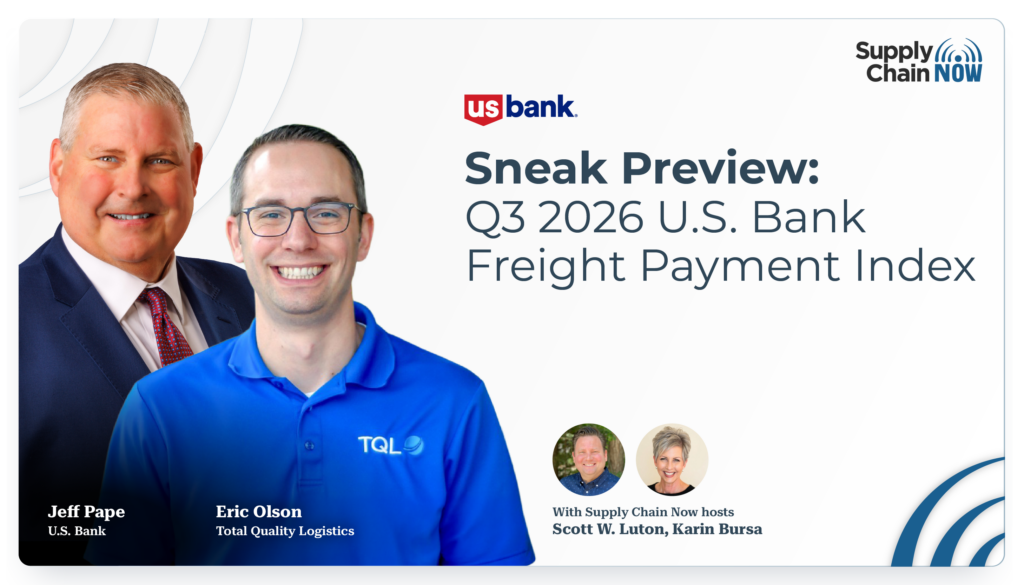
[00:01:55] Scott W. Luton: That’s the big billion dollar question of our time maybe. Today, really to that end, we’re going to be digging in to a sneak peek of the Q3 2026 U.S. Bank Freight Payment Index. Now folks, it’s going to be published on October 29th and you can go access it for free at freight.usbank.com. But Karin, one of our favorite things to do on this long running series is a couple things here. We like looking at things from a national standpoint. We also dive into the regional differences here in the domestic freight market. Folks are going to hear from the voice of the data and the voice of the practitioner. And I think you’ve got a really important data point to share before we get going.
[00:02:35] Karin Bursa: Yeah, absolutely. I mean, one of the things that makes this so interesting is I’m a big believer in facts, not feelings. So let’s get the data, let’s harvest the insights so that we can make better decisions faster. And when freight is moving, whether we’re talking about raw materials or finished goods, then that means the economy is moving. And so I look forward to this discussion and this index report from U.S. Bank every quarter because we’re not just looking at cyclical and quarterly insights. It really gives us a pulse on what’s happening. And just to give you an order of magnitude, when U.S. Bank looks at the freight payment index, they are harvesting insights from nearly $46 billion in transactions, actual transactions that have been processed. So when we say facts, not feelings, it’s giving us a great baseline to make better decisions faster and use some good signals from the market.
[00:03:41] Scott W. Luton: Well said, Karin. Well said. And of course, I appreciate all of your time in supply chain leadership circles. Look forward to your perspective here today. But folks, we’ve got some great guests here and I want to welcome all of our guests here today. I’m going to start with our two esteemed panelists up here, Eric Olson, support operations director, partnership and business development with our friends at Total Quality Logistics. And joining Eric is Jeff Pape, general manager, transportation with U.S. Bank. But folks, there’s even more. I think we can solve the world’s ills with Eric and Jeff, but we got more. As I mentioned maybe earlier, we’ve got these team members, some of them from the advisory council that U.S. Bank leans on as they look to keep their finger on the pulse of what’s going on in global supply chain. We’ve got a bunch of business leaders, supply chain leaders right here in the audience.
[00:04:25] Scott W. Luton: So welcome to each of y’all as well. Okay. So Karin, what are we going to do with all this talent in this room here today? Man.
[00:04:33] Karin Bursa: We’re going to get smarter. I hope to leave smarter than I came in.
[00:04:38] Scott W. Luton: We definitely are going to leave smarter. So Eric, welcome back. We’ve enjoyed, you’ve been with us on this series probably three or four times. You’re moving up the top 10 appearance list here. I love starting with a fun warmup question. You are a native Detroiter, big time, a rabid Detroit Lions fan, right?
[00:04:58] Eric Olson: Close enough.
[00:05:00] Scott W. Luton: Don’t mess with the narrative. Who is one of your favorite Detroit Lions of all time?
[00:05:08] Eric Olson: Well, first of all, thank you for having me here, having me back. It’s good to see you again and thanks to U.S. Bank as always for putting on this advisory council. It’s one of my favorite things that I get to do every year. And you and I talk about getting smarter the last couple days. I think hopefully we all have because there really is a lot of talent in this room. Favorite Detroit Lion, there’s not that many options, but it’s obviously Barry Sanders. I mean, I am at the right age to have seen him his whole career when I was really becoming a sports fan and there’s just nobody like him. I can play his highlights for my 11-year-old daughter when I go home today and she’ll be like, “Whoa, there’s nobody else like that.” And funnily enough, I think the first time I ever saw a Lions game, I saw Barry run over around and through the Green Bay Packers and the Rare Lions.
[00:06:00] Eric Olson: It’s one of my fondest memories.
[00:06:03] Scott W. Luton: All right. So folks, if you hear some laughter, it’s because Eric is getting one in on Jeff, who is a Green Bay Packers shareholder. So Jeff, welcome. Welcome to Supply Chain Now. And as I mentioned, you’re a shareholder. There’s not too many of those. It’s a prestigious position. Are you more of a Brett Favre or an Aaron Rodgers kind of guy?
[00:06:28] Jeff Pape: That’s a tough question, Scott, but I would say definitely a Brett Favre fan. I’m more old school and frankly old enough to remember Bart Starr playing, so he’s a throwback. But also just appreciate you having me, you and Karin hosting this and very grateful to be here with our advisory board. And we meet twice a year and it is truly one of the highlights that I do every year. So thanks to all of them for the contributions they make.
[00:06:56] Scott W. Luton: Jeff, that is great. Kidding aside, and I appreciate your take of the answer, and we’ll see how the Detroit and Green Bay teams do. Karin, we’re not talking about the Atlanta Falcons, okay?
[00:07:06] Karin Bursa: Want to talk college ball?
[00:07:07] Scott W. Luton: We maybe could talk college football, but not talking Falcons. But kidding aside, really appreciate all of y’all’s contributions, right? We’re getting smarter by hearing from practitioners and practitioner leaders out there across the market, and I can’t wait to get the full rundown of all the conversations here as part of the advisory council meetings. But let’s do this. Jeff, we’re going to put you on the spot one more time. I was talking about succinctitude in the pre-show. We’re going to test your skills here. So if you had to put today’s conversation in one sentence, the theme of today’s conversation in one sentence, Jeff, what would that be?
[00:07:42] Jeff Pape: It would be this business cycle is really driven by capacity constraints. Normally we’d like to see demand really driving both ends of the activity within the economy, but right now it’s capacity driven and there’s a lot of contributions to that.
[00:07:59] Scott W. Luton: Outstanding. Well done. A plus. Really quick aside, I see Alan tuned in from out remotely. Alan, let us know where you’re tuned in from and all of the folks that are with us remotely, would love to hear your take on anything we talk about here today. All right, so let’s make Jeff proud and accurate and get into this theme of today’s conversation. But before we get into the key takeaways, Eric, for our new audience members that may have missed some of your earlier appearances, tell us a little bit about yourself and cool things that TQL is up to.
[00:08:30] Eric Olson: Yeah, sure. So I have been at TQL for 20 years. I had my 20-year anniversary a few months ago, which it’s crazy that I started when I was eight. That’s something I’m pretty proud of. But TQL, we are a 3PL. Our biggest mode is North American truckload, and we sort of cover all van, flatbed, and refrigerated there, but we’re also into every other mode, rapidly expanding international, LTL, heavy haul footprint. And so we are always looking to grow and we do that by providing the highest service possible to all of our shippers across all modes, across all industries, and we’re going to keep focusing on that forever.
[00:09:11] Scott W. Luton: Outstanding. And folks, you can learn more at tql.com. All right, so Karin, we got two questions for you, and then we’re going to get pulse from the advisory council here. Number one, how do organizations and leaders use resources like the freight payment index? And if you can speak to any feedback we’ve gotten over the last four or five years of conducting the series.
[00:09:32] Karin Bursa: Yeah. So I’ll start with the second question first. The feedback on this series has been really positive. We’ll get comments in after at least the quarterly ones that I’ve participated in with you and members of the U.S. Bank team and then their invited guests. The one thing I like about it is it’s bringing that data together so we’re getting a pulse in the marketplace. I like that they do a national view and then a regional view because it can vary significantly by the region. And then sometimes we even pull that back to look at specific industries that are driving either increased volume or seeing lower shipments. So the bottom line is that that feedback comes in. So it is an index, it is a data point that is rich and valuable to chief supply chain officers, to CFOs, and to CEOs as they’re looking at their business and refining their plans, not just on a quarterly basis, but on an annual basis and oftentimes even longer as they’re contracting with resources and looking at particular lane and activity.
[00:10:39] Scott W. Luton: Outstanding, Karin. I appreciate that. So we’re going to dive into a couple different things, but Jeff, also thinking of our new audience members that may have missed these earlier five or six years of shows, can you explain briefly in a nutshell what the U.S. Bank Freight Payment Index is and how it works?
[00:10:59] Jeff Pape: Sure. It’s a combination of both truckload and less than truckload activity across our network. And to Karin’s point earlier, there’s $46 billion worth of spend that goes across that network. And so it’s an index base that shows on both a national and a regional level, not only the spend that’s occurring, but the shipment level that’s occurring. And those sometimes work in concert, but oftentimes don’t. So the regional aspect of this, the feedback we’ve gotten is really, really important to customers because it’s one thing to show a national index, but if you are in the Southeast, that’s very different than the Northeast and there’s different dynamics. So in addition to that, we publicize a rates addition to that freight payment index and on a quarterly basis as well.
[00:11:49] Scott W. Luton: Outstanding. And folks, again, if you want to download your free copy, go to freight.usbank.com. So Jeff, I want to dive deeper into really two buckets of takeaways. And we’ve already talked about, we’ve got the macro view and the micro view. I’m hoping I’m making my college economist professor happy with those. So let’s do this. So Jeff, when you look at the national and regional macro view, what’s a couple of key observations that you glean from the Q3 freight payment index?
[00:12:25] Jeff Pape: Yeah, there’s a couple quick things, Scott. First is at a national level. While the shipments were up slightly, it was a spend that was up considerably over 30%. The other thing that’s worth noting is this is the first quarter in five years where all of the national metrics showed an increase. So to just reinforce the point that each region is different, this is the first time in quite some time that all the indexes or all the indices were up. And then this is the third consecutive quarter where both national and regional volume was up by double digits. So when you think about what’s happening in the market and you think about that increase at a national level, it’s happening, but at a regional level, there’s very different things that are driving that.
[00:13:19] Scott W. Luton: All right. I love that. It’s like color commentary on what’s going on supply chain. Karin, I’m going to come to you next. What do you think of the national and the regional macro view? A couple of your observations there.
[00:13:31] Karin Bursa: Yeah, I obviously agree with the data and the insights, but over 30%, so 32%. I think it’s 32.1% in the report in shipper spend or paying more, but shipments themselves only grew marginally for the quarter. That’s a big message to all of us. So that expense of moving goods is increasing and taking a bite out of overall profitability or margins for businesses, which means eventually that may get passed on to whomever their customers are or has to get absorbed.
[00:14:13] Scott W. Luton: That’s excellent comments. It’s got to go somewhere, right? All right. So Eric, national and regional macro view, your observations?
[00:14:23] Eric Olson: Our experience at TQL, of course, matches what all these numbers are saying. And I think Karin, you made the point, Scott made the point, Jeff made the point. The main takeaway is of course that this is capacity driven and it’s unique in how heavily that’s true because usually you see demand spike more when rates are up as much as they are. But on the TQL side, we’ve seen year-over-year capacity decrease by over 20% in all trailer types in van and refrigerated and in flatbed. And even as rates have continued to rise, we haven’t seen a flood coming back into the market yet. I think there’s a lot of reasons for that. We’ve got some carriers in the room that I’m sure could speak to just the cost structure the way it is in the industry now, but it’s unique and it’s a huge impact.
[00:15:15] Scott W. Luton: All right. So Karin and Jeff, we’re going to sign up Eric for some voiceover work. Is your agent here, Eric? Okay. We’re going to make that happen. All right. Kidding aside, the regional micro view aspect of the freight payment index is one of my favorites. Jeff, you mentioned there’s usually some stark differences in the regions. That might surprise a few folks out there, but really I love seeing the different sectors and different dynamics and the different factors on region to region far beyond what we see here in the Atlanta area and the Southeast. So Jeff, we won’t have time to go region by region like we usually do on the show, but when you think of the regional micro views, what are
[00:15:56] Jeff Pape: A
[00:15:56] Scott W. Luton: Couple of your observations there, Jeff?
[00:15:58] Jeff Pape: Yeah, let’s start with the Midwest, Scott. So in the Midwest, we saw housing with interest rates and everything, housing got a little softer, automotive output and production got a little softer as well. But in that region, they did grow in this past quarter. There were more shipments. The spend was obviously up as we talked about. But then also in the Southeast, given we’re here, this is an interesting time to share this news as well. All of the activity that we’ve seen across the nation around data centers and the infrastructure that’s being built around that, that really drove in this quarter, the activity in the Southeast. That combined with some additional activity and imports has really driven the Southeast region and the activity there. So those are a couple of highlights. There’s a lot of puts and takes across the five regions, but we hope that that also gives some perspective to companies that are national but might have regional operations to help do better planning.
[00:17:01] Scott W. Luton: Yep. Good stuff, Jeff. All right, Eric, there is a ton of puts and takes, as Jeff said, across different regions. What do you see? A couple of your observations on this micro view level.
[00:17:11] Eric Olson: I think that one of the things that I really like about this index in particular is matching up our experience, our business experience with the national view. And so one thing that stood out to me was in the West. The West had a decrease for the first time, and that really wasn’t our experience at TQL. I was thinking about it’s the type of shippers that we run with and the seasonality of things like that. So it’s always helpful to dig in when you see something that doesn’t make sense. And so for us, I shouldn’t say it doesn’t make sense, that doesn’t match our experience. And so for us, it has to do with our shipper mix, our heavy food and bev and refrigerated, but I know that there’s some other things, and we had some conversations earlier about other things that might be driving that.
[00:18:02] Eric Olson: Now, can I kick it to the crowd?
[00:18:03] Scott W. Luton: Please.
[00:18:04] Eric Olson: I know somebody’s got a good thought on why that might be.
[00:18:07] Scott W. Luton: Thank you for that, Amy. Amy, for folks at home or in offices around the world spoke about how she’s seeing shippers diversify the import strategies, and we’re seeing the market shift from one state to another state. What’d you hear there from Amy, Karin?
[00:18:21] Karin Bursa: Well, I’m glad Amy brought that up because that was one thing that stood out to me is that higher freight costs can start changing our sourcing and network decisions. And so I think Amy is kind of spot on because that also affects our inventory placement, maybe our time to customer, et cetera. So we have to be able to look at all of those moves together and analyze what it means for our growing business or our changing business.
[00:18:48] Scott W. Luton: Outstanding. I know we saw another hand before. So Tiziana, Alan, others that are tuned in remotely, whether you’re involved in the U.S. freight market or elsewhere in the world, we’d love to get your perspective on what you’re seeing. Heather. So Eric, before you answer, that’s a great question, Heather, and I’m going to recap a little bit of it to our folks at home so they know what Eric’s speaking to. Heather referenced the massive spike in imports that we’ve seen this year, especially on the West Coast, of course, heightened rail activity. And the main thrust of the question was what does all of this and these other factors, what are we going to see in Q4? I think that was a main thrust of the question, right? Eric, speak to that. I know we’re going to get you to go back to your crystal ball a couple times in this conversation.
[00:19:37] Eric Olson: I think that obviously a lot of things peak in Q4 all the time, but I think that what we expect to see, what we’re already starting to see since we’re almost a third of the way through the quarter at this point is we expect to see kind of a more significant peak than usual and probably happening a little bit earlier. Capacity is reduced. There’s a reason everything’s moving on rail because of cost, because the capacity is already gone and you’re going to see that seasonal demand impact. And so we expect capacity to be restricted on the West Coast, primarily all across the country. And all we can do is have those conversations early with our shippers and with our carriers so that we make sure that we’re able to service the way we want. But I think it’s going to be a spike. I think it’s going to be a hard spike, and I think that we all need to be ready for it.
[00:20:27] Scott W. Luton: All right. So Karin, before I come to you, I think a couple thoughts here. Number one, I think the definition of the word peak continues to evolve, maybe evolve a lot more in recent times. And then secondly, you know what we didn’t do, folks, is we didn’t give Eric a round of applause for 20 years at TQL.
[00:20:47] Jeff Pape: Thanks, Jeff.
[00:20:50] Scott W. Luton: Karin, you know that 20 years in supply chain is like a hundred in other industries, right?
[00:20:56] Karin Bursa: Dog years, yeah.
[00:20:57] Scott W. Luton: So from a regional microview standpoint, your observations, Karin?
[00:21:02] Karin Bursa: Yeah, I think it’s important to look at the regional factors and to try to maybe dig a little deeper and understand what industries might be driving either the increase or decrease the pullbacks. We mentioned the housing industry, I think earlier, obviously that’s one that has had a lot of swings through really the last two years, but also things that are driving demand when we think of data centers, we mentioned the Southeast, the digital supply chain is an indicator of what’s happening in the physical supply chain. So really looking at those trends and making sure the type of transport is available, we’ve got the right relationships in place and the carriers that we’re working with, the partners that we’re working with and getting those goods tomorrow is very important and is different. So increased expense comes from a number of factors. It’s not just capacity.
[00:22:04] Eric Olson: Right. I think that’s really interesting general contractors and construction companies. I mean, that data center build out is driving so, so much of this. And it’s not just the Southeast. I mean it’s everywhere because they’re importing so much to build this. These companies who do one thing really well are suddenly scrambling to find a way to do something really important really quickly and all over the place.
[00:22:34] Scott W. Luton: I’m not going to get the numbers right, which is unusual for me, so I’m not going to put them out there, but I was reading of the rise of the data center and the impact it has had on U.S. in comparison to the internet and in comparison to the transcontinental railroad. And what we are seeing is truly historic. Now it begs the question, we don’t get to it here today, when does things change? When do things change? There’s a lot of different projections out there and we’re about to get y’all’s Karin and Eric’s crystal ball on the freight market a months ahead, but it’s something that is beyond the pulse. It seems like the heart of the economy here in the past year or so.
[00:23:16] Karin Bursa: I think in addition to looking at what’s going on in power and industrial consumption, we need to continue looking at just the import-export process. We know we’ve had a lot of volatilities introduced just around the tariff situation and what that looks like long term and the global impact on the movement of fuel on the businesses, both oil and gas as a consumption item, but also to fuel just business in general or the movement of goods.
[00:23:49] Scott W. Luton: And the pricing challenges all of this creates is tremendous. Eric, really quick comment.
[00:23:56] Eric Olson: So we have all this uncertainty. We have all these factors that are driving the market up. We still have the usual uncertainty, which is storms, which is weather, which is the same sort of thing. So the day-to-day concerns are always there and you add regulatory uncertainty and costs and all that on top of it, and it is worth talking about.
[00:24:16] Scott W. Luton: It is worth talking about and that it’s worth doing things about. I know our leaders up here in the room are doing, and it’s been said thousand times, probably just this week, is that in this era, it’s not a matter of how much uncertainty are we going to have? Actually, it’s not a matter of whether there’s going to be uncertainty, it’s a matter how much uncertainty. It’s just part of the equation, more of a constant, even though it’s a variable. That makes no sense from a mathematical standpoint, but it is what it is. And by the way, just quick check in, I’m looking at triple A prices. Diesel, the current average nationally, $6.31 a
[00:24:54] Karin Bursa: Gallon.
[00:24:56] Scott W. Luton: And a year ago it was 362. And we all know that, but every time I look at that again, it boggles my mind. Okay. Tiziana, I’ll tell you what, my machine is on font eight. I can barely see this, but I’m going to try. Tiziana says, “We’re seeing physical infrastructure build outs for data centers and AI. As these multi-year projects begin to pivot from heavy material transport to technological
[00:25:21] Karin Bursa: Installations,
[00:25:22] Scott W. Luton: What will be next? What should we be planning for?” Tiziana, that’s a great question. And we may speak to that here in the time we got left on the second half of the show. Real appreciate you being here. Okay. So Karin, you challenged me early this morning. She’s like, “Scott, you talk way too much, number one.” And I know that, right? And number two, she’s like, “Hey, try to come up with something four words or less per region.” So let’s see if I pass the test. Give me a grade. So west, fewer loads, higher bills. Southwest, freight’s expensive comeback. Midwest, still leading, but slowing. Northeast, steady as she goes. Southeast, freight finds
[00:26:06] Karin Bursa: Momentum.
[00:26:07] Scott W. Luton: And from a freight rate standpoint, prices won’t budge. So give me a grade on that very succinct approach. What’d you think?
[00:26:15] Karin Bursa: I think you did good.
[00:26:16] Scott W. Luton: Is that okay?
[00:26:17] Karin Bursa: Yeah. Did you use AI for that?
[00:26:20] Scott W. Luton: You put my secrets out there.
[00:26:23] Karin Bursa: There were no new words introduced. I’m just checking.
[00:26:27] Scott W. Luton: There’s no, it’s not this, it’s that. I’ll try to avoid that, but Eric, in a nutshell, it’s tough to boil all this stuff down like four words less, but is that hitting the mark?
[00:26:40] Eric Olson: I would give you an A minus for that.
[00:26:42] Scott W. Luton: A minus.
[00:26:42] Eric Olson: Yeah.
[00:26:42] Scott W. Luton: It’s better than I expect.
[00:26:46] Eric Olson: I would copy off your paper.
[00:26:47] Scott W. Luton: Oh, man. Cover it up a little bit. All right, good stuff. All right. So it goes out to our esteemed members of the advisory council. We’re going to have a fast and furious finish, but we welcome any other comments y’all might have. Really appreciate y’all’s perspective here today. But it is crystal ball time. Now, Jeff, you are not sure if everyone knows this, folks that turn in our shows know this, but in your position, you are not able to give any prognostications, at least when it comes to economy, supply chain, stuff like that. But can you give us a prediction of Green Bay’s record this year?
[00:27:25] Jeff Pape: Well, we’re four and two right now. I can count on two more wins for sure when we go to Detroit and when Detroit comes.
[00:27:34] Eric Olson: I deserve that.
[00:27:35] Jeff Pape: I think we’re coming out. I think we’re going to go with 12 wins.
[00:27:40] Scott W. Luton: 12 wins.
[00:27:41] Eric Olson: Okay.
[00:27:41] Scott W. Luton: 12 wins. All right. I like that. I like that. Bold. Be bold. All right. Kidding aside, Eric, when you think of the freight market, and kind of going back to Heather’s great question, but what else would you add in terms of what you think we’re going to see in the months to come?
[00:27:58] Eric Olson: I expect to see more of the same. I think our pricing team at TQL has completed 30% more bids this year than last. Our legal team is doing about 25 to 40% more contracts we see coming through. So as shippers react to the market, as they react to uncertainty, as they react to different things that happen in the courts and things that happen on the road, I just expect to see rates continue to be up even if demand doesn’t move. And I don’t expect to see capacity flood back in. And so yeah, I reserve the right to be completely wrong, of course, but I feel I would give my confidence a B minus on that. How’s that?
[00:28:45] Scott W. Luton: Well, you know what? I bet you’re more right than you are wrong in this 20-year journey you’ve been on. And you mentioned the courts. Tell you, just speaking for myself, have we ever seen the Supreme Court weigh in and impact global supply chains as much, at least in the modern era, as we have in the last year or two, Karin? Isn’t that something?
[00:29:05] Karin Bursa: Yeah, it is something. And I think the velocity of how things are moving quickly is important because we mentioned this transition and data center build out and seeing the impact of that, and it feels like it’s happening faster than economic changes have happened in the past. And so some of that is just simply due to the visibility and getting a good read on the market and understanding then what that means, the pull through or the ripple through effect. So I think all of those factors come into play.
[00:29:39] Scott W. Luton: Yep. Excellent. Y’all’s crystal ball is working well, and we look forward to checking back in on that in a minute. Any other predictions? I like the survey with the hands. If you got a good question that we can pulse the audience with, you let me know. A year from now, folks, do you believe Ray Raise your hand if you believe the transportation costs, or maybe I should say the cost of doing business will be even higher than it is at this moment a year from now. Okay. Does that look like all –
[00:30:12] Karin Bursa: Almost unanimous.
[00:30:12] Scott W. Luton: Yeah, almost unanimous. Your comments, are we going to be able to wrangle? I mean, because inflation obviously is alive and well and cost to do a business and supply chain. We going to be able to get our handle around this?
[00:30:23] Karin Bursa: Well, the big question I think is what will it take to bring more capacity back? How do we bring more trucks back, more drivers back so that it is profitable for them and is a good business decision for shippers as well? So you probably have a better read on that.
[00:30:45] Eric Olson: Well, I mean, that’s not a new question. Again, it’s been very acute this year, but that’s not a new question. And I don’t know if there’s an answer to that. I don’t have a good answer to that. I don’t know if there’s an answer. And so it comes down to the relationships that shippers do have with their carriers, that brokers have with their shippers and carriers, because we can help each other. We can help each other get through these challenges if we understand the goals, if we understand the challenges that we have. And so just being in constant conversation about what we’re seeing in the market, about what a shipper needs, what they anticipate, and making sure that we prioritize those shippers that have prioritized us throughout.
[00:31:29] Scott W. Luton: Well said, Eric and Karin. And Jeff, one of the things, Eric mentioned the conversation, we got to have the conversations, we got to have different conversations. And I might be stating obvious because I’m really good at that, Karin, but like what we’re doing here, I appreciate what you and your group have done to bring advisory council folks, leaders from different sectors, different business models, you name it, that come in and have meaningful discussion over a period of time. And I think it reflects, at least when I think about my time in manufacturing, some of my favorite things to do is to go meet with suppliers intentionally, get beyond email, get beyond the meetings that got to take place when things are broken and have productive, proactive conversations. It’s amazing how many eureka moments we’ve had, at least in my career. And I think we got to do more of that, especially in really challenging times.
[00:32:16] Scott W. Luton: Jeff, any comments on any of that?
[00:32:19] Jeff Pape: Well, Scott, it’s a really important point and the collaboration that exists with this group and when we get together, the sharing of information really informs where we want to go as a business, but also it is not lost on me and I’m amazed every time this group gets together, the collaboration and the leaning in both shippers and carriers have to help each other be successful because they are very codependent on each other. And in the markets that we’re in, we observed yesterday in a lot of the conversations that this is very much a partnership and each constituent is more than willing to help the other one get through these cycles. And each cycle is different and this is a cycle where the teams need to come together and it’s just amazing to me what happens when you have those conversations. And so we’re very grateful for the customers that are on our advisory board.
[00:33:17] Jeff Pape: We’re also grateful for all the customers and the meaningful conversations that we know are happening between shippers and carriers. And we’re just happy to be part of that and help facilitate it.
[00:33:27] Scott W. Luton: Appreciate that, Jeff. And you’re right, every cycle is different. There’s some common themes, there’s common challenges that have been around since the beginning of time, but there sure are some big nuances we’ve seen come up month by month, quarter by quarter.
[00:33:40] Karin Bursa: There definitely are. But I do think to Jeff’s point, thinking about how do we become the shipper of choice or the carrier of choice, the partner of choice, that these trading partners need to talk to each other and to understand that it’s not just a monthly relationship that they’ve established. Hopefully these are long-term relationships, trusted partners, and we can look at capacity not just in a simple quarter, but look at it on an annual basis. And then what do we do to be able to flex up and down? But being a shipper of choice in a constrained market is a good thing. So what do we have to do to get our own house in order in order to be that preferred customer in the whole relationship?
[00:34:26] Scott W. Luton: Yep. Well said. And we’re about to move to the closing segment here, but Eric, I just want to give you a chance to comment there. You strike me as someone that, I mean, we’ve had plenty of conversations over time, not over 20 years, but your first appearance probably was four years ago.
[00:34:41] Eric Olson: Yeah, maybe longer than that.
[00:34:42] Scott W. Luton: Maybe longer than that.
[00:34:43] Eric Olson: They run together.
[00:34:44] Scott W. Luton: Did we ever think we’d be here at this moment four or five years ago experiencing some of the things we’re experiencing? Goodness gracious.
[00:34:50] Eric Olson: I didn’t think we’d be here a month ago. I was in a lot of ways. Absolutely not.
[00:34:54] Scott W. Luton: That’s the velocity that we’re moving at. But going back to what Karin and Jeff are both speaking to, the power of proactively having different conversations with the folks across your ecosystem, whether you’re bringing in the freight payment index or other data truths you can lean on, I bet it’s been part of your 20-year journey.
[00:35:19] Eric Olson: Absolutely. And the best thing that you can do is start off that way. When you first get a bid, when you first get introduced to a shipper, when you first get introduced to anybody, be very, very, very intentional about learning, about asking the right questions, about listening to the answers, and then about figuring out with your teams internally how you can deliver what everybody needs. It’s the best way to be successful. And I think that to the larger point about just having these conversations, being together in person in this opportunity, it’s not just shippers and carriers that need to have those conversations. These events, these conversations are great opportunity to learn from, I guess we’re competitors, the other carriers, but really we’re peers. We all have the same challenges and there’s a tremendous benefit in having those relationships too so that you can stress out for six months and then come to something like this and then go back to your hotel room at night, close the door and say, “Thank goodness it’s not just us.” And really there’s a huge benefit in that and it helps you plan, it helps you learn and it helps you get better and get through this stuff.
[00:36:31] Scott W. Luton: Well, what is that phrase? When you’re with your peers in misery, it’s not quite as bad, right? I’m losing the old adage there, but –
[00:36:40] Karin Bursa: I hope it’s not misery loves company.
[00:36:41] Scott W. Luton: I think that’s what it is. I think it’s what it is. All right. Folks, y’all know I try to be very practically positive from a mindset, but hey, there’s a lot of pressure. There’s a lot of friction. There’s a lot. Plus this time of year, traditionally, no matter if you had all these outside factors and unique factors to deal with now, it’s crunch time. And hey, Carlos, Benia, great to see you. Let us know what part of the world you are tuned into. And Tiziana, we may not get to your question here today on what we should be planning to next kind of post data center, but we’ve got a data center leader joining us on the buzz in the next few weeks. So we invite you to tune in for that. All right, so let’s do this. Jeff, I want to make sure, we love these quarterly conversations.
[00:37:30] Scott W. Luton: I love pulling in Karin or Jake Barr or many others that see the same and see very different aspects of the domestic freight market. But I want to make sure I’m clear about one thing in terms of where folks can find the U.S. Bank Freight Payment Index, how they can subscribe to it. It’s pretty easy. Your thoughts, Jeff?
[00:37:48] Jeff Pape: It’s very easy and we’d welcome anybody that would like to get a quarterly update on it, but you can find us at freight.usbank.com, enter your contact information and you’re on the list. It’s pretty simple.
[00:38:02] Scott W. Luton: It is simple. And I would challenge you folks as you do that, as you download it and get a copy and figure out what you agree and disagree with, what you’re seeing, maybe what you’re not seeing, join us for this quarterly series and hey, we welcome your comments. I know the U.S. Bank team, they love folks that, “Hey, that’s exactly what I’m seeing or I’m seeing something a little bit different in my neck of the woods. We’d love to hear from you each quarter on part of the series.” So Jeff, appreciate that. And again, as you mentioned, freight.usbank.com. Eric, first up, when is the cake? Because I’ve missed out on the cake for your 20th anniversary. Was I not invited?
[00:38:35] Eric Olson: Keep repeating 20 years. I don’t think we need to emphasize that so much.
[00:38:38] Scott W. Luton: That is a feat, my friend. How can folks connect with you and the TQL team?
[00:38:44] Eric Olson: Well, you can visit www.tql.com for information about us. Again, we are operating all over the world, moving every mode, and we would love to talk to you about how we can help if you’re interested. I mean, I’m on LinkedIn sometimes, I guess Eric Olson. If you want to connect with me, that’s fine. I accept your connections pretty quickly.
[00:39:06] Scott W. Luton: Olson with two Os.
[00:39:08] Eric Olson: Yes. Olson with O-L-S-O-N. Yes, that is a common miss thanks to the lingering impact of Mary Kate and Ashley. We’ll never know that.
[00:39:18] Scott W. Luton: I’ve never connected the two. It makes perfect sense now, folks. Okay. Eric, Gustav. And all kidding aside, really two decades in this industry with the same organization that’s growing left and right. That is a feat to be celebrated, so really appreciate you being here. Now, Karin, you’re going to get the toughest question. Usually I wrap with some softer questions, but we covered a lot of ground here. I appreciate what Jeff and Eric have shared and Amy and Heather and Scott have shared. Also enjoyed my sidebar conversations before we even got started. But if you had to share just one key takeaway from anything in the sneak peek session we had, what would that be?
[00:39:59] Karin Bursa: I continue to believe it’s a great time to be in supply chain, number one. It is challenging. There’s lots of smart people in this room with us today, but also listening online. And it’s an industry that really allows you to be a problem solver. So there are a lot of things moving, no pun intended, as we make decisions about our businesses. And I think it’s important to use this data to inform your organization so that you can make decisions not just about what’s happening today, but what’s going to happen next year and after that, because some of those physical changes take more time to implement. It’s very difficult to do it in a 30 or 60-day window of time. So let’s not confuse soft freight demand or flat freight demand with abundant or inexpensive capacity. I think that this quarter’s report certainly shows that’s not true, but also that we need to look at all of the levers and to be good trading partners, that it doesn’t with technology.
[00:41:10] Karin Bursa: And I lean into technology quite readily, but it does not replace the insights and relationships that your people build with your trading partners. So give them the information, the insights, and then help them build those relationships and become great trading partners because it will only continue to snowball that this is a great industry for all of us and for the talent coming out of high schools and universities today.
[00:41:40] Scott W. Luton: Well said. Well said. And two things that you mentioned, I like how you called out one unique human superpower that’s not talked about often enough, and that is our ability to build relationships, relationships that can get through the easier times, which is the easy time to do that.
[00:41:59] Karin Bursa: It’s easy to be fun to work with them.
[00:42:01] Scott W. Luton: That’s right. And then the unique human superpowers that we’re building relationships that get us through the tough times when it takes a village, it takes an ecosystem. That’s a great comment. And going back to how you opened up the session here today, facts, not feelings. We’ve got to lean on resources like the U.S. Bank Freight Payment Index because sometimes just the data. Give me the data first, right?
[00:42:24] Karin Bursa: Yeah. It’s back to it’s good, reliable, deep data that, as was mentioned by our audience, is summarized in a digestible format for all of us. Not a hundred pages.
[00:42:36] Scott W. Luton: Yeah.
[00:42:36] Karin Bursa: So I think that that’s really important. It’s something that we can look at. It’s vetted in the industry and it gives us a good read on what’s happening.
[00:42:45] Scott W. Luton: Yeah. I mean, when y’all finally let me do a six-hour live stream, we might need a hundred pages, but I can get all this stuff in an hour. Give me eight to 10 pages. And of course I’m kidding for folks out there on the front lines making decisions, we don’t have much time for a hundred page dissertations on War and Peace and global supply chain. All right, so let’s do this. I want to thank everyone here today, starting with the members of the Advisory Council. Thanks for getting together with us here in Atlanta. Really appreciate what y’all do in industry. We know this industry and this business is not easy, and my heart goes out to you and your teams getting through this time of year, but really appreciate what you’ve contributed to the dialogue. Eric Olson with two Os, with our friends at Total Quality Logistics.
[00:43:36] Scott W. Luton: I’m not referencing your anniversary again, but congrats to TQL, all the growth and the innovation, and I hope to have you part of the series next year too.
[00:43:47] Eric Olson: I’m happy to do it and thank you for the opportunity and thank you for the good data and to U.S. Bank for putting on this event. This is
[00:43:56] Scott W. Luton: Fun. It is fun and it’s a lot easier to get product out. I’ll pay that much from my experience, Lisa. And we didn’t mention Bob Costello. He’s a big voice as part of the freight payment index. We’ve been honored to have him join us a couple times. Bobby C is some of his friends calling his perspective is really important in the freight payment index. Eric, great to have you here. Jeff Pape, really appreciate your comments on the index, your comments on industry, on leadership and on those Packers. 12 and six, we can take that to the bank. Is that right?
[00:44:31] Jeff Pape: I think we can.
[00:44:32] Scott W. Luton: Okay. Well, Jeff, kidding aside, thanks for being here. Thanks for assembling these industry leaders here and pleasure to have you join us on the show.
[00:44:40] Jeff Pape: Well, thanks for having us and appreciate all the support you and Karin do in the industry, the thought leadership and really the partnership we have. And my thanks to the advisory board and all of our customers for, they all contribute to this data and the index. So that’s really important and it was a pleasure to be here. So thanks again.
[00:45:01] Scott W. Luton: Appreciate that, Jeff. Karin Bursa, always enjoy your perspective. Thanks for being here.
[00:45:06] Karin Bursa: Oh, I appreciate it. I appreciate the opportunity and to be with all of you today. And thank you to U.S. Bank for putting the index together because sometimes it’s hard to get good vetted data in this industry and to see those trends. So it’s an important resource.
[00:45:25] Scott W. Luton: Well said. And one last question before we wrap here. Folks, we’re at the Kimpton, if I said that right, Overland Hotel. And we’re right here next to Porsche in their track next door. Are you going to be taking one of those Porsches home this afternoon?
[00:45:40] Karin Bursa: I’d like to take one on a spin around the course. I understand a lot of the folks that are with us this morning had that opportunity and I would probably do better in the passenger seat than in the driver’s seat. I’m just going to say, especially when we get near a hundred or more as you’re running that track. So it’s good to see all of you. Nobody’s wearing a safety belt here in the conference room with us today, but I might need something. You might. Yeah.
[00:46:08] Scott W. Luton: Love it. All right. We’re going to see. Folks, what a great conversation, Karin. Thanks for being here. Thank you, Eric. Thank you, Jeff. Thank you everybody out there with the advisory council. Thanks for everybody tuned in around the world. We love our SCN and Global Fam and really enjoy conversations that are driven by data, right? Facts, not feelings. Folks, two last things here. Number one, you know your homework. We had a lot of action perspective here between Karin and Eric and Jeff, some of the comments from the advisory council. Take one thing, one thing. Check out the U.S. Bank Freight Payment Index. There’s plenty of things in there, but take one thing and do something with it. Deeds not words. And with that said, on behalf of all the whole team here at Supply Chain Now, Scott Luton challenges you to do good, give forward, be the change that’s needed, and we’ll see you next time right back here on Supply Chain Now.
[00:46:56] Scott W. Luton: Thanks everybody.
[00:46:58] Voice Over: Join the Supply Chain Now community for more supply chain perspectives, news, and innovation. Check out supplychainnow.com. Subscribe to Supply Chain Now on YouTube and follow and listen to Supply Chain Now wherever you get your podcasts.