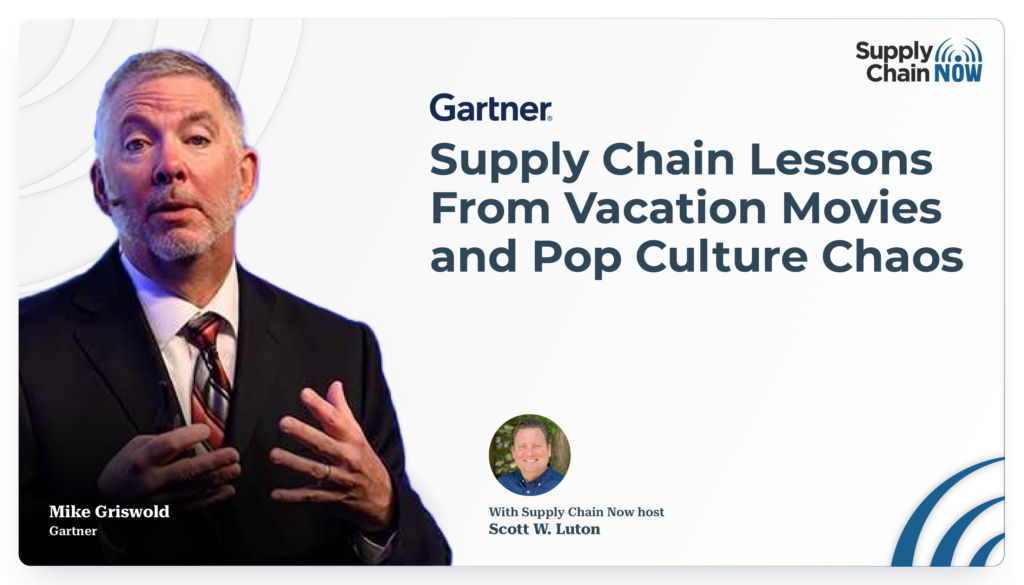
[00:00:00] Mike Griswold: AI is going to do everything for us. We’re not going to need people to do anything. AI is going to replace all these jobs. What we have found over time is a lot of that at the magnitude we thought isn’t true. Yes, AI will replace some jobs. Yes, AI will start to do more, but it’s doing more with adult supervision.
[00:00:26] Voice Over: Welcome to Supply Chain Now, the number one voice of supply chain. Join us as we share critical news, key insights, and real supply chain leadership from across the globe. One conversation at a time.
[00:00:39] Scott W. Luton: Hey, good morning, good afternoon, good evening, wherever you may be. Scott W. Luton, and always special guest. Mike Griswold here with you on Supply Chain Now. Welcome to today’s show. Mike, how are you doing today, my friend?
[00:00:51] Mike Griswold: Hey, I’m doing very well, Scott. It is great to be here, great to chat. I look forward to all of our time together, but I’m really looking forward to today’s topic. I think we’re going to have a lot of fun with this today. And hopefully people think so as well.
[00:01:06] Scott W. Luton: That’s right. That’s always the risky part. But folks, it is going to be fun. It is going to be informative and hopefully thought provoking as we work through our episode here today. Folks, this is one of our longest running or maybe the longest running and a very popular series, Supply Chain Today and Tomorrow with Mike Griswold with Gartner. He serves, of course, y’all should know. Many of y’all know this by now. Some of our new audience members may not. He serves as Vice President Analyst with Gartner. As he mentioned, we got quite a fun theme here today. Summer is in full swing here in the United States at least. And folks are taking lots of vacations, hopefully unplugging, recharging their batteries and the like. So we thought it’d be a litle bit of fun to look at the supply chain lessons that we can learn from some of our favorite vacation theme movies and TV shows, you name it.
[00:01:56] Scott W. Luton: So join us for a fun but informative conversation here today all with the one and only Mike Griswold. Okay. So Mike, let’s do a fun warmup question, a related fun warmup question as we get into the show here today. And I got to ask you and I’ve got some guesses. I’m going to see if my guesses are right because I know several activities that you will be a part of any Griswold vacation. With vacation being a big theme here today, what has been one of your favorite vacations over the years?
[00:02:26] Mike Griswold: So this will be probably a little bit of recency bias because my wife and I have been fortunate to go to a lot of places and have a lot of really good vacations. But in 2024, which will probably not surprise you, Scott, we built a vacation around golf. And in 2024, the Women’s Open was at St. Andrew’s in Scotland, which had not been there for a while. And we had been to Scotland before. We really liked Scotland and it was a great opportunity for us to play little golf, watch some really good golf and then really get a chance to enjoy Scotland, particularly in the town of St. Andrews and Edinburgh. There is a festival which I would encourage people to look up called the Edinburgh Tattoo. That’s a month long activity that happens in and around Edinburgh Castle. So yeah, that two years ago and now I’m trying to get the next time that the Women’s Open will be in St. Andrew’s.
[00:03:30] Mike Griswold: They haven’t released that schedule far enough yet because would try to do that again if we could, but that probably would be the near the top of the list, Scott.
[00:03:39] Scott W. Luton: On an outstanding trip, outstanding trip. And I can only imagine the beautiful photographs and experiences that you had. But on a lighter note, I almost got tickled there a bit because it didn’t dawn on me until I started talking about this because when it was on paper, it didn’t really connect. But vacation in Griswold in the same sentence, I got a little chuckle out of that.
[00:04:01] Mike Griswold: Yes.
[00:04:02] Scott W. Luton: And I’m sure you’ve heard over the years plenty of references and puns made around the infamous Griswold family, huh?
[00:04:10] Mike Griswold: Usually whenever I travel, whether it’s for work or for vacations, sometime at some point in the trip, someone will reference either the vacation movie in Wally World or they’ll reference Christmas Vacation and Cousin Eddie. So yes, it happens pretty much every trip, Scott.
[00:04:30] Scott W. Luton: Hey, life’s too short not to have some fun. Exactly.
[00:04:34] Scott W. Luton: Speaking of fun, one of my favorite things that we have started to lean into more and more is engage in some of the listener mail or comments or whatever we want to call it from folks that tune in, either they listen or they watch our conversations and it continues to come in. So I wanted to cherry pick a couple of things from the last few weeks and share those with you. I’ll start with Jerry is an entrepreneur and a leader in the technology space and he emailed us a few weeks ago and said, quote, “The Mike Griswold episode on practical AI adoption was one of the best supply chain podcast hours of the year. The augmentation over automation point keeps coming up in our customer conversations.” Now, I’m not sure, and Jerry, let us know. I’m not sure exactly which episode he’s referencing because I feel like we’ve talked a lot about practical AI adoption over the years, but Mike, react to Jerry’s comments there.
[00:05:31] Mike Griswold: I appreciate the comments and appreciate the perspective. I think the more that you look at Gartner research and I think it’s pretty consistent with other research that people might be looking at, it is about this idea of autonomous and what role does AI play in enabling an organization to get to this idea of autonomous business and autonomous supply chain. And I think we may have talked about this last time. We’re well past some of those similar conversations we had around, are people going to shop for groceries online? Is the internet going to have legs? Is Amazon ever going to be more than a bookstore? We are well past, is AI here to stay? It is now, how are you going to take advantage maybe better and more quickly than your competition around what AI can afford you? That really is what the conversations need to be about now.
[00:06:31] Scott W. Luton: Well said. And I think as I was sharing earlier today on a different conversation, as I’ll think about all the different event conversations, podcast conversations, webinar conversations, you name it. I think one of my dominating themes this year has been the leading organizations will be reinventing the operating models out there based on all the technology shifts, the challenges, the risk, having to revisit old workflows. They’ve been around forever that we’re still assuming works and we find out, oh, these things are pretty dated and static. Is that one of the common themes that you’re seeing in your conversations this year, Mike?
[00:07:11] Mike Griswold: For sure, Scott. I think one of the areas that my team will be looking at as we look at the back half of the year is the impact and you touched on it, Scott, around operating models. What’s the impact of AI on not only operating models, but how you think about designing your organization and those ramifications. We also, I know we’ve talked about some of the strategies that people have or might have around the role that AI plays in how you hire people, things like entry level roles. There is a school of thought, which I think frankly is an incorrect school of thought, but there’s a school of thought that says AI can replace entry level jobs. From our perspective, from a Gartner perspective and from our research perspective, that’s not a good idea. There are these organizational people and talent ramifications from AI that I think are now starting to be talked about more because the technology in and of itself isn’t quite as new maybe as it used to be.
[00:08:17] Mike Griswold: And now people are much more comfortable talking about the technological applications of AI. Now we need to talk about the harder stuff, which is people, process, and organization.
[00:08:28] Scott W. Luton: Well said, Mike. And then a second piece that we got from a longstanding member of our SCN Global Fam, Andrew is a technology CEO from Shropshire. I hope I said that right in England and he joins in regularly and he commented on our live stream discussion with you and me and Karin Bursa and Jake Barr where we focused on key takeaways from Gartner Supply Chain Symposium 2026 in Orlando and Andrew in particular enjoyed your thoughts on what I guess I’ll call the CSCO personality perception or misperception that’s out there. React to that, Mike.
[00:09:05] Mike Griswold: It’s one of those things where as we were collecting the data from some of our CSCO effectiveness surveys and we look at some of the Cross Gartner CEO studies and this data started to emerge, we sat around kind of a virtual room, looked at each other and said, “Man, how do we tell this story?” Because it’s not a great story, but it’s also one where in some ways you kind of have to say the emperor has no clothes, right? We have to tell people this is how people are perceiving this role You are in that role. Now that may not necessarily pertain to you specifically within your organization, but you have to be aware that what the data is telling us is CSCOs are seen or viewed with a certain light and if you want to change that perspective, you’re going to have to be very conscious around how you do that.
[00:10:03] Mike Griswold: It’s not a case where I think CSCOs can kind of sit back and let the results speak for themselves. It’s a case where CSCOs, which I know is hard for a lot of people, need to start selling themselves to their C-level peers and the board in some way in some instances to make sure that everyone has a full appreciation of the value that the supply chain is bringing to the organization and maybe even more importantly, CSCOs need to figure out how do they tell the enabling story. You are able to get into new markets because of the supply chain. You’re able to launch new products more quickly and more effectively because of the supply chain. You’re able to grow because of the supply chain, right? How do we get better at telling those types of enabling stories? That to me is another underlying message to what we talked about last time.
[00:11:00] Scott W. Luton: That’s right and big thanks to Jerry and Andrew. Appreciate your comments and your listenership. So we encourage all y’all out there that are watching us or listening to us. We welcome your feedback as well. And one quick thing, quick little nugget for folks that are listening or watching on the YouTube version of today’s show. We’ve included a few sites and sounds from all of our interviews and our work in Orlando at Gartner Supply Chain Symposium. So enjoy that at the end of today’s session. All right. Mike, we got a really fun topic here today that we unpacked a minute ago and we’re going to start walking through these three supply chain lessons that we can learn from vacation theme movies it sounds like that stick out to you. So what’s the first one, Mike Griswold?
[00:11:47] Mike Griswold: Yeah. Let me kind of paint maybe a quick summary of the three topics that I want people to kind of take away and then we’ll use the movies to kind of bring them to life. And these are three things, Scott, that you and I have talked about quite a lot in our time together. The first is how do we handle disruption? The second is visibility or lack thereof and the third is human factors drive outcomes. Those are the three, you do a really great job of kind of distilling the lessons. Those are the three lessons. Disruption, visibility, human factors drive outcomes. Let’s go to the first movie, if that works for you. Okay.
[00:12:28] Scott W. Luton: Yes.
[00:12:29] Mike Griswold: And you touched on it. No vacation discussion would be complete without the vacation movies, right? Clark W. And his family. It’s interesting, Scott, when I got the email from you about, “Hey, let’s do this on our next show.” I was really excited. I went to ChatGPT because I had some things in my head, but I also just wanted to say, “Hey, what happens if I put this into ChatGPT?” And I typed in, “Give me some vacation theme movies with supply chain lessons.” And the very first thing it came back with, “Well, there aren’t a whole lot of movies with supply chain,” but then it came up with a list and then it did a quick summary. Unfortunately, a lot of those movies, they do have supply chain ramifications, but they’re kind of in the, let’s call them the adult R rated type of … I wasn’t going there.
[00:13:20] Mike Griswold: So the first is Vacation and the first theme is around disruption. And if we all remember the movie, Clark has these grand plans to drive the family from Chicago to Wally World. He is planning as if nothing is going to go wrong. We know that that’s the first mistake of any supply chain person is to assume that everything is going to go according to plan. There’s a couple of lessons there. One is this idea of planning for some disruptions. Now it’s interesting because we had this conversation I think of several years ago during COVID when we were talking to people about how do you build a risk playbook. Probably no one in their risk playbook had the fact that stores were going to be closed, that you could not open a brick and mortar store. And I’m sure Clark, if he had put together a disruption, would not have had Wally World being closed on the day that he wanted to be there.
[00:14:23] Mike Griswold: But the message in that movie, one is around disruption and how do we think about planning for disruption and having contingency plans? I also think there’s a message in there around at some point you have to recognize that the battle is lost and we’re going to do something else. Whether it was the hubcap stolen from his car, whatever it was, having to go get Aunt Edna a real quick sidebar, my wife and I saw the movie when it came out. I’m going to date myself a little bit and we were in theater people. Everyone thought it was funny, but I actually, my grandmother’s name was Edna and she lived in Arizona.
[00:15:08] Scott W. Luton: Oh, wow.
[00:15:09] Mike Griswold: Yeah, my wife and I lost it at that scene. But at some point in any supply chain plan, as disruptions amount or as things happen, at some point you just have to make the hard decision that we need to stop this particular plan. And I think Clark was hell bent on getting everyone to Wally World regardless of kind of the signals he was getting over the course of the journey. So those would be a couple of observations from that movie as it relates to the supply chain.
[00:15:39] Scott W. Luton: I like it. And so two thoughts. Number one, as you’re sharing that, especially your comments around at some point when things aren’t working, we got to call time out and make a hard shift. And so that phrase from the annals of military history, damn torpedoes full speed ahead, that sounds great. That’s a great piece of bravado and history charm and all that stuff. But when there are torpedoes ahead and you have a lot to lose, that little voice in our head, “Well, what if we do this? “ We got to listen to that little voice sometimes is the first thought based on what you shared. And then secondly, Planes, Trains and Automobiles. I think it was Steve Martin and John Candy trying to get home. I think it was Neil and Del were their names. I can’t remember exactly, but a little leadership lesson I think that offers us is single points of failure.
[00:16:31] Scott W. Luton: They’re terribly dangerous. Redundancy matters. There’s lots of different plays on this, but we got to diversify suppliers, carriers, transportation modes, you name it, there’s power and diversity. And I think between Vacation and Planes, Trains and Automobiles, there’s some similar, despite what ChatGPT says, there’s some similar supply chain leadership lessons there, huh?
[00:16:53] Mike Griswold: Yeah. That movie actually popped up very early in the ChatGPT search. So it definitely recognized what you said, right? The being locked into a single mode of transportation, not having alternative routing sources or routing alternatives, I should say. So yeah, definitely lessons in that one as well.
[00:17:14] Scott W. Luton: Even if you make a certain leg of the trip in the back of a box truck with a polka van, hey, it’s not that bad. Yes. All right. So your number two topic, and just to refresh folks, disruption, visibility and human, what was that third theme? Human
[00:17:31] Mike Griswold: Factors drive outcomes.
[00:17:33] Scott W. Luton: Okay. Rule number two with visibility. Tell us more, Mike.
[00:17:37] Mike Griswold: Yeah. So I think the back of the truck and the Polka van is actually from the movie I’m going to speak to, which is Home Alone. Oh, that’s right. Yeah. So it was a good way-
[00:17:48] Scott W. Luton: John Candy, but
[00:17:48] Mike Griswold: Home Alone. Yeah.
[00:17:49] Mike Griswold: Yes. So Home Alone is to me a classic and the reason I was thinking about visibility is it’s around visibility to important things. If we think of Kevin as kind of inventory, we’re missing inventory. Part of it is they had a plan, but then the power went out, the alarm clock, they’re all scrambling to get on the van to get to the airport. No one really took a step back to say, “I know we’re frazzled, but we still need to take stock of everything. We still need our inventory.” I think the other thing that came to mind is really kind of not only necessarily a lack of redundancy but around what was delegated. If you think about who was delegated to do the headcount, it was one of the kids. It wasn’t an adult. So yes, kids should be able to count to a certain number, but in all the crampness of the van and the rush to get out, when we think about important tasks in our organization, yes, I’m a big believer in giving people opportunities and giving them stretch types of targets and objectives to help them grow personally and professionally.
[00:19:12] Mike Griswold: But at some point there are really important tasks that you need to be really smart about who you delegate them to and make sure that those people are laser focused, right? I’m going to give you this task. We have one job, make sure everyone’s butt is in a seat so that when we go to the airport, we’ve got everybody. And then I think just this idea of even for those important things, having a bit of redundancy wouldn’t be bad. So maybe having someone else do a headcount to make sure we’ve got our inventory of Kevin so that we can make sure everyone gets on the plane and everyone gets to the destination. So when I got the homework assignment, I thought Home Alone has some good supply chain elements to it as well.
[00:19:53] Scott W. Luton: I’m with you. Two thoughts on your key points you’re making there, it made me think of, hey, make sure the folks you task to do whatever initiatives, projects, pilots, execute on whatever aspect of the operations, we got to invest in their abilities and what they know, right? Especially here in the golden age of supply chain tech, we’re moving faster and faster by the hour and your team will appreciate that, right? Organizations investing in their skillsets and their upward mobility. So that’s one thought I had from your comments there, Mike. And the second one, I’m going to add to our list here. I’m going to stretch these next two as I try to respond to yours, okay? But Jaws, technically the movie Jaws, everybody was at the beach, right? It was vacation, so I’m going to stretch a litle bit there. But the leadership lesson there might be ignoring warning signs is expensive.
[00:20:45] Scott W. Luton: We got to listen to the frontline in particular when we talk about go to the Gemba, and I’m not sure that direct Japanese translation, but it means kind of go to the value where value’s created and that’s the frontline. The people closest to the problem, closest to the value, they recognize the threat and the risks long before oftentimes decision makers act. So don’t ignore those warning signs or that feedback we get from the frontline. I’ll get you to respond really quick before we go to your third.
[00:21:15] Mike Griswold: Yeah, that was on the list as well and it was around kind of the risk reward and how do you balance that and the mayor taking a totally financial perspective of the ramifications and kind of dragging his heels around closing the beaches to your point when the frontline was basically saying, “Look, we’ve got a big shark in the water with lots of tourists, what could possibly go wrong? We need to close the beach.” So the other element is I was thinking about your reference to like how the mom ultimately got home. This is a supply chain lesson that I think is hard from the movie perspective, which is look, the mom wants to get back at any at all cost to see her kid, right? There’s an emotional element to that that I get.
[00:22:08] Scott W. Luton: In Home Alone. Yeah. In Home
[00:22:09] Mike Griswold: Alone, yeah. So if we think about the supply chain element to that, which is how do you in some ways unemotionally look at your alternatives? And the reason I bring that example up because the family got home literally right after she did. I mean, they were a litle bit calmer. They took the next flight, et cetera, et cetera. She went through all these, her own little Planes, Trains and Automobiles just to get home to see Kevin. So sometimes I think we need to try to not let the emotional aspects of a decision get the best of us because if you remember right in that movie, like I said, both parties got to the location at about the same time. One certainly less stressful than what the mom went through.
[00:22:54] Scott W. Luton: That’s right. As Karin Bursa likes to say facts, not feelings. Yes. Facts, not feelings.
[00:23:01] Mike Griswold: Yes.
[00:23:01] Scott W. Luton: Okay. This is some really good stuff. I wish we had a top 10 list, what to bring you back and we will. I think I got the call from the producers that we are-
[00:23:09] Mike Griswold: Excellent.
[00:23:10] Scott W. Luton: renewed again. How about that? Perfect. Okay. So let’s round out your top three here. What’s your third one, Mike?
[00:23:16] Mike Griswold: Yeah, the third one is Jurassic Park and I’m going to use Jurassic Park as kind of the all encompassing all the movies. The first one in particular, I think similar to Jaws, we may making a little bit of a stretch. It was going to be a vacation destination. That’s kind of why I put it there. I love Jurassic Park. It’s got some of my most favorite quotes in the first movie, “Just because you can make dinosaurs doesn’t mean you should make dinosaurs.” One of my all-time favorite quotes in the second movie is, “Taking dinosaurs off the island is the worst idea and the long history of bad ideas.” So I just love those movies. But if we focus on the first one and there’s another one farther down in the sequence of movies that I think illustrates this point as well is the overreliance on automation.
[00:24:10] Mike Griswold: I gave this as human factors drive outcomes. If we think about the vision of Jurassic Park was basically people show up, they get shepherded around on these remote control rides, they can see the dinosaurs and so on. And we quickly find out that that’s a recipe for problems without having the ability for people to intervene at certain times because they want to interact a little bit more with the dinosaurs because the ride gets stuck, whatever it might be. So I think what I liked about or why I picked that particular movie is it reminded me of the very, very early conversations if I bring us back to AI where AI is going to do everything for us. We’re not going to need people to do anything AI is going to replace all these jobs. And what we have found over time is a lot of that just at the magnitude we thought isn’t true.
[00:25:13] Mike Griswold: Yes, AI will replace some jobs. Yes, AI will start to do more, but it’s doing more with adult supervision. That to me is the message. And as we go even farther down the Jurassic Park series, some of the later ones where it is a vacation spot and you’ve got lots and lots of automation that just goes wrong. So to me, it is about at the end of the day, the humans are what is going to deliver outcomes. Humans are the ones that are going to help the technology deliver value for us. It is not going to be solely the technology.
[00:25:52] Scott W. Luton: Love it. And those are some great movies. I tend to forget about just how good even the first one was. So two thogs. Number one for all of our viewers and listeners out there that are fighting a good fight when it comes to automation, made the stakes of not being successful, not involve T. Ran and Source Rexes. I think we can all agree on that, number one. And then number two in my accompanying movie, we had a list of six. So again, Creative License, Apollo 13, because they were technically on a trip, right? Not a vacation, but astronauts were on a trip. So kidding aside, the leadership lesson there is focusing on the mission, not the blame game, because if you think of some, at least my favorite leaders or managers I’ve ever worked for when disaster struck on whatever what scale, great leaders stop asking who calls a problem and they start solving it.
[00:26:46] Scott W. Luton: And when I think of the cultures that embody that, these are organizations that really are leading industry and are doing big things and driving innovation and it starts with leadership, I think. So I get you to respond to both failing without Tyrannosaurus Rex’s T-Rexes and what great leaders do, Mike.
[00:27:05] Mike Griswold: We’re both definitely going to take poetic license with Apollo 13, but I do think there’s a couple parts of that movie that really stick out. One is on the one hand we have Houston, we have a problem, highly recognized quote, but we also have failure is not an option later in the movie that probably does not get the credit as being attributed to that movie as it probably should because that to me, to your point, Scott, is kind of the leadership mindset. So we are not going to fail. So now we need to figure out what does success look like and how do we do that? There’s another element which I think happens either in that same kind of dialogue sequence or a little bit earlier or a little bit later where he’s got the old school chalkboard. He’s got a picture of the earth, a picture of the moon, basically saying, “We have to get this from here back to here, right?
[00:28:00] Mike Griswold: How are we going to do it? “ So I think it’s having a vision and understanding the big picture, right? Here’s the vision, here’s the mission and along the way, similar to what we’ve talked about, we’re going to have some disruptions. I don’t think anyone ever envisioned it would be as dramatic as it was on Apollo 13, but we need to figure it out. And I think the other element to that movie and I think there’s elements to it in the other ones that we’ve been talking about is this general idea of how do you take smart people with disparate backgrounds and functions. Think about everyone’s responsibility in mission control, highly specialized, highly functional, yet Gene Kranz found a way to get them all together in a room. How do they figure out how do they work together to get the spacecraft back? So that to me is another important leadership exercise is how do we get those disparate people focused on a singular activity, singular task, right?
[00:29:09] Mike Griswold: In that case, getting people back from space in our lives, it’s like, how do we get stuff from point A to point
[00:29:15] Scott W. Luton: B? Mike, I love it. We could be here forever. And I want to add one more thing, not going to be too dramatic or cheesy, but we get asked a lot about career guidance and professional develop guidance. And I think one of the things that your feedback there and your thoughts there reminded me of, and I’m not going to remember the characters, but there’s one astronaut in that movie and I think it was based on, of course, real life that was planned to be part of the mission, but then he couldn’t go. So he stayed back on earth as three astronauts were dealing with the disaster. But rather than disengaging and going to pout in a corner or going on vacation or whatever, he stayed engaged and his input when it comes to engineering and rescuing these astronauts, he gave career to Cool input and suggestions that allowed the NASA team to make it happen.
[00:30:05] Scott W. Luton: And I think for all of us, we all have setbacks. All of us do professionally. And I think that mindset of, okay, this stinks or use whatever language you want to use, but staying engaged and staying positive and finding a way to persevere and show your value, I think that’s a big lesson learned. Mike, your response there.
[00:30:25] Mike Griswold: Yeah, I agree completely. It’s the Gary Sinise character who the name’s escaping me, but he was around someone who had the measles.
[00:30:35] Scott W. Luton: So they
[00:30:35] Mike Griswold: Basically said, “You can’t go. “ And they pulled him out of wherever he was once they had the issue on the spacecraft. And frankly, I’ve not read enough kind of books around this particular topic to know how historically accurate. I’m sure it’s quite accurate. But the movie would lead you to believe that if the Gary Sinise character does not get in the simulator and figure out how to power the LEM back up in the right sequence, given they only had a very fixed amount of battery power, they don’t get back because they can’t turn the computer on, they can’t do any of that stuff without him figuring out the correct sequence. And you’re exactly right. It’s about how do you deal with bad news? How do you deal with or how do you respond when things don’t go your own way? That’s a great example of … And I think part of it too is in that particular environment, they’re still viewed as a team or they still view themselves as a team.
[00:31:38] Mike Griswold: You have one astronaut who’s kind of an alternate, but he went through all the same training. He was originally slated to go. So it is about staying engaged. It is about dealing with disappointment and how do you continue to support your team, your company, whatever it might be when things aren’t going your way. So it’s a great point.
[00:31:59] Scott W. Luton: Well, Mike, this has been a lot of fun. I tell you, we could be here for hours probably talking about some supply chain or leadership or business lessons learned from some of our favorite movies. But as we start to wrap here today, I want to mention a couple different things that we usually do talk about towards the end of the show. And that is there’s a wide variety of Gartner events coming up, whether it is events like Gartner Supply Chain Symposium, which I want to remind folks, we did a key takeaway show. You can find that on our podcast channel. Mike and Karin and Jake hit that out of the park, home run stuff. You can also check out the blog summary of that over on the resource hub at supplychainnow.com. But similar events, we’ve got supply chain planning summit coming up. We’ve got the new procurement summit.
[00:32:45] Scott W. Luton: I believe I got that right, coming up. It was just announced. And of course it’s never too late to start planning for Supply Chain Symposium 2027. It’ll be here for you know it folks. You can learn about all of those events and a lot more at gartner.com. You can also learn about the top 25. It’d be released really soon, right, Mike?
[00:33:04] Mike Griswold: Yeah, I believe it is next week is the big webinar and a quick tease. I know you and I will be talking about it with Laura next month, which will be super exciting.
[00:33:17] Scott W. Luton: So folks, by the time you’re listening to this conversation, it will have posted. You can go check out the webinar and dive into the top 25 research so that when we tee up the next conversation, you all are already read up on who was recognized and why. And we’re really looking forward to diving into that conversation with Mike and Laura to see what actionable takeaways we can have here today. Two final questions, Mike. The procurement summit. I think I saw that is out in San Diego if I’m not mistaken. There’s never a bad time of year to be there, huh?
[00:33:49] Mike Griswold: And I believe it’s September, but if you go to the Gartner website, look at events, you can find everything there. Yeah, I’m excited. We have a very large procurement practice within Gartner’s supply chain practice and lots of great experts, lots of great content. If you wear a procurement hat like our planning people wear their planning hat, that’s going to be the event for you.
[00:34:16] Scott W. Luton: Outstanding. gartner.com folks, you can find all the details, all those events and a lot more. Okay. Mike, I’ve got to ask you before we take off, how can folks connect with the Mike Griswold?
[00:34:28] Mike Griswold: LinkedIn and email. Mike.griswold@gartner.com. I will be especially interested, Scott, any feedback you might get after the reveal around people’s thoughts on the top 25. Like any ranking, it generates lots of thoughts. Most of them positive, not always. But yeah, we love people’s thoughts once we do the reveal around what you think of the list.
[00:34:54] Scott W. Luton: I want to be really clear and ask for it folks. Whether you agree with the top 25 or if you’ve got some constructive dissatisfaction, I’ll call it with it. We welcome your feedback. For sure. And you know what? For sure. Over the course of this series, I think we’ve addressed all kinds of market feedback around the top 25. So we love the discussions. There’s value in the discussions and the agreements and disagreements. So let us know your thoughts and we’ll try to maybe bake that into the conversation with Mike and Laura.
[00:35:24] Mike Griswold: That would be great.
[00:35:25] Scott W. Luton: All right. Well, Mike, this was great. I really enjoyed, as always, my time with you. I enjoy learning from you. I want to thank Mike Griswold, Vice President Analyst with Gartner. Thank you for being here, Mike.
[00:35:37] Mike Griswold: Thank you, Scott. And again, thank you for the great topic. It was a lot of fun.
[00:35:41] Scott W. Luton: It is. I look forward to next month already. Folks, hope you enjoyed this conversation as much as I have. Hey, what are your movies that you find supply chain leadership perspective or lessons learned in? We’d love to hear from you. The top 25, let us know your thoughts, dive into it. If you’re a listener like I am, you love this kind of stuff, give us your thoughts. We’d love to share it on one of our next shows. But hey, your homework is simple. Take one thing that Mike shared here today, share it with your team. You know the power of deeds not words. And with all that said, if you’re watching this on YouTube, check out our sights and sounds from Gartner Supply Chain Symposium. But regardless, Scott W. Luton here on behalf of the Supply Chain Now team challenge you to do good, give forward, be the change that’s needed.
[00:36:25] Scott W. Luton: We’ll see you next time. Right back here on Supply Chain Now. Thanks everybody. This is terrific.
[00:37:30] Voice Over: Join the Supply Chain Now community for more supply chain perspectives, news, and innovation. Check out supplychainnow.com. Subscribe to Supply Chain Now on YouTube and follow and listen to Supply Chain Now wherever you get your podcasts.