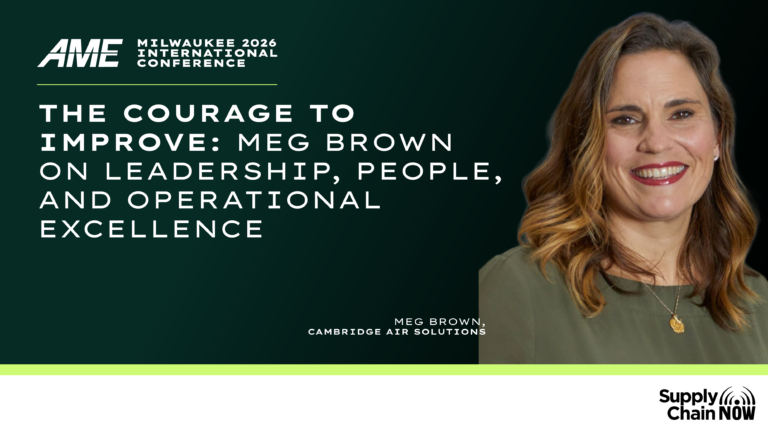
The Courage to Improve: Meg Brown on Leadership, People, and Operational Excellence
Caring about people includes caring about the work we ask them to do. For Meg Brown, Chief Operating Officer at Cambridge Air Solutions, that means holding high expectations, confronting problems, and helping people discover what they are capable of achieving.
That belief was central to her conversation with Supply Chain Now Founder and CEO Scott Luton at the Association for Manufacturing Excellence (AME) International Conference 2026 in Milwaukee. Brown, who will chair the 2027 AME International Conference, joined Luton to discuss leadership, continuous improvement, organizational culture, and the courage required to create meaningful, lasting change.
An Unconventional Road to Operations Leadership
Brown’s professional journey began with a degree in Environmental Engineering from Northwestern University. While her education strengthened her analytical thinking and problem-solving skills, she discovered early in her career that she was equally drawn to the human side of business.
That interest led to 24 years in human resources across construction, technology, and manufacturing. Her journey eventually brought her to Cambridge Air Solutions, an organization whose purpose-driven culture and commitment to unconditional love and high expectations deeply resonated with her.
At Cambridge, those two values are inseparable. Caring about people means telling them the truth, challenging them to grow, and believing in their ability to accomplish more than they may believe possible.
As Brown became increasingly involved in operational improvement initiatives, she discovered a growing passion for improving processes, solving problems, and helping teams achieve better results. That combination of people leadership and operational improvement ultimately led her into the COO role.
Today, Brown brings a people-centered, purpose-driven approach to operations leadership, grounded in the belief that exceptional business results and developing people are not competing priorities. They reinforce one another.
Why Caring About People Means Improving Their Work
One of Brown’s strongest convictions is that loving your people leads to exceptional performance. And when that performance is achieved with people rather than done to them, the results are more meaningful and sustainable.
Cambridge Air Solutions’ five core values—unconditional love, high expectations, care, courage, and respect—provide the foundation for that philosophy.
Broken processes take a toll on people. They create frustration, unnecessary work, and days spent navigating problems that should have been solved long ago. Brown believes improving those processes is one of the most tangible ways leaders can demonstrate care and respect.
“Improving those processes is an act of respect for the people doing the work,” Brown explained.
But that doesn’t mean leaders should be the ones solving every problem.
Brown believes a leader’s greater responsibility is to create an environment where the people closest to the work are empowered and equipped to improve it themselves. That requires building trust, making problems visible, encouraging curiosity, and removing barriers that prevent people from taking action.
It also requires leaders to resist the temptation to jump in with answers.
The goal is not to build an organization that depends on a few great problem-solvers. It is to build an organization where everyone has the confidence, capability, and opportunity to improve their work.
Brown also sees tremendous value in bridging the traditional divide between human resources and operations. HR leaders become more effective when they understand customers, processes, and business performance. Operations leaders become stronger when they understand what motivates people and how to help them grow.
Sustainable excellence requires both.
Building an Operating System That Lasts
Brown emphasized that sustainable operational excellence requires more than adopting the right tools. Standard work, visual management, meaningful performance measures, and structured problem-solving are essential, but their value comes from how people use them every day.
At Cambridge, the organization is developing its Cambridge Operating System (COS) to establish consistent daily management and problem-solving practices across operations.
The aspiration is not simply to implement new processes or management routines. It is to build an environment where problems are surfaced rather than hidden, improvement becomes part of everyday work, and employees develop the skills and confidence to make things better.
Brown is also candid about the challenges.
“We’ve struggled to sustain momentum in our continuous improvement efforts at Cambridge many times over the years,” she shared.
That experience has reinforced an important lesson: launching improvement initiatives is often easier than sustaining them.
For Brown, the answer lies in the everyday behaviors of leaders and teams. Making problems visible. Following through. Creating time for improvement. Developing people rather than simply directing them.
Cambridge is still on that journey, and Brown sees the work of building a sustainable operating system as both an operational priority and a leadership responsibility.
Creating the Courage to Lead Differently
Brown’s leadership philosophy is rooted in a deeply personal purpose: to serve as a catalyst for others to be courageous and know they are loved. That purpose shapes how she approaches leadership, from difficult conversations and employee development to organizational change and continuous improvement.
“I want people to know they matter, their ideas matter, and they are capable of extraordinary things,” Brown explained.
She believes courage is essential to improvement because meaningful change requires people to question established practices, acknowledge mistakes, challenge assumptions, and try things that may not work the first time.
And that courage must begin with leaders.
Leaders set the tone for whether problems are welcomed or avoided, whether mistakes become opportunities to learn or reasons for blame, and whether people feel confident speaking up.
Brown strives to lead with curiosity, listen before judging, and recognize when her own assumptions or desire to have the answer might be getting in the way.
Creating a culture of continuous improvement means making room for others to step forward, contribute, and grow.
The Power of the AME Community
Brown’s involvement with AME reflects many of those same beliefs. Initially drawn to the organization’s commitment to continuous improvement and people-centered leadership, she found something even more valuable: a community of practitioners willing to openly share their successes, struggles, and lessons learned.
Serving as Tours Chair for the 2025 AME International Conference in St. Louis was especially meaningful. The experience brought together volunteers and organizations committed to helping others learn, improve, and build relationships.
At the 2026 conference in Milwaukee, Brown was inspired by the opportunity to learn from practitioners at organizations including Ultradent and Nucor.
One of her proudest moments, however, was much closer to home.
Watching Cambridge teammates Becca Jenkins and Bruce Kisslinger Jr. take the stage to share their experiences was a powerful reminder of what happens when people have the courage to step forward and help others learn.
For Brown, seeing others grow, contribute, and recognize their own potential is among the most rewarding parts of leadership.
Charlotte 2027: The Courage to Improve
Brown is now preparing to chair the 2027 AME International Conference in Charlotte, North Carolina. The conference theme, The Courage to Improve, is supported by the message Elevating people. Improving work. For Brown, the theme captures something fundamental about operational excellence: improvement requires courage.
The courage to challenge the way things have always been done. To acknowledge what isn’t working. To experiment, learn from failure, and try again. And perhaps most importantly, the courage to lead differently.
Her aspirations for Charlotte go well beyond delivering exceptional educational programming.
She wants attendees to experience a conference where they feel welcomed, included, inspired, and connected. A place where relationships form, practical ideas are exchanged, and people leave energized to make meaningful changes in their organizations.
And she wants it to be fun.
Brown believes learning and improvement should be energizing experiences. She hopes Charlotte will be filled with opportunities to connect, celebrate, laugh, and enjoy being part of a community that shares a passion for making things better.
At a time when technology is advancing rapidly and organizations face increasing competitive pressures, Brown believes developing people and strengthening their ability to solve problems has never been more important. Ultimately, she hopes attendees leave Charlotte not just with new ideas, but with the courage and confidence to put them into practice.
Because the true measure of a successful conference isn’t what happens during the event. It’s what people do differently when they return home.
A Leadership Lesson Worth Remembering
As their conversation concluded, Luton asked Brown to share one piece of advice for leaders seeking to improve themselves and build truly excellent operations. Her response was simple, but challenging.
“It isn’t about you, and it starts with you.”
For Brown, leadership begins with recognizing that the goal is not personal success, recognition, or having all the answers. It is about helping others succeed and creating an environment where people and organizations can thrive.
But doing that requires leaders to look inward first.
To recognize their own assumptions, fears, habits, and ego. To ask where they may be unintentionally standing in the way of progress. And to have the courage to change their own behavior before expecting others to change theirs.
The work of leadership may not be about you, but the responsibility to lead differently starts with you.
Where to Learn More
Connect with Meg Brown on LinkedIn and learn more about Cambridge Air Solutions via the company website: https://www.cambridgeair.com. For more information about the 2027 AME International Conference in Charlotte, North Carolina, visit the Association for Manufacturing Excellence: https://www.ame.org .
More Blogs
What a Buyer Wants, What a Buyer Needs