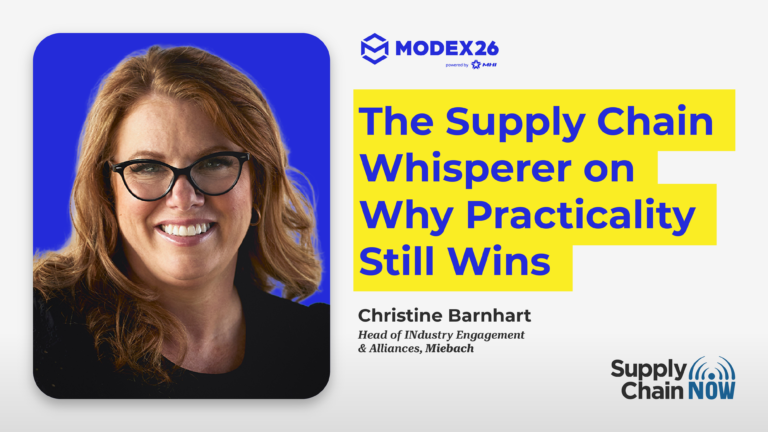
The Supply Chain Whisperer on Why Practicality Still Wins
At MODEX 2026 in Atlanta, Scott Luton sat down with Christine Barnhart, Head of Industry Engagement & Alliances at Miebach. She is known by many across industry as “The Supply Chain Whisperer.”
Their conversation covered everything from AI and supply chain maturity to workforce evolution and the importance of practical execution. Through it all, Barnhart offered a grounded perspective shaped by years of operational leadership and transformation work.
And if there’s one central takeaway from the discussion, it’s this: the companies that succeed won’t be the ones chasing hype. But they WILL be the ones building resilient, executable supply chains.
There Is No “Normal” Anymore
Supply chain leaders have spent years navigating disruption, but Barnhart believes the industry has finally reached an important realization.
“People have finally come to this conclusion that there is no such thing as normal anymore,” she explains.
That mindset shift is changing how organizations think about planning, investment, and agility. Network design exercises that once happened every three to five years are now being revisited continuously. Companies are investing in tools that shorten decision cycles and improve responsiveness in near real time. The old approach that focused on “design once, optimize later” – – that is no longer enough. Especially when, for years, much of supply chain design was casually created on the back of a napkin.
AI Won’t Fix Bad Foundations
While AI dominates industry conversations, Barnhart offers an important reality check: technology alone cannot compensate for weak processes or poor data quality.
“AI now has really highlighted that bad data just drives you to bad decisions and bad outcomes faster,” she says.
That observation cuts through much of the noise surrounding AI adoption. Organizations rushing into implementation without addressing foundational issues may simply accelerate inefficiency rather than solve it. For Barnhart, maturity matters. Supply chains need strong data governance, modernized processes, and operational clarity before advanced technologies can deliver meaningful value.
Practicality Over PowerPoint
One of the most compelling parts of the conversation centers on Miebach’s operating philosophy. Barnhart describes the company as deeply rooted in execution and engineering. Rather than focusing on flashy presentations or trendy buzzwords, the emphasis is on building solutions that actually work in the real world.
“You can have beautiful [presentation] decks with wonderfully amazing strategies… but if it doesn’t actually operate in the real world, what are we doing?” she asks.
It’s a refreshingly direct perspective in an era where organizations are often overwhelmed by “eye candy” technology and overpromised capabilities. Barnhart’s operational background, including experience in maintenance engineering and large-scale supply chain leadership, shapes that pragmatic approach. As she puts it, many on the Miebach team carry “scars” from real-world operations, and those experiences influence how they advise customers today.
Why Partnerships Matter More Than Ever
Modern supply chains are too complex for any one organization to master alone. Barnhart emphasizes the importance of strategic ecosystems, both within consulting teams and across technology partnerships. Miebach’s global structure allows the company to tap expertise from around the world depending on the customer’s needs.
At the same time, Barnhart stresses the importance of independence.
“We are always vendor agnostic,” she explains.
That objectivity is critical in helping organizations navigate an increasingly crowded technology landscape without being driven by incentives or hype.
The “Now Generation” Is Changing the Workplace
One of the most engaging parts of the conversation focused on the emerging workforce. Scott has long referred to this segment of the population as the Now Generation, rather than the traditional “Next Generation”, because they are often times already making an impact.
Barnhart describes younger professionals as “digital natives” who are deeply comfortable with technology and eager to challenge outdated ways of working. She also sees a generation that is more intentional about balance, collaboration, and purpose in the workplace.
“They want to work and they want to embrace their professional careers, but they clearly understand that at the end of the day, they want to go home,” she says.
Rather than criticizing these differences, Barnhart believes organizations should learn from them. At the same time, she notes an opportunity for mentorship around relationship-building, networking, and interpersonal communication – – which are all skills that may not have developed naturally in increasingly digital environments.
AI Will Change Work More Than Eliminate It
Barnhart also pushes back against some of the more extreme narratives surrounding AI and job displacement.
“The technology is there today. The people are not,” she explains.
Organizations and employees need time to adapt, and while AI will absolutely reshape workflows, the fundamental mission of supply chain remains unchanged.
“At the end of the day, our job is still to take things from mines and fields and oceans and convert them into a product that somebody needs,” Barnhart says.
The tools may evolve, but the purpose stays the same.
Final Takeaway: Build for Reality, Not Hype
Throughout the conversation, Barnhart consistently returns to one core principle: practicality matters. Whether discussing AI, automation, talent, or transformation, her message is clear:
- Build strong foundations
- Focus on execution
- Embrace change thoughtfully
- And stay grounded in operational reality
At MODEX 2026, amid all the excitement around robotics and emerging technology, Christine Barnhart reminds supply chain leaders of something timeless: the best strategies are the ones that actually work.
Where to Learn More
Connect with Christine Barnhart on LinkedIn. To learn more about how Miebach Consulting is helping organizations unleash their supply chain potential: https://miebach.com/br/en
More Blogs
Collaboration That Actually Pays Off