Scott Luton (00:02):
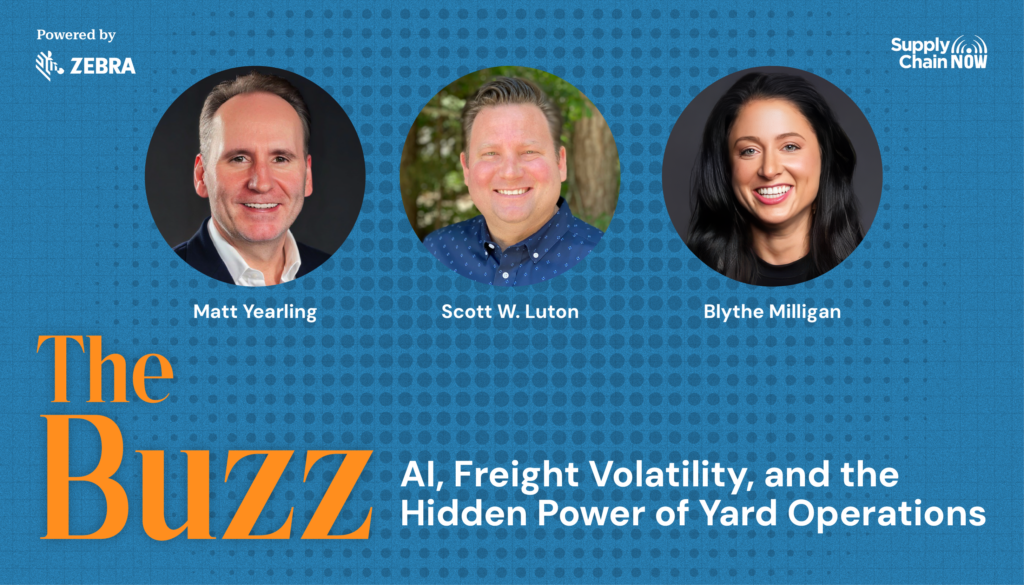
Welcome to Supply Chain Now, the number one voice of supply chain. Join us as we share critical news, key insights, and real supply chain leadership from across the globe, one conversation at a time. Hey, good morning, good afternoon, good evening, wherever you may be. Scott Luden and special guest host, The Blyth Milligan here with you on Supply Chain Now. Welcome to today’s livestream. Blyath, how you doing today?
Blythe Milligan (00:25):
I’m doing fantastic. It’s a beautiful day in Florida. Heat index is about a hundred degrees today, so feel for all the people who are working outside and hopefully you’re near some water
Scott Luton (00:35):
If you
Blythe Milligan (00:36):
Have to be outside.
Scott Luton (00:37):
Amen. Only a hundred though. I was expecting 137 from Florida. We had a
Blythe Milligan (00:40):
Little cold front come through this weekend. Oh,
Scott Luton (00:43):
It’s great to have you here today, folks. On today’s show, it’s a buzz where every Monday at 12 Eastern time we discuss a variety of news and developments from across global supply chain and business. News that matters is what we like to call it. Now, the buzz is powered by our friends at ZebraTechnologies all month long here in July. Zebra is the world’s foundation for intelligent operations with hardware, software, automation solutions, and services that empower your frontline. Learn more at zebra.com. Now, Blath, it is so good to have you here today. We got a lot of good stuff to get into. So let’s see the freight market, including diesel prices, cover your eyes folks. The Chinese economy, Owing’s continued turnaround, the path ahead for AI and supply chain, and much, much more. And if better yet, in about 15 minutes or so, we’re bringing in a special guest, Matt Yearling with YMX Logistics.
(01:34):
You’re going to love his take on things and his sense of humor. Blyth, you got the next three hours blocked out?
Blythe Milligan (01:39):
I do. Actually, my entire schedule was blocked out for today, so thank you for having me.
Scott Luton (01:44):
It is terrific to have you here. Again, admire what you’re doing from everything logistics standpoint and cargo recs and much, much more. So it’s great to have you here and learning from you here today. So folks, buckle up for a big edition of the buzz powered by Zebra Technologies right here on Supply Chain Now today. All right. Hey, look here to John Wayne Global Supply Chain. Jake Barr says it’s a great day to be a supply chain professional. Challenges everywhere you look. Also, great to se the superwoman of logistics Blythe Milligan on today’s show, Blythe. That is some serious praise there, huh?
Blythe Milligan (02:15):
That is very nice praise. I actually met him at a manifest earlier this year, and so it was nice to… We were kind of recording right next to each other so I was able to have a quick conversation with him. So it’s great to have him join the show too.
Scott Luton (02:29):
Jake, great to see you, my friend. And Catherine Hence back with us. Hey, Catherine. Happy Monday, everybody. Catherine is tuned in from the Big B, City of Birmingham. Great to see you, Catherine. Appreciate all that you do. Alan Jacques, tuned in from the beautiful country of Canada. Great to see you, Alan. Looking forward to y’all’s take here today. And in case you missed it, big thanks to Joshua and Amanda, making it easy for folks to find all the things we talk about here today. You won’t click away there from learning more about Zebra. Okay. Blast, we got to get to work. We got three things to knock out before Matt Yearling with YMX Logistics joins us. So let’s start with this. Over the weekend we published, I’m not sure if anyone’s tuned in this weekend because we had the Open and we had the World Cup.
(03:16):
So I’m not sure how many folks read this here today, but we did publish our latest edition. With that said, tons of stuff here. I want to highlight three things in particular, Blythe. We led off with kind of four distinct stories that had a common thread though. Get this, Chinese automakers are finding a ripe market in the United Kingdom. CNBC reports that in 2015, 384 Chinese vehicles were sold in the UK. In 2020, that figure rose to over 25,000. And last year it was over 285,000 vehicles were imported into the UK. We also mentioned the big transformation project that General Mills is launching. They’re targeting $3 billion in cost savings over the next four years and they’re redesigning their supply chain network to better support higher modern volumes. And then lastly, we shared something, Blythe, most of us already know. China dominates the rare earth market.
(04:09):
I know, I know breaking news. I know it’s not, but get this, just to put numbers on it, they’ve cornered a 68.6% share of global production of rare earths and over 85% of global refining capacity of rare earths. Look at the other countries that round out the top, let’s see, two, four, six, seven. Any surprises there? Blath, really quick. Any surprises on those top seven countries?
Blythe Milligan (04:32):
I would definitely say Myanmar being up there that high. I haven’t even heard them in my own news digest of being anywhere in sort of the top 10. So that’s really surprising to me. I mean, everybody knows that China has the greatest impact when it comes to the refining capabilities, but for Myanmar to be up there too, that’s really surprising. I wonder maybe what’s the root cause to that?
Scott Luton (04:54):
We’re going to dive in. We’re going to dive in. And folks, in case you’re listening, she’s pointing out that Myanmar comes in third at over almost 11% of global production of rare earths. So check that out. Of course, they’re critical to electronics, national defense components, automotive, you name it, and much, much more. And we’re really curious in light of everything in geopolitical that’s taking place, how this develops from here. So folks, check it out. We also included one last thing, great live event coming up this Wednesday where me and Rick McDonald have a power pack panel. We’re talking about the future supply chains. Come join us. So Blythe, that’s a lot there. And there was more with that said, and I know you had a busy weekend, but did you get a chance to dive into anything else? Anything else stood out?
Blythe Milligan (05:39):
So I really liked the aspect or the focus on BYD because I’ve been to, I was at Logistics World, which is in Mexico City
Scott Luton (05:47):
Earlier
Blythe Milligan (05:47):
This year. And if you take an Uber or Uber adjacent anywhere in the Mexico City area, you are probably going to be in a BYD car. And so as an American, it was my first time being in one. It felt very tech advanced. I’ve also spent some time recently in the country of Sri Lanka and their BYD cars are everywhere there too. And so it was just really shocking to see this auto manufacturer that you never see in the States, but they’re everywhere in different countries. So I just wonder, is it a matter of time before these cars start seeing the American road infrastructure? And I’m not sure if the American government’s going to let that happen, but they certainly are dominating in a few other places in the world.
Scott Luton (06:35):
Blyth, that’s such a great observation and brings two thoughts to my mind. Number one, you have been traveling everywhere around the world. I’m so jealous this year. And number two, everything is indeed logistics. Everything is logistics. Automotive conveyance or other forms. All right, really quick. Hey, Corinne Bursa, her matra. I love Corinne’s mantra. It’s a great time to be in supply chain and she’s looking forward to today’s updates. Corinne, we’ve got a jam packed show and I can’t wait to have you back on supply chain now soon. Corinne always brings the heat. Okay. All right. Number two is, hey folks, we like good resources, right? Good, reliable, data-driven resources. And if you want to better understand the domestic freight market, I want to point out the US Bank Freight Payment Index in particular, the rates edition released a few weeks ago. And one of the key takeaways for second quarter 2026 in terms of freight market, lower volumes, but higher costs.
(07:30):
Very interesting. All right, get your own free copy. We’re dropping a link in the chat. And folks, we’ve got a freight guru with us here today, and I know we’d be here for a couple hours, getting to the bottom of what’s going on. But I’m intrigued, Blythe, on a couple of your observations when you’re observing the freight market right now. What stands out?
Blythe Milligan (07:51):
I think it’s just that sort of never-ending battle of brokers versus carriers and the collaboration needed for both of those sides to come together and be able to work more efficiently in a fair environment when push comes to shove and margins have been tight for years. And now, especially on the carrier side of things, they’ve been desperately wanting to see some increases in rates and they’re starting to see that, but then the wrench that’s thrown into everything is diesel and fuel. And it’s one of those things where carriers were looking for a little bit of a break and they started to get it with some of the rules, especially around English proficiency that’s kind of challenged the market, but it was creating challenging circumstances within the market itself. And you thought that carriers would start to see some of these increases in pay, but the fuel is just wrecking them now because of geopolitical tensions.
(08:46):
And so I think we’re still looking for the light at the end of the tunnel when it comes to the broker versus carrier relationship. And I just don’t see that relationship smoothing over anytime soon.
Scott Luton (08:58):
Blythe, we got to get on our friction diet and we got to find ways to get friction out of the day-to-day. Really good stuff there. And it really deserves, it’s not a fair question because it deserves a couple hours to talk about it, but I really appreciate the great work you’re doing challenging those logistics and freight thinkers out there. Folks, also going back to the resource, we dropped the link right there. Go check it out. US Bank Freight Payment Index, you can sign up for the regular one and it’s free. Can’t beat that. You’re talking about the relationships there really quick, Blythe, and your observations. Jake Barr, who we were talking about a second ago, he joined me for a show a few weeks back and he made an interesting observation that I think makes a lot of sense when you stop thinking about it.
(09:36):
He said, everybody is an elephant or a goldfish, one or the other. Either you have a long memory or you have a very short memory. And then the world of freight, long and short memories I think are vibrantly at play. Would you agree?
Blythe Milligan (09:49):
Yes, 100%. And I actually heard that episode. I was listening to it right before we started recording. And I think you guys had asked each other, “Are you the elephant or the goldfish?” And I shouted out while I was getting ready outside. I’m absolutely the elephant. I have a long memory of any kind of just minor slight against me, almost like an athlete that they use, “Oh, this person didn’t draft me at this spot. We’re going to hold that vengeance and revenge for years.” I definitely think I’m on the elephant side of that.
Scott Luton (10:23):
Well, there’s blessings of both. And Michael Jordan was certainly an elephant and he was the greatest all time in my book. So anyway, we’ll keep that debate going, but that was a great call out. And Jake and Corinne and Katherine are all great to see y’all here today. All right, one last thing before bringing our incredible guests. I’ve mentioned this, and I guess today’s going to be just a day of unfair questions because Blythe, you’ve been doing great work for years really with everything is logistics. And folks go find, and if this isn’t on your radar for the three people out there, go find it, add it to your playlist. It’s everywhere you get your podcast. Let me get that in. So the unfair question, what’s been one of your favorite moments from an episode or favorite conversations? You name it, Blythe.
Blythe Milligan (11:01):
I think we’re going to get into a little bit more of the AI discussion later on, but I recently did a series on CargoRex where I interviewed eight leaders at eight different companies and asked them the actual use cases of where AI is making an impact in supply chain and logistics. And the short story of it is that it’s in the boring incremental improvements, getting better 1% every single day. I think for a lot of us, we have been expecting for a couple of years for AI to take all of the jobs and replace our work and we can spend more time, have more free time doing the things that we love. That just hasn’t really been the case. What we’re seeing as far as successes, especially when AI is being implemented, is that we’re seeing a lot of companies don’t have the data structure that they need.
(11:47):
They’re using this time to optimize their processes and clean up that data. And then just finding those easy, not easy, but boring wins and help their staff and their customers get a little bit better each day. And so I think that’s where the biggest takeaway for me was the humanoids are already here. We’re already the best players within logistics and supply chain right now are using AI as a superpower. And so that’s why that’s sort of my favorite episode right now is the humanoids are already here using these powerful tools.
Scott Luton (12:21):
I like it. I like it. It’s kind of like your comments they remind me of the old GE model. Just give me a couple points each year. We could have a whole discussion on where we got to be, if that’s still relevant or not. But we’ll save that for another time. Folks, go run and get Everything’s Logistics to your playlist. You can also find a lot of great information over at her URL, everythingislogistics.com. Okay, lath, good stuff, good stuff. And again, it’s like picking your favorite kid when you ask about your favorite episode. It’s just not fair. A lot of good stuff. All right, speaking of good stuff, we have an excellent guest here today, excellent host, excellent guest. We are being joined by Matt Yearling, a seasoned executive with over 30 years of experience in enterprise software and supply chain solutions. As CEO of YMX Logistics, he leads a company’s mission to define a new standard for yard operations for enterprise shippers.
(13:14):
His career also includes senior leadership roles prior to his current role, at least Oracle, Ports America, Sage, several other big organizations. Matt was also a speaker at the 2026 ACT Conference. I bet you could find Black there because she’s been at all of them, all the events. Matt has also been recognized as a thought leader by many, many trade publications. Please join us in welcoming Matt Yearling, CEO with YMX Logistics. Hey, hey Matt, how you doing?
Matt Yearling (13:39):
I’m doing very good. Thank you for your kind words.
Scott Luton (13:42):
You bet. It’s so great to finally meet you. I don’t know if you know this or not, but I’m a member of your Atlanta-based fan club and I think Blythe is holding down the fort for the Florida Base Fan Club. Is that right?
Matt Yearling (13:51):
There you go.
Blythe Milligan (13:52):
Absolutely. I’m Northeast Florida to be exact.
Scott Luton (13:55):
Okay. Lots of chapters. Let’s see here. Jake says, “Hey, Matt Yearling and his team at YMX bring new meaning to the baseball term going yard exceptional partners.” That’s how I praise from Jake and Mary Kate and great seeing Mary Kate Love says, “Hey, I love Blythe’s perspective and approach to AI. Makes it seem less daunting.” I agree with you. Less daunting is good in today’s daunting world. But here, Blythe and Matt, I want to start with a funwarm-up question as we get into the news of the day and then we learn more about what YMX is doing and check this out. On today’s date, back in 1969, the United States of America met President Kennedy’s challenge and took a big leap forward for humanity, placing humans on the moon. It was a feat, of course, in and of itself, but along the way, the Apollo program inspired countless people and led to a variety of scientific discoveries and inventions.
(14:47):
And what a great timeless, iconic shot of all time there. So it begs the funwarm-up question, Matt, are you a fellow space nerd and are you intrigued by any component of space discovery over time or where we are now?
Matt Yearling (15:00):
Well, actually, I think what intrigues me the most is the Renaissance that we’re going through right now. So back in 69, I was one years old, so I don’t really have any memory of that. But what I do have memory of a space related is 1977, the first Star Wars film. That really opened up my interest in space travel and everything space then. I mean, the only other newsworthy item, which is relevant to where I live today, was Elvis dying in 77, but I recently got my vows renewed by Elvis and he’s still alive in my book.
Scott Luton (15:33):
I love that, Matt. I want to see pictures of that by the way. All right, so Blith, circling back to the Apollo program and then this special date back in 1969, are you a fellow space nerd? And what sticks out space discovery wise are you?
Blythe Milligan (15:46):
Well, it just so happens that I picked out my rocket coffee mug for today. This is completely serendipitous. So yes, I am a huge space nerd. I have covered space logistics for the last couple of years now. I was invited over to NASA to watch a NASA and SpaceX launch and it’s an incredible experience to go down to Cape Canaveral, the Space Coast, and be able to be in that environment and see all of these legends. And as much as I have thought of myself as a sports nerd for years, there are space nerds out there that know every rocket, that know every astronaut. They know the years and the dates and failed missions, successful missions. And I was just awestruck that people like this exist, but then also that there’s such a fandom around space and just the rejuvenation of just building out that infrastructure in space from a maintenance perspective, refueling, building a new space station, the quest to the moon, obviously the quest to Mars.
(16:51):
I absorb it all and I love it all.
Scott Luton (16:54):
I’m with you. And Matt, I am so jealous. She got an invitation from NASA. Matt, we got to be friends with Blythe and get our own invitations, huh?
Matt Yearling (17:01):
Well, so when SpaceX launches from California, I see it in the sky over Southern Nevada. It is spooky to see. It’s like anything you haven’t seen before. It’s really cool.
Blythe Milligan (17:14):
Well, to put it in perspective, they used to do three launches a year. Now they’re doing three to five launches a week. And pretty soon there’ll be three to five launches a day.
Scott Luton (17:24):
Hey, space supply chain, we’re going to bring you back and talk about that too Blythe. And by the way, Jake says Elvis is alive. Saw him yesterday. So we got to get that story. We got to get that story. I’m
Matt Yearling (17:34):
With him on that. Jake is correct. I’ve seen him multiple times a day.
Scott Luton (17:37):
Oh, man. All right. So let’s get into the B block here today on The Buzz powered by our friends at Zebra Technologies. And we’re going to cover three stories. I’m going to get y’all’s take on a couple stories that cherry-picked from everything going on. And I want to start with the diesel gasoline market. Folks, you might want to cover your ears, maybe your eyes. I don’t know. The Wall Street Journal reported just last week that the domestic supply of diesel gasoline is close to its lowest mark since the early 2000s. Prices are no better. Prices peaked in April at about 570 per gallon. And then we found some relief, right? Got that gasperly MOU and some calm calm down, which kidding aside, we all want calm down of tensions and military actions, but the national average of diesel, it’s roaring back. It rose to $5 and a penny last Thursday on average.
(18:28):
Check out, this is not a pretty chart. This is not a pretty chart diesel pricing going back to August 2025. The folks, most of us know that diesel touches everything from the hundred million gallons of diesel fuel that truckers use every day in the US to farmers that use diesel for their tractors and equipment. Forget this diesel futures. And Matt and Blythe, I am not an economist, so I had to make sure I knew what a diesel future was. So that is a financial contract that allows buyers and sellers to lock in prices for diesel delivery on a specific date in the future. Makes sense. Well, diesel futures are up 85% since the start of the year. And while last week we got a little good news that the inflation rate for June has cooled a bit, a lot of economists out there believe that that feel good moment may be short-lived.
(19:17):
We shall see. So Matt, you’reling a lot there. As it relates to the economy and diesel’s role or any other observations that you’re tracking, your thoughts?
Matt Yearling (19:27):
Three things. One is some of the large shippers have a hedge program, Dennis, to use the contracts to your comment just now. So that’s one. But there have been several of our customers caught flat-footed in terms of the whole uncertainty and disruption that we had with Iran earlier in the year. So organizations have been caught flatfooted on the cost.
(19:47):
You’re dealing with that. The last thing that I would make though is if you look at, just specific to my business, we focus on truck and executing, moving trailers around in yards inside the four fences. And the asset that we typically use predominantly is a diesel asset. Right now, historically in the past year or so, 25% of all new assets are EV. But what we are seeing this year is 40% EV, even without incentives. So it’s got to the point where it does pencil out to actually deploy EVs in the four fences because you’re only doing 10 to 15 miles a day. It’s a perfect application of EVs. So yeah.
Scott Luton (20:24):
Interesting. Interesting. A lot of stuff there, Matt, thank you. Blyth, your thoughts on what we’re seeing here.
Blythe Milligan (20:30):
I think it’s just going to be continuing tightening on margins. We’re hearing now is that with the increase in orders, especially on the e-commerce side of things, especially around back-to-school items, a lot of the retailers too are trying to get ahead their holiday orders, especially ahead of the tariff news. I think we have the tariff pause. It takes effect until early August, maybe August 1st. And so a lot of retailers are placing those orders now to avoid those potential fees that might start up again. And so I think there’s still a lot of uncertainty. There’s still really tight margins out there. And so throwing the wrench of tariffs back into the mix is not something that a lot of customers or shippers want to see.
Scott Luton (21:08):
Blythe, I’m with you. I’m with you. And I bet this is Andrew. I think Andrew’s reporting that in the UK it’s $10.31 per gallon of diesel on average. Wow, we think we got problems. Oh man. Andrew, if that’s you, I think it is. Great to have you here as always. All right, so let’s move on from US economic news to what’s going on with the economy in China. I don’t think we talk about that. At least not enough here on the buzz. So check this out folks. CNN reported last week that China missed on a key growth target in second quarter. 4.5% year-over-year growth was the expectation for the Chinese economy for second quarter 2026, but actual performance clocked in at 4.3%. Not a huge miss, but a miss. As a news outlet pointed out, it’s pretty rare for the Chinese government to admit bad economic news, but low domestic demand at home seems to have overwhelmed the robust export activity in China.
(22:01):
This dynamic is built as the two-track economy. Got the K economy, I guess. You got two-track economy. Learned all sorts of economic news here in 2026. Now, Chinese exports in second quarter increased 27% over the previous quarter, beating most projections thanks to semiconductors and computer parts. And while the conflict in the Persian Gulf is hardly good for anybody, CNA notes that the resulting oil crisis has boosted demand for the vibrant clean energy technology sector in China. Kind of what Matt was talking about earlier, batteries, EVs and the like, getting a big boost. In fact, in June at this all time mark, China surpassed one million cars exported for the first time in history. M. All right, so Matt, your thoughts on anything you heard there and what’s going on with the Chinese economy?
Matt Yearling (22:49):
I think obviously what’s going on in the Middle East is a factor and then also geopolitical relationship with United States as a consumer of imports from China. But I think they’re doing a good job of mitigating that with relationships elsewhere in the world. But as you point out, the whole infrastructure in China, I mean from a number of different perspectives, they are way more advanced than even United States on transportation, on trains, on infrastructure with electrification and distribution. And as you said, mostly EVs are getting bought from consumers. And even AI and robotics are making significant advances. And so it’s going to be interesting to see how this plays out in the coming years.
Scott Luton (23:31):
I’m with you, Matt. It is going to be fascinating, especially as the Chinese economy continues to evolve in the longer arc of history. Blyth, your thoughts here.
Blythe Milligan (23:42):
I’m always a litle hesitant to trust the numbers that come out of China because you’re not sure what’s verifiable and what’s historical and comparing those over the last 10 years or so. But the bigger winner I think in all of this, especially among tensions with the US and China is the relationship with Mexico growing as our number one trading partner. I think I just read this morning that the Laredo corridor is now the top corridor in the entire North America. And so being able to nearshore a lot of these goods, have manufacturing, not just moving to Mexico, but having some of those manufacturing plants move from Mexico into the United States, it’s something that we’re not going to see in the short term, but in the long term is going to be very good for the United States to be able to bring back manufacturing, but to bring it back in a way that makes sense for the modern era and automation and employing AI and not just building manufacturing that we knew of in the ’90s, but what does manufacturing 2.0 in the United States look like?
(24:44):
And I think that’s forcing a lot of companies, a lot of customers to rethink that process.
Scott Luton (24:50):
Matt, I’d say she nailed it. And I think one thing, and again, I’m a non-partial, we don’t talk politics here, but you touched on it. There’s such a powerful, unique relationship in North America in this trading zone. Very unique in all parts of the world. And we got to pull those levers and use it for the good of all.
Matt Yearling (25:08):
100%, just to emphasize what Blythe was saying. Typically, it was LA, Long Beach. That’s where the vast majority of import would come in for the shipping. But now Texas is going to be significant, even more significant than California as this plays out.
Scott Luton (25:23):
Interesting. I love that. And Laredo, I got to call my Aunt Edna down in Laredo and get the scoop down there, Blythe and Matt. And Jake makes a good point because we are overdue in upgrading our infrastructure. He says we must accelerate our infrastructure spending. It is the bedrock of the supply chain. That’s right, Jake. Completely agree. All right, let’s talk about Boeing. I love talking about some good news and I think we’ve been tracking this Boeing turnaround for a long time and I love celebrating good news. Let’s see here. And when we talk about the US economy, Boeing’s role and its impact on the economy, it cannot be overstated aviation and Boeing. So I’m hoping that we can reach a point where folks start saying again, “If it ain’t Boeing, I ain’t going. ” That was an old pilot adage from back in the day.
(26:07):
The latest news as reported by CNBC is that the Federal Aviation Administration, FAA, has officially decided to allow Boeing to aprove its own airworthiness certificates for both the 737 Max and the 787 Dreamliner. The FAA stripped this authority from Boeing some six or seven years ago. It doesn’t feel that long, but six or seven years ago after of course those terrible fatal crashes. So this is a big step forward. Now here’s a little side note, Matt and Blythe looked up earlier today. So while Boeing made up ground on orders in June versus Airbus, Airbus is winning the war in 2026. Boeing has 314 deliveries of aircraft for the year versus 351 for Airbus. But get this in terms of overall orders, Airbus is beating the pants off Boeing 886 to 445, just about close to doubling. But Matt, that shouldn’t take anything away from the good news that is for Boeing’s continued march forward.
(27:03):
Your thoughts, Matt.
Matt Yearling (27:04):
Well, I think what you’ve just articulated is the long tail of trust in the brand. So I also had the opinion of any time I wanted to fly, it was just be Boeing. And then when they had the trust associated with safety and cutting corners on some elements of introducing planes and that manifested in fatal accidents, I think that’s going to take a long time to repair.
Scott Luton (27:29):
It’s
Matt Yearling (27:29):
Going to take a long time to repair. So that’s what we’re seeing. There’s more trust and respect in the Airbus brand as it stands today. And hopefully that turns around, but that is the reality of where they were and where they need to go to now is they need to get back to the basics that they once were.
Scott Luton (27:43):
I’m with you. And Blythe, I don’t know about you. I wish Matt could articulate my points because he sounds so much more eloquent than I do. Matt, I don’t know if we can work out a deal like that, but I love your accent. Blythe, it is a matter of trust though. And that’s one thing certainly we’re tracking with this turnaround. Your thoughts?
Blythe Milligan (27:59):
Yeah. And just to add on to that note about the trust in Boeing, I remember when all of those unfortunate accidents happened that it really taught the US consumer on what type of plane that you’re flying on when you’re booking travel arrangements. And certain people would not book those 737s or any other Boeing aircraft if they saw them listed on the flight schedule. So they would intentionally go after Airbus or go after Airbus flights. And so when you think about that, I actually think that might be a good thing. Competition is always a good thing. Glas half full and it takes significant events in order for a company of that size, of that history to rework their supply chain, rework how their inspections are run and who is running them. And with Airbus kind of biting at their heels a little bit, I think that’s an opportunity for these legacy companies to streamline things and get better.
Scott Luton (28:59):
I’m with you. I am with you. And Andrew points out a good thing going back to the trust factor. He asked, is it a bit like marketing your own homework? Yes, it is. And it’s something that aviation companies earn the right to do, or really they enjoy the right to do after going through a variety of certifications. And imagine if the FAA came into your operations and say, you lose the credibility and the ability to say, “Hey, this aircraft right here coming off the assembly line is fit for flight.” I mean, this was a big, big, big move six, seven years ago back when that happened. But Matt, I love both of y’all’s comments. And Blyth, yes, competition’s a great thing. I look forward as Boeing continues to turn around to see what the competition between Airbus and Boeing will unlock for the rest of industry.
(29:45):
And Matt, of course, trust is the currency of global supply chain and of course also the currency between consumers and the brands they know and love and use. So we’ll see as we continue to make more progress there. The Boeing team makes more progress there. I want to share a resource So we’re about to dive into the Matt Yearling segment. I can’t wait to hear from him cool things he’s doing and hear Blav’s take on that. But first I’d like to share another resource. Folks, we love sharing resources around here. We also know, we all know that running a high throughput distribution center these days, well, that means that every single second counts, false jams, package recirculation, missed SLAs can cost you big time money. Our friends at Zebra Technologies change the game with powerfully simple machine vision powered by AI. What else? Zebra makes machine vision easier to access, simpler to deploy, and infinitely more scalable.
(30:38):
Whether it’s streamlining dock door operations or speeding up pack bench scanning or detecting conveyor jams, Zebra takes you from pilot to production with total confidence. Fix your toughest warehouse challenges today, not tomorrow, today. Zebra Technology’s vision made easy, powerfully simple, and always scalable. Matt, we got a lot of stuff to dive into with you. I want to start though with this. So the only event that Blythe missed this year, I think, is Modex. She is everywhere else, I’m telling you, and she’s got reports and summaries coming from them. But you and I both were at Modex. You had a team, and I think you spoke at Modex, if I’m not mistaken. I spoke to a couple of your colleagues. You’re everywhere. And I hear big things about an event you hosted. David Schillingford almost risked making his flight to make sure he hit the YMX event.
(31:25):
What were some of your favorite key takeaways from this massive event? I think drew about 50,000 people. Matt?
Matt Yearling (31:30):
Yeah, no, I think it gets bigger and bigger every year. I’m not sure what it was like for you, but typically I have the opportunity to go around and look at everything. I didn’t because there were just so many things going on.
Scott Luton (31:42):
Right.
Matt Yearling (31:43):
Yeah, so it was a wonderful event. A lot of engaged new and existing customers. So a couple other things we actually had a physical yard truck there this time. One of the things that I spent a lot of time talking about is technology, but technology is kind of the mechanism, the driving value and understanding how to lean into big companies and just say, “Hey, how about we look at things very differently?” And then we align operations, we align the physical infrastructure with drivers and trucks. So it actually was helpful to have one of our favorite trucks, our RNGV asset there in the booth. And so it was a real tangible conversation to have with everybody in the show. And then finally that event that you were referring to with David is we had an opportunity to host a nice little session at the Georgia Aquarium and get behind the scenes look.
(32:31):
So I think my only takeaway is, okay, we think that whale shark is massive, but I feel like that’s like yard management in the sense of the bigger water tank. When you look down in the water tank, you think, well, actually that shark is actually pretty small.
(32:48):
The tank is massive.
Scott Luton (32:49):
It is.
Matt Yearling (32:50):
And so it was amazing getting a different perspective of that aquarium and not just looking through that glass that everybody else looks throuh. So yeah, if you get the opportunity, make sure you do it. So maybe next time, Scott.
Scott Luton (33:02):
I’m with you. Well, and maybe next time I’ll tell you what folks, I’m feeling left out. I’m not getting invites from NASA. I’m not getting invites to Matt’s event. Man, I must be living my life wrong. But kidding aside, Blyth, when you hear some of those key takeaways there, what comes to mind? And whether it’s Modex or just what you’re seeing out in the industry, what’d you hear there from Matt?
Blythe Milligan (33:20):
I immediately was thinking, I wonder how quickly his schedule fills up before an event like Modex. Because I always think of Manifest and it’s about five, six, or no, they had about close to 8,000 people last year, but Modex has what, 60,000 people? I can’t imagine the people logistics that you have to maneuver for your schedule in order to, I guess, optimize your time as much as possible in an event that size.
Scott Luton (33:45):
Massive. And by the way, while we’re on the topic, kudos to the Manifest team. They opened up a European component of the event this year. That’s awesome. And it is record numbers in Vegas for the original event. And kudos to the MHI team because between Modex and ProMat, the man, they put on a first class, both the organizations put on a first class. So
Matt Yearling (34:07):
Not to interrupt, Scott.
Scott Luton (34:08):
No, please. You
Matt Yearling (34:08):
Know that Modex has opened up a Modex West in Vegas.
Scott Luton (34:11):
I heard this. Yeah. I’m not sure where this is going to fit in, Blythe and Matt, but hey, clearly the demand must be there, right? Yeah. So we’ll see. Sure. All right. So Matt, as we start to dial it in more on you and YMX, I want to talk about your journey for a minute because a lot of your career has lived at that intersection of technology and operations. So I want to pick your brain. And what’s one of the biggest lessons you’ve learned about turning digital investments, and there’s so many different forms of those, but turning those into measurable business outcomes?
Matt Yearling (34:41):
When I look back 10 years ago, I really had the thesis of what I wanted to do with a logistics company, primarily because I’ve spent my life being an arms dealer of technology for enterprises and looking at how it’s deployed and really seeing that it didn’t drive the value that was articulated as part of the sales process. So today I see more than 50% of technology implementations not delivering what was sold in the first place. And then what I also see is I just see general technology fatigue. So like the operational excellence or the technology people looking for the next widget for a problem that they cannot articulate. And so going back 10 years ago, I’m thinking, how do we change this outcome? Is it really that widget that’s going to drive value or is it looking at this in a different way that’s going to drive value?
(35:29):
And look, my team has hundreds of years of experience in a very specific area of the supply chain inside the four fences, outside the four walls. And there was nobody, and this has been a focus for 20 plus years for me, nobody could understand what the ramifications of what the yard meant for transportation and warehousing, how to size it, how to optimize it, what was the flow like? And so to really come back and say, okay, so what would it take to look at this differently? Have everything from an operations perspective? As I say, the drivers and the assets and the technology to be a more AI native, best of breed logistics company just solely focused on yard operations. So we can bring the know – how and then we can assess because we’ve all been in different industries. So we know what the yard means for a retail versus manufacturer.
(36:24):
So we’ve been in all these industries and what would be the appropriate use of technology, but really what is it you’re trying to solve for your operations? And so that’s really been the guiding light for us. And what we do find is what was initially articulated as a problem upfront is not actually where the value is that we create as part of the engagement with the customer after six months and beyond. It’s more value elsewhere where they didn’t even think that there was value to be created, but that’s really where you optimize that mismatch between transportation warehousing and all of a sudden we start solving other problems.
Scott Luton (36:57):
And the blind spot, all of us have a really big blind spot. And I love hearing anecdotes and opportunities where we don’t even know the value we can unlock that sits right there in the blind spot because of other things we’re doing. Blyth, Matt just shared a lot of his learnings both from earlier in the journey and where they are right now, that intersection of technology and operations. What’d you hear there, Blythe?
Blythe Milligan (37:23):
I think I go back to the example, and I’m not sure if you’re going to bring it up here in just a second, but Matt had shared a blog article available on their website
(37:32):
Talking about Netflix versus Blockbuster and what were some of those early signs of the consumer adapting and the needs that they wanted. And I’m curious if maybe Matt can help shed some light on this because I don’t know that a lot of businesses know where they need to optimize. The famous Henry Ford quote, “If I would’ve asked the people what they wanted, they would’ve said more horses instead of an automobile line.” And so I’m curious as to specifically when it comes to the yard, where are those opportunities that maybe the customers aren’t seeing that could kind of Netflixify their operations?
Scott Luton (38:11):
Let’s do this. I’m going to make a little audible here because I’m like you, Blythe, I’m ready to get into it. I’m going to skip over. I had a crystal ball question I was going to ask both of y’all, but for the sake of time, I’m going to skip over. We’ll come back to that if we have time. But I want a two-part question here. We’re going to bring up the blog in a second. But first, Matt, we were talking pre-show, you and me, Blythe, that yard management is a bit of a, not enough folks are talking about it. It’s not on enough folks’ radar. What should more business leaders know about yard management to start with, Matt?
Matt Yearling (38:36):
Okay. Well, I can answer this a number of different ways. I’ve really just focused on the nodes and network for all my life. So in marine terminals, there’s a couple of hundred port marine terminal operators. In the United States is probably somewhere between 13 and 1500 rail cramps, and there’s 10 to 20,000 manufacturing distribution that really has some level of requirement in this space. And so for sure, 100% it’s an area that is not well understood, underserved, lacks technology enablement, is still a blind spot. And people really don’t understand the value. 50% of the time they’re insourcing, 50% of the time they’re outsourcing. It represents probably, well, not probably, is way less than 5% versus transportation or less than 10% in terms of warehousing. And so yeah, that’s really the problem in the sense that nobody focuses on it. Nobody thinks it generates a problem or it’s an issue.
(39:28):
And typically, and going back to an old phrase from my perspective from a technology perspective is people throw hardware at the problem. To fix issues, let’s deploy more trucks and drivers as opposed to, well, let’s step back and see what we’re trying to accomplish. And really rather than focusing on optimizing that 5% spend, understand how that 5% spend impacts your transportation and warehousing cost. Because I can actually tell you that if you just focus on optimizing that spend more effectively, you’re going to untap and actually create more value in transportation warehousing that would actually end up paying for that service in the first place.
Scott Luton (40:07):
So Blath, I want to pick up on one thing you mentioned there because we’re all guilty of it and a lot of CEOs are guilty of it. It’s just throwing technology. A lot of folks are throwing AI at all the wrong problems these days. Some right.That was one of my favorite things he shared. What did he share that resonated with you here, Blythe?
Blythe Milligan (40:24):
I think it’s just the stepping back and taking a look at what could be done differently. And I think it’s the hardest and the easiest thing to say because especially to even take advantage of these tech advancements, it requires a hard look at the way you’ve been doing things and change very hard, especially over the last five, six years that we’ve all seen where it’s been a dramatic increase in the rate of change in a variety of aspects of our lives. Supply chain is no different. And it’s one of those things where I’m just, it’s how do you manage the change management aspect? And it’s so challenging and so difficult. And I’m wondering where the people aspect comes into play of helping folks adapt more technology or adopt more technology to the way that they work.
Matt Yearling (41:13):
Well, so can I just wedge into that a little bit? Please. Because it is interesting because the fundamental thesis is how do you operate the yard with the same level of sophistication that happens inside the four walls of facility? I can tell you in my past life I’ve created terminal operating systems in the marine terminal environment. I’ve created yard management systems for manufacturing distribution. And I was asked by the world’s largest shippers, you name it, big logos, I’m not going to say who it is, and the world’s largest landlords. And I say, Matt, how do we plan the yard? Because I have this very sophisticated model associated with how the throughput and the equipment and how we’re going to execute inside the four walls of facility, but we have no clue inside the four fences. And so that’s what we’re doing. We’re finally getting to the point where we know it’s that gap in between transportation and warehousing.
(42:05):
They both serve their masters and it’s like, how do you illuminate that in a very different way? And so we’re finally delivering on that for the customer.
Scott Luton (42:12):
The four fences versus the four walls. I like it, Matt. I like it. And I once worked for a CEO that had his own approach to solving his yard problems. He banned carriers from entering his yard. That was a very unique approach. Story comes at 11. All right, so Matt, and let’s do this. So Blythe let the cat out of the bag with this blog article because it was a good one. I love when folks business lessons in a history nerd setting. And I think a lot of folks can relate to the Netflix, the blockbuster story in and of itself, but the competition between the two. So tell us, Matt, what are you hoping folks glean from this great blog? We’re dropping a link in the comments.
Matt Yearling (42:55):
So there’s a number of elements associated with this. I’ll give you a couple ones in a minute, but really fundamentally, just going back to really the underlying thesis and what we’re doing and what we are focused on is describing and painting a picture of what the market should accept as a standard in terms of what the service is and what is the capabilities of best of breed yard operations. What does that look like? What is it we’re in the business of providing? What value that we can provide strategically? Who is consuming it? For example, sourcing versus the business. The business understanding what the value is, understanding what the pricing is associated with this, understanding the opportunities of continuous improvement. So we’re defining a whole new set of experiences and outcomes associated with the yard. So naturally in this story, we’re more like the Netflix than Blockbuster, primarily because some of the other factors, some of the traditional logistics providers, whether or not they’re carriers, 3PLs or pure play providers that are going to the customers, customers only see them once a year when they raise the rates.
(44:05):
Well, guess what? Blockbuster made a significant amount of money on late fees. That was a cash guy for them. So nobody likes surprises. And really from a customer perspective, it’s like the only time I see you is when you’re raising my rates. What have you done for me lately? That’s one thing. And then the other thing is just because you’ve been around for 30 years like Blockbuster doesn’t mean to say that you’re guaranteed longevity over the next 30 years. For us, we wake up every day understanding it’s day one. So we understand that the customer wants to understand, what have you done for me lately? That is really kind of what we’re focusing on. And then the other thing, coming back to trust, because trust is significant. What the customer wants to do is look you in the eye because it’s still a human-powered… We’ll talk about AI maybe in a minute, but it’s still a very much a human relationship.
(44:56):
They want to look in your eyes and say, “What are you going to do for me? ” So you articulate that and you deliver on that. And there’s a number of instances in this world where customers know they’ve been lied to, and you don’t need to lie. Just tell the truth and deliver on the expectations that you’ve set. And that’s it,
Scott Luton (45:12):
That’s it.
Matt Yearling (45:12):
Matt,
Scott Luton (45:13):
I like it. I want to share one of my favorite anecdotes from the Blockbuster Netflix battles that y’all may or may not have heard. But before I do that, Blythe, there’s so many points that Matt made that are going to stick with me. Of course, trust. That’s going to be a big theme of today’s edition of The Buzz. But what’d you hear there, Blythe?
Blythe Milligan (45:29):
Oh, the people element. I think that is something that has been the bedrock of a supply chain for the entirety of its existence. And even though we’re adopting new technology at a rapid scale, it still comes down to the people and the relationships that you build, the events that you go to, the connections that you make. I think a lot of the in – person events in particular in virtual settings like this just become even more important to be able to establish that relationship and build on it.
Scott Luton (45:59):
Well said. The people of this industry, if I’ve said it once a million times here, even in the golden age of supply chain tech, at least the latest golden age, it’s the people that make it happen every single day. And Blythe, your focus strikes me as on the people regularly. Back when you joined us, we were talking about the weather and your mind went straight to the folks that work outside every day all day. And that was a very real comment because it’s tough to work in the heat if you’ve ever done yard work or construction work, you name it. All right, so I’m going to do this, Matt and Blythe. I don’t know if y’all heard this little anecdote. So Netflix Blockbuster, one of my favorite anecdotes from back in the day that they were cutthroat competitors. Cutthroat, although Netflix wanted Blockbuster buy them.
(46:43):
But in 2005, Netflix was the upstart. It was taking some of Blockbuster’s market share company CEO Reed Hastings had just told a bunch of Wall Street analysts that Blockbuster’s throwing everything at them, everything but the kitchen sink. And then just a couple days later, a kitchen sink arrived at Netflix offices with a note that said, “Here’s your sink signed by Blockbuster.” I love that. I love that. There’s something about American corporate competition or just competition in general that I think that anecdote illustrates. So let me ask you, Matt, as we start to come down to home stretch, we’re going to make sure folks know how to connect with you and all the cool things that Blouth is up to. What’s one thing? I know you got 17, but one thing, Matt, that you’re most excited about what YMX Logistics is doing as we move into the second half of the year and continue to move deeper in the second half of the year rather.
Matt Yearling (47:32):
Yeah. So really the key thing for us is that intersection of technology and operations. So we’re powered by AI and just spent a number of points here emphasizing human in the loop. We use AI to really help the productivity of what we’re doing in the physical sense. And so we have an autonomous yard operating system. So we’ve got digital twins, computer vision, real-time location systems, autonomous trucks, electrification, and superior operational process really driving the outcomes for the customer. So that’s really our strategic focus is getting social proof around the outcomes that we’ve driven into customers thus far and we’ll continue to do about it. So yeah, we’re just focusing on illuminating the yard, predictable execution and outcomes. And going back to again, I love your perspective on humans. So we know we’re a human-powered organization. We know that in the desert where I live or in the Phoenix area, it’s hot.
(48:37):
So we’ve even put in two AC units in yard trucks.
Scott Luton (48:41):
Wow, okay.
Matt Yearling (48:43):
It’s important for safety and for the quality of life of our drivers is a paramount importance to us. So yes, humans are important to us and supply chain is definitely powered by humans. There’s no doubt about it.
Scott Luton (48:55):
Matt, I love that. You’re putting your money where your mouth is, and it’s all about that quality of life for our incredible human component. So love to hear that, Matt. And by the way, day one, every day is day one. I love that sentiment you shared earlier. All right, so let’s do this. I want to make sure folks know I connect with both of y’all, but first folks go check out our award-winning resource hub over at supplychainow.com. We just published our latest article, our manager’s cut, we call them, which is kind of TikTok versions of deep research paper. You’re going to love it. This one focuses on the sales you’re losing to an inventory record. Inventory’s cool again, folks. And of course, this is part of our ongoing collaboration with the Journal of Business Logistics. We’ll drop the link in the chat. So let’s make sure Matt Yearling, you and the YMX Logistics team, you’re on the move.
(49:46):
I love your passion for what you’re doing and the innovation and how you’re advancing. I don’t want to be mean. Folks don’t think of the yard enough. They don’t. They don’t. Yes. And I appreciate that spotlight and how you’re advancing the craft there. How can folks track you and YMX team down?
Matt Yearling (50:02):
Yes. So 100%, just go to our website, ymxlogistics.com, or email me at myearling@ymex.logistics.com.
Scott Luton (50:09):
Outstanding. It’s just that easy, just that easy. We have to have you back on. And Blythe, I’ll tell you, you knocked it out of the park. You and Matt were quite the one to punch. I’m a big fan. Hey, I’m Blythe Milligan, co-chapter president of the Atlanta Chapter Fan Club. Everything is logistics, CargoRex, which we didn’t touch on, which is a really cool thing, cool platform. How can folks track you down, Blythe?
Blythe Milligan (50:33):
They can find me on any of the social media platforms. The quickest way to get there is just by going to the Everything Is Logistics website. I have all my socials linked in the bottom of the site. We publish all of our new episodes there as well. And then of course, cargorex.io, where we’re building the Google search of logistics. And so lots of resources in both of those platforms. You can kind of pick your poison, whichever one you like.
Scott Luton (50:54):
Pick your poison.
Blythe Milligan (50:55):
The good
Scott Luton (50:55):
Kind of poison. Right. It won’t kill you. It’s not hemlock, folks. It’s not Mlock. And we’re dropping that. Everythingislogistics.com, and I bet we’ll also drop the YMX Logistics URL in just a second. We also included that last article I mentioned. Your one click away right there. Oh, there it is. There it is right here. Ymxlogistics.com. Go check out what Matt and his team are innovating today because every day is day one. Big thanks. Matt Yearling, CEO of YMX Logistics, Braving Heat out there in Vegas. Matt, thanks so much for being here.
Matt Yearling (51:29):
Thank you.
Scott Luton (51:29):
Really enjoyed his perspective. And hey, Blythe Milligan, great to have you here. Really enjoyed your perspective today on a variety of topics, some that we’re going to have to continue into your next appearance. So folks, make sure you connect, follow, check out the podcast, and check out Cargo Rex. We didn’t get a chance to talk about that really cool stuff. Thanks for being here, Blythe.
Blythe Milligan (51:49):
Thank you so much for having me. This was a blast.
Scott Luton (51:50):
It was. To our friends at Zebra Technologies, folks go check out, connect with what they’re doing. You can learn more at zebra.com. Of course, big thanks to Amanda and Joshua behind the scenes today. They had a rodeo. Well, we dropped a lot of things in there in chat, but folks, we try to do that to make it easier as we’re all getting a tidal wave of noise each and every day. So we try to make it easy with the links. Most importantly, all the people out there making global supply chain happen and a portion of those same folks that tune in here, thanks for what you do. Keep the feedback coming. Feedback is a blessing, but your challenge and you got lots of options. Optionalities are good things. Between what Matt and Blythe shared here today, take one thing they shared and do something with it, right?
(52:30):
Put it into practice, deeds, not words. That’s how we’re going to continue transforming this wonderful industry that we’re all part of. And on behalf of everyone here at Supply Chain Now, Scott Lewton challenging you to do good gift forward. Be the change that’s needed. We’ll see you next time right back here on Supply Chain Now. Thanks everybody.
(52:47):
Join the Supply Chain Now community for more supply chain perspectives, news, and innovation. Check out supplychainnow.com. Subscribe to Supply Chain Now on YouTube and follow and listen to Supply Chain Now wherever you get your podcasts.