Transcription
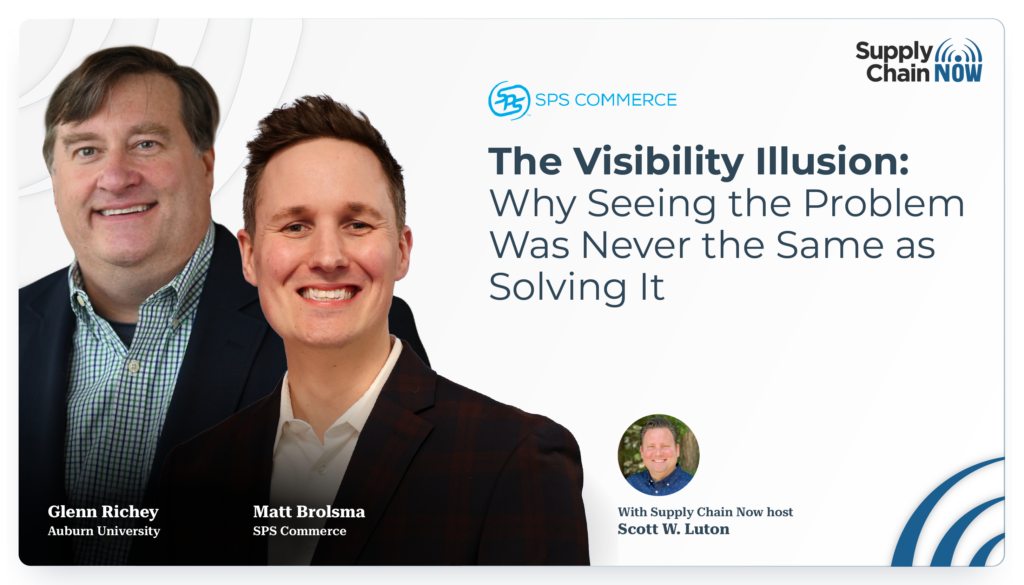
SUPPLY CHAIN NOW | SUPPLY CHAIN NOW | MATT BROLSMA & GLENN RICHEY
Episode Transcript
This has been generated by AI and optimized by a human.
[00:00:00] Matt Brolsma: $38 million was a striking number. And that’s actually the recovered lost retail. So the difference, the simple math there is what they ordered from what they received, right? So you think about it, if you’re ordering 500 units, your supplier short ships you or they can’t ship on time and then you’re out of stock, right?
[00:00:17] And so you think about those types of conversations that can build up right? And then buyers reacting, “Oh, this supplier always short ships, so I’m just gonna over-order,” right? It’s just like the tendencies that tend to happen in those dynamics, right?
[00:00:31] Intro Voice Over: Welcome to Supply Chain Now, the number one voice of supply chain.
[00:00:35] Join us as we share critical news, key insights, and real supply chain leadership from across the globe, one conversation at a time.
[00:00:43] Scott W Luton: Hey, good morning, good afternoon, good evening, wherever you may be. Scott Luton with you here on Supply Chain Now. Welcome to today’s show. Folks, for decades, supply chain leaders, you know, have been chasing greater and greater visibility.
[00:00:56] We’ve invested in all sorts of tools and tech and platforms, you name it. Yet in some ways, we’re still asking variations on a basic question that we all know and love: Where’s my stuff? Maybe the problem isn’t that we can’t see enough. Maybe it’s that seeing the problem was never the same as solving it.
[00:01:14] Today we’re diving into why supply chain visibility continues to fall short, why AI can actually magnify the consequences of bad or incomplete data, and why the real answer may start with something much more fundamental: stronger trading partner relationships, better data, and the ability to actually act on what we see.
[00:01:35] And get this, we’ve got some compelling numbers to unpack along the way, including one retailer that recovered more than $38 million in lost retail. Man, get ready for a fascinating conversation here today full of actionable takeaways. So I wanna bring in an incredible one-two punch, uh, two special guests for this episode here today.
[00:01:55] Uh, first, Dr. Glenn Richey is the Harbert Eminent Scholar in Supply Chain Management and research director in the Center for Supply Chain Innovation at Auburn University. Now, in addition to his formal education, Glenn has an executive certificate in international business from the University of South Carolina, my, my neck of the woods.
[00:02:16] Yeah. Uh, prior to entering academia, Richey worked for 10 years in managerial positions across several functional areas including, get this, well-versed procurement, sales, retail consulting, finishing, manufacturing, warehousing, and logistics supply chain operations for two big companies out there, Scott Paper Company and Genuine Parts Company’s S.P. Richards division.
[00:02:40] Now joining Glenn here today is Matthew Brolsma. Now at SPS Commerce, Matt’s, Matt leads go-to-market strategy for the company’s supply chain performance platform, where he helps to empower enterprise retailers, distributors, and grocers to achieve operational excellence through smarter supplier collaboration.
[00:02:59] Now, as you’ve seen here in the past, ’cause Matt joined us on the podcast, I think last year, he specializes in translating market complexity into simple strategic narratives that drive action across sales, customer success, and executive teams. As I mentioned, one-two punch here today. Let’s welcome in Glenn and Matt.
[00:03:18] Matt, welcome back. How you doing, my friend?
[00:03:21] Matt Brolsma: It’s great. Great to be back, Scott
[00:03:23] Scott W Luton: Well, we enjoyed a robust conversation last time, and, and you’re back again, and you bring titans in industry like Dr. Glenn Richey. Glenn, welcome back. How you doing, my friend?
[00:03:33] Glenn Richey: I’m doing great, Scott. Thanks for having us.
[00:03:36] Scott W Luton: Well, I learned so much from our past conversations with both of y’all.
[00:03:39] Glenn, it was good to see you in person in Dallas. And of course, as I mentioned, Matt came, uh, on a great podcast episode last year. But I wanna start with this before we get into supply chain stuff Both of y’all have something big in common, and I didn’t uncover it until I was getting ready for today’s conversation.
[00:03:53] You both are very ardent, if I use that word right, music lovers, very passionate music lovers. So Glenn, you could be here for, for hours, but what’s one aspect of your big love for music that you act on regularly?
[00:04:07] Glenn Richey: I mean, that’s a, that’s a great question. It’s, uh, um… You know, I, I think I had a, uh, a fascination back when I was in university that I might even go into that business, and, uh, so I was playing around a little bit with it.
[00:04:18] I was much better at selling the bands than I was singing. So, uh, so, so that really got me, uh, uh, moving more towards the, the booking side. But I, I mean, I like, uh, going to these different events and concerts have a lot to do with innovation, right? And, and these folks are up there, they have this amazing passion, and, and they just do things on the cuff that you can’t believe.
[00:04:41] And, and so it’s, uh, it’s a great opportunity to be around other people and really experience a, an uplifting environment. And, you know, if we can orchestrate some of that into the supply chain, a little more innovation, a little more passion, who knows where we take things?
[00:04:54] Scott W Luton: Glenn, it’s almost like you composed a song just in your response there.
[00:04:58] And we’re gonna have you and Matt back. We’ll talk about the supply chain of music. I, I love that your, you’re on, uh, some of your, uh, work has been on the business side of that. It’s fascinating. Uh, now Matt, we learned something about, uh, one of your hobbies last time around.
[00:05:12] Matt Brolsma: Yep.
[00:05:12] Scott W Luton: You love music as well.
[00:05:13] Tell us one place where you spend some of your time.
[00:05:16] Matt Brolsma: Uh, well hopefully, Scott, uh, last time I was the first and only DJ to have been showcased on your podcast. Hopefully that’s still the case. Uh, but like Glenn didn’t make the jump into music, I made the jump into music and did the whole late night DJ scene for a while.
[00:05:32] Um, but you know, like I like to say, like, you can take the DJ from the dad, but can’t take the DJ out of the dad. I had to, in my late- latest, uh, basement remodel, I had to incorporate my DJ equipment somehow. Yeah. All right. And, uh, so…
[00:05:48] Scott W Luton: Well, love it. And as far as I know, you’re still the only DJ that has ever been here on Supply Chain Now.
[00:05:54] So, hey, that’s something. We’re g- we’re gonna send you an award. It goes on your mantle. And better yet, we’ll have to l- we’ll have to get, uh, uh, all connect in person, maybe enjoy a concert out there. Yeah. Or some of y’all’s performances. Um, but we got so much to get to here today, Matt and Glenn. I’m great, uh, can’t wait to learn from you both.
[00:06:11] But folks out there that are listening or are watching us, before we get into our conversation, I wanna point one thing out, ’cause you’re gonna hear us reference a white paper a, a few times in today’s conversation, and the good news is you can go out and access it. It’s easy to download. It’s a really good one.
[00:06:25] It’s, uh, very agnostic, I think, and actionable. It’s called Seeing Isn’t Solving: Why 30 Years of Visibility Tools Never Fixed the Problem Underneath, and you can go download that for free at spscommerce.com Um, okay. So Glenn, uh, I want to dive into, uh, our conversation here today. I want to start with this word that we, we’ve been using and overusing for years now, of course, visibility.
[00:06:51] So when we say we want greater supply chain visibility, um, what do we really want, do you believe? And number two, how do we distinguish between visibility, transparency, and traceability? Your thoughts.
[00:07:04] Glenn Richey: Yeah. Great, great question. Um, this is an area we’ve been researching here at Auburn for quite some time.
[00:07:09] Tyler Morgan and I do, do work in the area. And, and, you know, when you think about, uh, these topics, these terms, really, uh, transparency becomes the big word, right? So transparency is kind of, you know, what are we gonna show? What are we gonna be- reveal? Or, or maybe from your standpoint, right, will the partners share enough information to help you do what you need to do to see what’s happening and act on it, respond to it?
[00:07:34] Um, and so you can break that down into visibility, which is kind of what’s going on, tell me what’s going on, show me the strategy around the things that are happening. That could be financial, it could be supply chain, it could be marketing, it could be a whole lot of different things, right? And then traceability, which is following the product and the information through the system.
[00:07:53] So we can say, where is it now? Where will it be next? And that type of thing. So traceability, of course, attaches to those advanced shipping notices and those types of things that have become so popular, um, in the industry. Uh, our research really has focused since COVID on responsiveness, right? And this idea of being transparent, understanding traceability and visibility in a way that lets you be more than just an economizer, right?
[00:08:20] To let you drive into making responsive decisions. And so visibility, transparency, traceability, all those things should lead you to being more responsive. But the bottom line is that you have to be actively into it, and the data that you’re seeing has to be good. Um, there’s a nice report out there that shows that…
[00:08:39] It’s a state of visibility report, I think it was 2024, something like that, that shows less than a quarter of the companies out there have 75% or more visibility into their shipments, right? So, uh, a good portion of their shipments are who knows where. Um, and so that’s, that’s something that we can fix.
[00:08:58] There are opportunities to do that, but, you know, we’ve got to be in the right position. And so kind of carrying through And visibility kind of leads us to traceability, the operational component. That hopefully allows us to build some knowledge, and that knowledge hopefully allows us to make adjustments that respond to what the customer needs, the market needs, uh, the area needs, right?
[00:09:18] So, uh, visibility kind of drives the train in this sentence, and data makes it real.
[00:09:24] Scott W Luton: Mm. Um, there’s somewhat, your response could be a podcast series, Glenn. And I, but I love, uh, kidding aside, I love your precision on these terms. You know, it’s like AI, right? We’re gonna talk about AI later. But, uh, my friend Lora Cecere always, whenever she gets a question on AI, she likes to turn it around and says, “What do you mean when you use the acronym AI?”
[00:09:46] And that’s so important so that we’re fundamentally, we’re, we’re aligned on what we’re talking about and what the definitions and what, uh, uh, between these terms that we’re using a million times a day. Yeah. So that’s a great start, Glenn.
[00:09:59] Voice Over: Yeah.
[00:09:59] Scott W Luton: So Matt, I’m curious, you know, all the companies you work with, the retailers, distributors, grocers, what does visibility mean to them?
[00:10:07] And is it still fundamentally, “Hey, where’s my stuff?” Or has the expectation gotten to be much bigger than that, Matt?
[00:10:14] Matt Brolsma: Uh, it’s funny. So I’d like to just, like, pull on what, uh, Glenn just said there on the responsiveness side, because I think I read a lot of, uh, industry thought leadership around, like, what’s the next evolution of visibility, and it’s all about taking action and doing it.
[00:10:30] Mm-hmm. And that’s seemingly where the focus is largely. But when you get into the actual day-to-day with our, with our, our customers, it’s really just this fundamental, like, yes, where’s my stuff, a- across what you would say from, like, the PO life cycle. So from the moment that order’s cut to, you know, getting the invoice processed, it’s trying to just figure out where is it at any given time.
[00:10:53] And there I’d say, like, largely it’s about r- like, uh, readiness at that point, right? So it’s, it’s about, uh, planners being able to confirm if they’re gonna get the inventory to meet their, uh, assortment goals, right? As part of the merchandising function. It’s within the DC if they can staff accordingly to be able to receive those, uh, those shipments and move them through, right?
[00:11:15] Um, so there’s, there’s a lot there, but I, I would say it’s probably one of the biggest thing too, is the real pain point that there’s no single source of truth here. Like, organizations largely are interacting with different execution systems, different tools to try to get at this, and that’s the large pain point that I hear from customers today.
[00:11:35] Scott W Luton: Mm. So I love one of the things on the front end of your response there. Uh, you know, it’s, it’s great to see stuff and s- and see deeper and see further, but action solutions, what to do as w- when we do see stuff, that’s what we’re searching for. And then the second thing, Glenn, I’m just so disappointed. You know, I’ve been looking for the fountain of youth, but I’ve also been looking for the single source of truth.
[00:11:57] And it’s like Bigfoot evidently. Uh, comment really quick on that, Glenn.
[00:12:02] Glenn Richey: The six… Finding the single source of truth. I mean, I, I, I, I… There’s so many directions we could go, uh, I, I think, on that. Um, and there are concerns about, you know, mentoring and that type of thing. We need more, more young people to be able to jump in there and get behind those, those overall issues.
[00:12:18] Um, I’m still chasing the single source of truth. Me too. It is, uh, it, it, it’s part of my job, I think. Um, but you know, it gets down to having good data going in, to be quite honest.
[00:12:28] Scott W Luton: Well, so Glenn, other things. I mean, we’ve been chasing after this visibility issue and more for decades, right? Yeah, yeah. Easily 30 years.
[00:12:35] You know, we’ve gone from EDI to ERP and WMS and TMS and vendor portals, control towers, blockchain, real-time transportation visibility. I could go on and on and on. Of course, here in the golden age of supply chain tech, tons and tons of, of artificial intelligence baked into all kinds of things Um, some of these things I mentioned have certainly been a lot more effective than others, but I gotta ask you, why does it feel like we’re still trying to solve visibility?
[00:13:04] And is it partially because we’re solving these individual pieces and really mis- fooling ourselves that it’s, it’s, it’s the whole picture? Your thoughts, Glenn?
[00:13:13] Glenn Richey: Yeah, that’s, that’s a, that’s a great comment. I, I mean, we’ve spent, like you say, 30 years kind of connecting systems, finding ways to connect systems.
[00:13:21] Matt and I spoke recently about EDI and how that doesn’t get people very excited sometimes, but it’s still super important to the work that we do in supply chain and, uh, and valuable and part of a big event that we do every year. So I mean, connecting systems is tough. Connecting companies is even more difficult, right?
[00:13:40] They have different systems. They have pieces that have been defined specifically for the systems. They have different incentives. Um, they have different willingness to share information, what they’re, what they’re happy to share. Um, and then in some cases, it’s kind of the shadow supply chain, where maybe we don’t 100% know, uh, who the individual is we’re connecting with.
[00:14:01] And I can give you an example. Um, there was a McKinsey study, probably 2025, the beginning of the year, um, and they talked to suppliers, and something like, um, 90% of buyers related to suppliers, uh, something like 60% of them actually knew their tier one supplier well. They had good visibility into that tier one supplier.
[00:14:23] Now, that’s a question for somebody that’s pretty close to you. Um, and then you start asking questions about the tier two suppliers and, and wow, who is that, right? And where are they in the world and, and what are they up to? And so we’ve written some recent stuff on reputational risk and that type of thing that kind of shows the difficulty of making those connections.
[00:14:42] So, so while the system connections are something we’re chasing, right? If the human being connection is still, still a very important issue, and, uh, and those connections are, are always difficult to manage. You can think about back to dating experiences and that type of thing. Some of those connect directly to kind of the way supply chains tie together and the way individuals communicate and connect.
[00:15:03] So I think that’s why we’re there. It’s the dynamics of, of that scenario, but now we have tools to do it at a higher level than we ever have. And so if we can get them in the right shape, in the right place, then we can do things that hopefully we’ve never been able to do before.
[00:15:17] Scott W Luton: I, I like that practical optimism.
[00:15:19] And hey, wasn’t Shadow Supply Chain one of the Bee Gees hits back in the day, Glenn? Does that sound familiar to you? Um, so- I hope
[00:15:26] Glenn Richey: not. I hope not.
[00:15:28] Scott W Luton: All right. So Matt, I, I wanna ask you, kidding aside, I, I’m gonna stick some musical ana- analogies in here since I know we have
[00:15:35] Glenn Richey: to keep it current. As you should.
[00:15:35] As you should. Yes. Yeah, yeah. That’s right. Yeah.
[00:15:37] Scott W Luton: Um, so how much of the problem is that we’ve historically built single company visibility, which Glenn’s kind of referencing some of those, those data factoids, when the supply chain itself, of course, is here, uh, inherently cross company? Your thoughts, Matt.
[00:15:51] Matt Brolsma: Yeah. Well, uh, again, I got to, I got to go back to Glenn because every time I meet with him, I feel like we could always go along talking about this. But he mentioned something really important, I think is the long tail, right? They’ve always got their strategic suppliers figured out for the long tail. If you’ve been in a DC and you see product sitting or pallets sitting by the wayside because they need to be audited, audited, it, it’s just one shipment that can disrupt it.
[00:16:16] I think back to the classic Visa commercial, right? Everyone’s paying credit card, and then the commercial slows down when someone whips out cash because it just holds everything up. That’s where my mind goes to. I mean, and same with traceability too. You c- you can’t not have the full thing addressed because you need to account for all your shipments products, right?
[00:16:34] Um, but I, I guess more directly back to your question, Glenn, I think There’s a couple of areas here on this one, I think. On the si- single company visibility, um, everyone I talk to has some level of, like, visibility tools, analytics reporting platform, right? They built a proprietary thing in Power BI, they have a control tower.
[00:16:54] Those naturally, innately just roll up the data in their four walls, right? So it’s only as good as the data that shows it. Um, the, the other element of that is when you look at some of these tools that are cross-company wide, uh, it’s typically an adoption problem, right? EDI, um, blockchain, you know, all like…
[00:17:15] The thing is, is like it’s, it getting to the critical mass that’s needed to drive this, that’s the challenge, right? And EDI has been around for however long, but we still have an adoption issue there, right? Um, the third camp that I would say is just niche, niche solutions, right? That maybe don’t address the entire PO lifecycle.
[00:17:32] A good example of that is transportation visibility solutions. They’re solid solutions, but they’re, they’re tracking the transportation, the freight, right? What’s on the truck and where it’s going, which doesn’t tell you everything else around that, right? Mm-hmm. So I think those are some of the challenges that y- you see when you look at why this hasn’t been fixed or why this is still a problem after 30 years.
[00:17:52] Scott W Luton: Mm. And, you know, last point there, uh, tracking the move is important, but we need a whole bunch more data, and that’s really one of the massive opportunities we have here in 2026. Um, and then one other thing to mention, you know, you mentioned the adoption problem, and we see, um… We talk about this all the time here at Supply Chain Now because it manifests itself in so many different ways, and this is where I wanna ask both of y’all kind of a follow-up question based on some of what you shared.
[00:18:19] So what happens, and Glenn, I’m gonna pose this to you first. What happens organizationally when people lose trust in the system? And I’m gonna tell on myself here a little bit, ’cause I’ll be… As my team knows, all my incredibly talented team, I can revert, and a lot of folks out there revert, spreadsheets, email, phone calls, you know, the traditional ways of working.
[00:18:39] What happens? Uh, Glenn, your thoughts?
[00:18:41] Glenn Richey: Yeah, I mean, we go to kind of contingency management, right? When, when, when we don’t trust the system, and we start looking for ways to, to cover ourselves for, for problems that could, that, that could exist. I gave Matt an example of an implementation I did back 20 years ago, where we put scanner eyes and all that good stuff into a nice DC.
[00:19:00] And, uh, I thought, “Well, I’ll go in there now that we’re past the beta test and see how things were going,” and got in there, and the guys had put boxes over all the scanner eyes- … because the machines had made one mistake, and they’d lost trust in the machinery. So, you know, that multi-million dollar installation, uh, didn’t get carried on very long, and then I had to get in there and kind of beg them to give it a chance, right?
[00:19:22] But, um, I, you know, I can also think back to other experiences where maybe our purchasing functions weren’t working the way we wanted them to. And so instead of trying to work with the system and figure out what was wrong, we developed, just like you said, Scott, a spreadsheet that could go in and, and put this back together.
[00:19:38] And now our purchasing and sourcing agents are looking at the system, looking at the spreadsheet, and trying to make a decision between, as Matt would say, those two versions of the truth, if either of them were correct. So, um, yeah, it’s trust is, is important. Um, we have plenty of research that shows that trust drives commitment.
[00:19:57] And so if you want commitment in doing the job, commitment to relationships, commitment to the execution of a pro- of, of a program, trust has gotta exist. And so you lose it all when you lose trust. That’s right.
[00:20:08] Scott W Luton: And you know, every, every new technology’s not the same, so let me put that out there. But, uh, in, in some cases, I think when we revert back to these traditional methods, it’s like volunteering to be in a potato sack race, right?
[00:20:22] You lose the potato sack, you can run 20 miles an hour, whatever it is, but you’re, you’re… it’s a constraint. It might be a comfortable constraint, but we’re really slowing down what the day-to-day could look like. Uh, Matt, w- what else? When we lose trust in these systems and we revert back to these, these, uh, old way of doing things, what happens, Matt?
[00:20:41] Matt Brolsma: Uh, well, uh, as a marketer, right, um, dashboards in their perfect state always show the best, but when rubber meets the road, um, and these implementations happen, there’s always these types of issues, right? Where it’s doesn’t work out as expected and people disengage. Change management is hard. I mean, it’s one thing that at SPS we do across the supply chain quite frequently, is help drive change management, right?
[00:21:06] And it’s, I, I don’t know, like, I’ve been a technology user, and I’ve… If I don’t understand it fast, I just kinda go back to my ways, right? I, I mean, I just got off the phone with a customer recently who’s had this very sophisticated process, but they were still bypassing it for item setup and going directly to the buyer, um, for a spreadsheet- Mm
[00:21:25] because it was easier, and the buyer wanted a spreadsheet, right? So it’s like, I think that just change management in general is hard if you’re not purposeful about it, especially if it doesn’t work as intended, um, which we have talked a little bit about in plan two more about the importance of quality data feeding that, right?
[00:21:41] To be able to drive
[00:21:42] Glenn Richey: value
[00:21:43] Matt Brolsma: up.
[00:21:43] Glenn Richey: Mm-hmm.
[00:21:43] Matt Brolsma: So. And not to mention the stat, I think, right? The 62% of people, of buyers, planners still using spreadsheets, which I think we talked about. Scott, you acknowledged that you’re in the camp of tend to lean into spreadsheets still, you know? So I, I get it. I am
[00:21:58] Scott W Luton: guilty as charged.
[00:21:59] And, and Matt, uh, I think we were talking about that pre-show, so I wanna call that out specifically for folks, uh, because that stat comes from all th- this great white paper that has tons and tons of data factoids. Seeing isn’t solving, why 30 years of visibility tools never fixed the problem underneath.
[00:22:16] And Matt, that 62%, uh, w- formerly, what is that again, Matt?
[00:22:23] Matt Brolsma: Yeah, that’s looking at, um, just survey data of how many of respondents are still leveraging and relying on spreadsheets on top of phone calls, emails- Right … you name it. God forbid- Are you s- … fax at this point, right? I mean, but still happens, still see it.
[00:22:41] Scott W Luton: Now, are, I, I bet we’re all maybe a little bit surprised that that 62% is not 92%. I mean, for- … if we’re keeping it real, I think maybe we got some tweaks from, uh, responses. But, so folks, go check out that white paper. You’re gonna find a lot more factoids. But, uh, Glenn, we’ve referenced kind of AI in passing, you and me and Matt here.
[00:23:00] Mm-hmm. And of course, it’s, it’s amazing to see what s- many organizations are doing with AI. But at the same time, to be fair, there’s also a lot of frustration out there and, uh, and tons and tons of pilots. There’s pilot fatigue. Uh, we had one of our guests, uh, not too long ago tell us that one of, one of their customers had more pilots than Delta Air Lines, right?
[00:23:18] That, that’s a great line. But I want to ask you, as we’re laying our AI, layering AI on, you know, into what we’re building here into the overall environment and landscape, you know- Sure, lots of opportunity and lots of ability to make supply chain smarter and faster. But does AI actually solve this visibility problem we’re talking about?
[00:23:37] Or Glenn, does it make the consequences of a weak data foundation even greater?
[00:23:43] Glenn Richey: Yeah. Yeah, that, that’s the concern. I mean, um, I’m, I’m in a lucky position to be somebody that’s, you know, an external researcher, can watch this stuff going on, and, and, uh, have had great opportunities to see the amazing things that generative AI, agentic AI can do.
[00:23:59] I mean, it can sense the market in an amazing way. A lot more variables, uh, than we used to talk about. We were saying seven or eight variables, now you can be really deep and find lots of different things. It can help you with the implementation and move that along, right? And it can help you with the general response and following up and those types of things.
[00:24:16] But you got to remember that AI magnifies the foundation that’s underneath it, right? It doesn’t fix bad visibility. So if those things are bad, what attent- essentially it does is speeds up the process to a bad consequence, right? In other words, it can give you the wrong answer and then help you and your supply chain work rapidly to implement that wrong answer.
[00:24:40] And so that’s the, the super challenge that I see out there is the human involvement and that in- interconnection that kind of helps manage those supply chain exceptions, the inventory records that might be bad, um, inconsistent, uh, definitions of columns of, of things that are actually in the data, that type of stuff.
[00:25:01] And, you know, the AI tool is gonna look for convenient recommendations first, right? And even if it doesn’t have everything it needs to make those recommendations, it’s trying to fill the gap. Uh, and so those things are really important, you know, for us to look at. Um, it is very big right now for companies to think that they are legitimate when they implement AI.
[00:25:23] They need to be careful about what the foundation looks like before they get involved.
[00:25:27] Scott W Luton: Mm. Well said. Been there, done that advice, uh, from one Dr. Glenn Richey. All right, so Matt, little scenario here, and I bet you’ve seen this play out millions of times. Maybe not millions, but I bet thousands. What happens when an AI recommendation, it looks great.
[00:25:42] Man, it looks great, shiny, confident, we’re all excited. But whether it’s a port delay or supplier exception or an inventory problem that really the AI needed to know about was never captured as structured data in the first place. What happens, Matt?
[00:26:00] Matt Brolsma: Well, um, I think what you described there with, uh, port delays actually a, a customer conversation I recently had.
[00:26:06] They deployed, uh, AI capabilities, agentic capabilities over replenishment processes. And, um, that as soon as they noticed, the AI noticed that stock levels are running low, it kicked out an automatic replenishment. Well, little did they know, they looked, AI just referenced those ship by dates on that order to plan for that inventory was going to arrive in time, and they didn’t get anything back from the supplier, the supply chain noticing that it got stuck in the port.
[00:26:38] And so as a result, when that, uh, buyer or that team’s interacting with that agent, um, they’re not, they’re actually not understanding or aware that there’s a problem until it’s too late, until it shows up late and they’re out of stock, right? So I think that’s just a real, like, example of context is so important, right?
[00:26:55] Uh, and what Glenn said, that it just amplifies the existing foundation. If you don’t have these processes in place to actually do this, it’s garbage in, garbage out
[00:27:04] Scott W Luton: Uh, well said, Matt. Uh, and that’s a great example. All right, so Glenn, uh, we could be, we could be in example city for probably hours, but what else comes to your mind in terms of, of, uh, an example that illustrates what we’re talking about?
[00:27:18] Glenn Richey: Well, I mean, there, there, there are lots of things out there. I think that, that one of the things, uh, for the listener, for us to, to think about is that, I mean, this is a stepwise, uh, process that Matt brought up there. And so, you know, it’s data, the visibility component, right? Turning that into knowledge, making a general decision, adjusting that decision, and then looking at long-term outcomes over time.
[00:27:39] So, so those are… That’s where hopefully the AI tools will take us in the long run if the data is good. Right now, we see a lot of this where it’s kind of detection and alert, right? But the detection’s not the response, right? It’s not changing the order, it’s not changing allocation numbers or the transportation plan, any of those things, building policy, right?
[00:28:00] So, so it’s how effectively and quickly can we get to the, get to the action, which I think Matt made a good point of. Um, and then in there, the question becomes how much time passes? So, so there’s a cost of waiting to make that decision. If you don’t trust the data, right, it’s gonna extend that time period, the cost to serve goes up, and then you’ve kind of lost the benefit of actually having the tool.
[00:28:24] Um, you know, I, I always think back to one of the, the first things that got me into a scenario where I was a little bit worried about one of the tools, I won’t say what tool it was, but a few years ago, I did the arrogant thing of putting my own name in there just to see what would pop up to give me a little bio, and, um, the tool announced that I was an expert in dancesport.
[00:28:45] Um, I think y’all have seen me here on the video. I am not an expert in dancesport, don’t do a lot of dancing. Yeah. Uh, uh, so, so the, the good news is, several months later, it, it had who I was, what I researched, and what ship my father was on in Vietnam, which maybe was a little bit too much information.
[00:29:04] Right. But, but the point is, is that the kernel of all this, there was something that was fundamentally wrong. And even though I make it, make it sound silly, um, it, it’s, it’s definitely something that’s important- I have seen some, some interesting things happen in R&D, both positive- Right … and negative. Uh, it’s a place where you can really speed up things with like testing of prototypes and that type of stuff.
[00:29:25] So you think about we could potentially develop 180 prototypes. We get the information that says, “Don’t develop those 150. Stick with these 30, see how they go, and pick the best.” But think about it. If the data’s incorrect, you could end up with the 30 that are wrong, and you may have cut out processes that would have gotten you to an innovation.
[00:29:45] So, um, yeah, there’s a lot going on there, Scott. It could be, like you said, a whole podcast in itself.
[00:29:50] Scott W Luton: It could. Uh, and, and really quick aside, uh, you mentioned kind of a earlier mishap in your journey, and of course, the importance of data. Hey, I had plenty of mishaps in mine. When I was in manufacturing world and I was, uh, quoting a new part for a current customer, um, the part came in, I saw 37,000 is what we were quoting against.
[00:30:08] I went out and sourced, you know, all this stuff and, and, and sent a quote in. And, uh, uh, my dear colleague that always got me out of trouble, his name’s Clay. He goes, “Scott, they don’t, they’re not getting a quote for 37,000 parts.” I was like, “What are, what are they getting a quote for?” “37 parts.” Oh my gosh.
[00:30:25] Clay got me out of the jam, though. But anyway, so Matt, I want to, you know- Let’s assume, this is a big assumption though, but let’s assume that the data is good, right? And the visibility platform, uh, that we’re referencing correctly identifies that a supplier shipment’s gonna be late, okay? But if that exception simply lands in somebody’s queue and a planner still has got to, they got to notice it, they got to email the supplier, and then chase down that answer, it’s still 1982.
[00:30:53] We haven’t really solved the problem. Would you agree? Your thoughts, Matt.
[00:30:56] Matt Brolsma: Yeah, I mean, I would have to say of all the conversations with customers I’ve had lately, this is the number one thing, right? They’ll see some level of the dashboard talk about, “Oh yeah, we got that today.” However, when it gets down to it, it still falls on an individual person to email the supplier or call the supplier, right?
[00:31:15] And that’s the question we get all the time because we work both sides of the supply chain, is what from a product roadmap perspective are you guys doing to help reinforce or make it easier to notify suppliers? Because that is a huge thing, um, just from like, uh, accountability for the supplier, right?
[00:31:32] They’re missing, uh, steps in the process. They didn’t send certain documentation. Um, they didn’t notify us in time. But also too, just from the standpoint of if there is a dis- mutual disruption happening, like the supplier and the retail, uh, this is a collaborative relationship. They should be working together to figure out the best way to handle that, right?
[00:31:50] I mean, that’s how it should be working. So I think the supplier communication and getting that in the know is, is, is a bottleneck or is a challenge there as well, I’d definitely say.
[00:31:59] Scott W Luton: Good stuff, Matt. And, and to your great point about the retailer and s- the supplier working together, you know, these big retailers, from my experience, they don’t want to charge fees.
[00:32:10] They want what they need when they need it. You know, th- th- they want to make their money with the f- the, with the forward-facing consumer. They don’t want to make their money on the fee side, having to, you know, uh, charge their suppliers from a performance standpoint, at least from what I’ve seen. Um- Mm-hmm
[00:32:23] Glenn, expound on what we heard there, uh, from Matt before I move forward.
[00:32:29] Glenn Richey: Yeah, uh, well, I mean, we could go a lot of directions with that. I think that, that Matt is, is kind of moving towards this, uh, this connection to where trusted information is, is kind of the most important. I think that there was a, um, a saying, I’m trying to remember exactly how it goes, um- Yeah, you can’t have trusted visibility without a trusted relationship.
[00:32:51] Scott W Luton: Ah, I like it.
[00:32:53] Glenn Richey: And, and so that ends up being kind of the, the infrastructure underneath the data, right? A- and you have to realize that, you know, this is a scenario in that relationship where somebody outside your company owns part of the truth, right? So that’s really giving of your business, uh, to somebody else.
[00:33:12] So, you know, that relationship and the governance of that relationship becomes very important. Um, and you know that trusting, that visibility across the relationship gets down to data readiness, which is one thing we’ve been into already, but also the willingness to share, right? And so, um, it’s gonna be interesting to see, as, you know, Matt was talking about the, uh, rep making the phone call.
[00:33:37] Well, I mean, uh, we, we’ll be moving to some point where agentic agents are making these connections and these calls, and I think from a managerial standpoint, we have to ask how that impacts the relationship overall. Right.
[00:33:49] Scott W Luton: Well, so you’re kind of, uh, um, starting to, to kind of write down a framework, uh, visibly, is what I heard you start referencing, Glenn.
[00:33:58] So instead of, you know, another visibility tool, I’m hearing the start of a framework, relationship management and data read- data readiness, which you just mentioned. Right. And then kind of going back to what we were talking about earlier, um, combining those with, uh, visibility and performance management, um, I think that sequencing is really important.
[00:34:19] Glenn, would you agree? And, and, and if so, why does that matter?
[00:34:23] Glenn Richey: Yeah, it’s ve- it’s very important, right? Because, I mean, this is a, a, a sequence process. I mean, everything in the supply chain seems like it’s a sequencing issue to me for some reason. Um, but you know, it, it’s, the infrastructure of the relationship is where the, the knowledge comes from.
[00:34:38] It’s where it’s created, it’s where it’s defined, it’s where it’s maintained, and it’s where it’s shared, it’s where it’s cleaned, right? And so that’s a sequential process in itself that has to extend across the supply chain. Everybody’s doing those things to some degree, and so it really is just a, an orchestration of data across a sequence of pro- of processes that move from company to company.
[00:34:59] Scott W Luton: Hmm. So, uh, Matt, I wanna go back and borrow something that Glenn came up with. And Glenn, hey, you’re like me, so I can’t think of so many great sayings sometimes. But eventually I reach out and grab it, and you, you shared a great one. And, and Matt, I’m gonna use it as a precursor to the question I wanna ask you.
[00:35:15] Trusted visibility doesn’t come without trusted relationships. Did I get that right, Glenn?
[00:35:20] Glenn Richey: Yeah, that’s right. That’s
[00:35:21] Scott W Luton: right. Okay. I love that. Um, but Matt- What does tr- uh, relationship management, that’s a phrase that we, we can throw out there, but to you and w- and to what you see leading companies, uh, approach it, what does it mean in technical and operational terms, especially when you think of, you know, hundreds or thousands of trading partners?
[00:35:41] Your thoughts, Matt.
[00:35:42] Matt Brolsma: Yeah, so I kind of see it as like three pillars of people, process, and technology, and so much of this tends to get overlooked, right? So starting with the obvious one is the technology infrastructure to enable communications, right? So EDI being one of, example of them to, uh, all of those transactions and part of the process from the PO to invoice, right?
[00:36:03] That you’ve, you’ve got a systematic way to exchange that with your suppliers. Um, what tends to get overlooked, and I’ve spent a lot of time recently, is vendor guides. Like, they … Those are the, those are the ways that a retailer communicates expectations clearly with suppliers, right? And there is so much opportunity for clarity in those.
[00:36:24] Like, if you think of the supplier’s world, if I’m dealing with 10 different trading partner relationships, I’ve got different portals, I’ve got different guides. Some of these, like some of the ones I’ve reviewed, there’s like 20 different documents as a supplier guide. Mm. So the more it’s buried in there, the harder it is for me to know what does good look like in the, my business relationship with you.
[00:36:44] So if you want to talk about having visibility, that’s where everyone focuses on the top layer. They’re not really thinking about the underlying, like what do you got to do to work together the best way with your suppliers, right?
[00:36:57] Scott W Luton: Yeah, that’s excellent comments, twofold. Uh, the, the vendor guide, oh, we have massive opportunities.
[00:37:02] It, it … When I, when I heard you say vendor guide, it reminds me of some of the really bad instructions we get when we go buy furniture or stuff from the home improvement things. Oh my gosh, and they always want us to call them back rather than the retailer. Ah. Um, but then secondly, you know, there are, y- you know, for as many visionary leaders out there, organizational leaders that truly understand what good or even better, great or world-class looks like, there’s still a lot of ambiguity for many, Matt, to your point, about what good performance looks like.
[00:37:34] Uh, so that’s a great call-out. Um, all right. So I want to ask you this, Matt, because you’ve got, you and the SPS team got some, some network data, and of course, this is again cited in the white paper I’ve referenced a couple times. This is really striking. Suppliers in a structured compliance program, based on what y’all have researched, reached 81.6% compliance versus 42.8% cross, you know, kind of across industry in terms of an average.
[00:38:03] Matt, why is that consequential?
[00:38:06] Matt Brolsma: Uh, well first of all, it’s super fortunate that the SPS network of 300,000 connections allow us to kind of look at all of that, right? Um, but largely when you look at those numbers, what do those numbers mean? So 42% is like across the average, across the entire network, what is data compliance?
[00:38:23] So like of expectations around things like orders, acknowledgments, shipments, all of that. Uh, what percent of that is actually happening? That’s 42%. Um, I think to get appreciation for that is just to think about everything Glenn has talked about and what we’ve talked about, right? Of like the importance of a data foundation.
[00:38:41] That is just showing that you’ve got 41% of the foundation in place.
[00:38:46] Voice Over: Mm.
[00:38:46] Matt Brolsma: It’s kind of hard to build a house if you’ve got less than half of the foundation that’s rock solid and in place, right? Uh, so what does a compliance program look like? Well, I, I tend when I talk to people, like compliance is kind of a bad word- Right
[00:39:02] per se, ’cause it’s like the hammer, right? And it’s like, no, I mean, it really, it’s just about back to what I said, those expectations set, are we following through on them and, and from an accountability perspective, right? So what we’ve done is we’ve looked at the organizations that achieve that high compliance rate, and it is all the principles that we’ve started to talk here together, right?
[00:39:23] Having that solid vendor guide, expectations mapped out, having the infrastructure, the processes in place, and then the tools on top of that to layer all that in, um, is, is helping enable and ensure that, uh, there, you know, those expectations are being followed on through. So.
[00:39:41] Scott W Luton: All right. So you, you, you hit on something, and I want to pull it out, and Glenn, I’ll get you to comment before we walk through this example where Matt’s gonna, uh, uh, knock our socks off.
[00:39:51] When you think of a short list of terms that elicits You know, a not good feeling, I’m just gonna call it. On that short list, I would argue, and I’m not trying to defend anybody out there, but compliance, audit, exam, those would be in the top 10, I think. Glenn, would you agree with that? And, and compliance, it can…
[00:40:11] Compliance, we’ve got to change the connotation because it really can help, it can bring so much to the table that we need. Your quick comments there, Glenn.
[00:40:19] Glenn Richey: Yeah, I think it’s, it, it, it, I, and I like how Matt said it, compliance does sound like a, a pejorative term, but it’s, uh, it, it’s the monitoring component of what we do in the supply chain to make sure people are living up to their expectations, right?
[00:40:31] So, um, I, I, I think we don’t wanna talk about, talk about compliance, but we better do it. Right. It’s, it’s kind of what, what pops into my head. You said, um, you know, uh, I, I don’t know if it’s, it’s terms or that type of thing, but I think we, we had a kind of offline conversation before we started about, you know, that there’s a written contract, and then there’s a handshake agreement.
[00:40:52] And both of those things are of vital importance, right? And a lot of the veracity that happens in our systems or the, um, uncertainty that happens is because of the unwritten part of the contract, right? That relationship that we have that back in the old days we’d call a gentleperson’s, gentleman’s agreement, that type of thing.
[00:41:12] Um, and so hopefully what happens is through some of the communications, the relationships that are developed, and the advancement of these visibility tools, we have a little tighter connection in that, in, in that sense, right?
[00:41:24] Scott W Luton: Yeah. It, it’s really, um, i- in a lack of, in a, in a less than eloquent response to what you’re sharing, it’s a bit of an ambiguity buster, and that’s a great thing.
[00:41:33] Glenn Richey: Yeah.
[00:41:33] Scott W Luton: Yeah. Right? Um, because a lot of what we’re referencing here today, kind of to your point, Glenn, it, it, it can’t be soft handshake driven, right? Yeah. It, it’s not scalable, it’s not robust. Things are gonna get dropped. That’s a great call-out.
[00:41:47] Glenn Richey: So I had a, uh, a, a German manager not too long ago. We were talking about some of this stuff related to innovation and what’s going on with AI.
[00:41:55] And, and, and one of the things he said I thought that was very interesting was he said it’s not the big data that he, he likes, it’s the little data. Mm-hmm. It’s those sparks of innovation that you’re able to find. And so that’s ultimately our goal, right? Is to get to those things, the real bits of truth that allow us to advance the company and make a super important adjustment that puts us in a better position.
[00:42:16] And, uh- Mm-hmm. That’s right … that’s what’s exciting.
[00:42:18] Scott W Luton: We move mountains through millions and millions of, of, of small nudges. And that’s kind of what your- That’s right … your anecdote reminds me of. Now, Matt, you get the be- maybe the best part of wh- of today’s whole conversation because I’m gathering something.
[00:42:30] When we were kind of referencing some of this in the pre-show and maybe some of this in the white paper, I think. Um, but you’ve got this retailer example.
[00:42:38] Glenn Richey: Mm-hmm.
[00:42:38] Scott W Luton: Where this organization ultimately recovered $38.2 million in lost retail. And as if that’s not good enough produced a, uh, just under 11-point fill rate advantage and improvement in its highest adoption categories.
[00:42:55] So Matt, to achieve results like that, what else would you add to that, and what changed operationally to be able to produce outcomes like that?
[00:43:04] Matt Brolsma: This is like, this is why I love my job. Right. Uh, because when we saw the 81%, right, the compliance structured program, we started to like dive in with some of these organizations.
[00:43:14] And unfortunately, I can’t share names of who this is because we were in-depth on their financials, but looking through things like that. Uh, the $38 million was a striking number, and that’s actually the, the, the recovered lost retail. So the difference, the simple math there, is what they ordered from what they received, right?
[00:43:31] Right. So you think about it, if you’re ordering 500 units, your supplier short ships you, or they can’t ship on time, and then you’re out of stock, right? And so you, you think about those types of conversations that can build up, right? Um, and, and then buyers reacting, “Oh, the supplier always short ships, so I’m just gonna over-order,” right?
[00:43:49] So it’s just like the tendencies that tend to happen in those dynamics, right? So as they start to get better access to the visibility that we’re talking about today, right, that structured like foundation with the right tool set to really stay on top of that. They, over a three-year period, were able to close out that lost retail number by the upwards of $38 million, which is am- amazing, right?
[00:44:11] Um, so and, and, and we were actually ch- we were actually challenged that. It was like, well, is that just like normal business dynamics? Like did the market… Like is it their categories? But when we actually started to look at adoption of certain tools within those from like certain categories, like I said, with buyers that maybe are accessing it more, planners that are engaged with it, right?
[00:44:31] That’s where you start to saw- see that number pop as well as the fill rate performance, just because, um, they’re, they’re staying more on top of h- these shipments and where their inventory is at, right? And it gets back to the fundamental question. They’re knowing where their stuff is, right? So it’s, uh, it’s pretty powerful stuff.
[00:44:50] Scott W Luton: It is. And gosh, 38 million, you can almost get three Taylor Swift concert tickets, uh, with that kind of money. Man.
[00:44:57] Matt Brolsma: There it is. There it is.
[00:44:59] Scott W Luton: Hey, hey, I, you know, uh, my oldest, uh, her name’s Brantley, is a massive… We’re all big Taylor Sw- Who, who’s not a Taylor Swift fan, right? So I threw that in, threw that in there for her.
[00:45:10] Um, all right. So Glenn, back to this-
[00:45:12] Glenn Richey: Yeah …
[00:45:12] Scott W Luton: big example, and gosh, uh, you, you, you, you talk about show me proof. Well, Matt just shared it. Yeah. Put your researcher hat on. What stands out, and what does it tell us about the relationship that you were talking about earlier between data quality, responsiveness, and actual business performance?
[00:45:29] Glenn Richey: Yeah, I mean, that’s really what it gets down to is the, is they have the front end, the foundation, in really good shape, it sounds like, and that foundation allows them to, to move things forward in the best possible way to advance. So it’s a, it’s a super, uh, uh, example. I need Matt to like follow, follow behind me at my next, uh, uh, lecture and, and t- and tell them why this matters.
[00:45:49] And I, I, honestly, the truth, Scott, is when we bring executives into the classroom, we love to do it. I can say something 15 times, they don’t listen to me. But if Matt came in there and said it once, it’d be ingrained in the system forever. But, uh, but no, I mean, I think, uh, I, I think it really is. That, that development of trust in the data itself allows for the tools to kind of, uh, surface and be used in the most effective manner.
[00:46:12] Scott W Luton: Mm. Well, you know, and, and, and I really wanna point out, Glenn, I can appreciate that, uh, in a lot of the, uh, uh, the professionals and, and, and, uh, academic circles that we’re, we’re very honored to collaborate with kinda share a lot of the same thing. But, you know, I wanna point out to your point earlier about the, that you were implementing that solution and we were, we were putting boxes over top of the- Yes
[00:46:32] the scanner eyes. I mean, you’ve got lots of stories, uh, on the practitioner side that you’re now evangelizing through aca- academic work, and that’s a really- That’s right … important distinction.
[00:46:41] Glenn Richey: That’s right. Yeah.
[00:46:42] Scott W Luton: Um, all right. So folks, Matt and Glenn, as promised, this has been a very robust conversation, but I wanna kinda bring it home for those supply chain leaders or, uh, you name it, that are either listening or they’re tuned in here today, and they’re, they’re, maybe they’re taking notes.
[00:46:58] They’re looking at, at what to do maybe on Monday morning. I got a two-part question for you both, and Glenn, I’ll start with you.
[00:47:04] Matt Brolsma: Okay.
[00:47:05] Scott W Luton: Before folks go out there, whether they’re on procurement teams, whether they’re the one making the decision, uh, you name it, before they procure the next control tower, visibility platform, AI tool, insert fill-in-the-blank tech here What questions should they ask to determine whether, you know, the foundation underneath it is ready?
[00:47:25] And what’s one thing that folks gotta start doing, supply chain professionals gotta start doing come Monday morning? Go
[00:47:32] Glenn Richey: ahead. Yeah, I mean, I think so much of this gets, gets down to kind of the, the process itself and, and understanding, you know, where the relationships are and that type of thing. So, um, you know, whether it’s Friday this week or Monday or whatever, when, when, when the, the executive, when the listener has time to sit down and, and kind of think about these things, I would say, you know, try to trace one exception through the system.
[00:47:55] Something that went wrong that you can put a finger on. Maybe an item wasn’t delivered, maybe something got damaged, maybe equipment didn’t get main- uh, maintained or something like that. Mm-hmm. And, and go in and ask questions like this, “Do I trust the data related to this?” Right? And then you could also, if the data’s coming from partners, you know, try to think, do they trust the data, right?
[00:48:16] Are they just sharing the data openly and, and, uh, there’s been no cleaning, no under- undercurrent to try to suck the veracity out of the data? Um, I think that’s a, a, a big question. A- another question they could ask is, can I see beyond the first tier? You know, can I see the first tier clearly, and can I see beyond the first tier?
[00:48:36] And so this gets into a bunch of all of those kind of sensing opportunities that relate to the tool itself. And so those might give a feel for do I trust the data? Does the partner have a situation with the data that’s coming over? And do I have really good visibility onto the supply chain itself and where those different partners lead?
[00:48:56] And so lots of different things could happen. You could end up mapping the supply chain, thinking about what you exchange, thinking about who you exchange with, right? And then I think from there, think about who could make the adjustment for the long term, right? Is there something you could do to make the adjustment?
[00:49:10] And it might be on the data side, it might be on the supply chain responsiveness side overall. And then ultimately what you’re trying to do is build a feedback loop, right? So, so this kind of regular behavior that you could do on an individual item like this can grow into a more strategic discussion.
[00:49:27] And that’s one of our big challenges in supply chain, is that we’re so tied to speed and cost that we don’t take the step back to make the dis- the strategic decision related to these overall processes. So, so think about what you trust, what your partner trusts, what you can see, and then who’s responsible for making that adjustment, and then continue to kind of push for responding better.
[00:49:50] And, uh, it’s a very simple activity, but it might give insight into things that are bigger, more concerning, and things that get you into the right position to do things well.
[00:50:00] Scott W Luton: Glenn, what a great point, uh, as we start to wrap up the conversation here today. So Matt, I’d ask you the same thing. You know, um, there, there’s so many opportunities.
[00:50:10] There really is. And sometimes these opportunities don’t even require massive capital investment, which I find fascinating here at kind of where we are from a, a global supply chain standpoint. But, you know, what questions would you recommend the teams ask? What should they start doing, if not Monday morning, Friday afternoon, whenever?
[00:50:28] And I think you’ve got a cool resource you’re gonna share with us, Matt.
[00:50:30] Matt Brolsma: Yeah. Um, well, I would say that I think Glenn nailed the big ones, just as you think about Monday morning. Um, I wouldn’t add much to that. But I would say is, like, it’s definitely more comprehensive than just a few questions, right?
[00:50:43] Mm-hmm. So I think when we looked at the research, uh, we identified common attributes that seem to show up in some of these organizations, and we actually spun that up into, like I, like you mentioned, a resource here that we can provide people after the fact, which is… It’s a little, like, checklist to go through and score yourself to see how you’re doing today, and maybe to help pinpoint areas of op- opportunity.
[00:51:05] Um, so that’s maybe a great resource I would point to.
[00:51:09] Scott W Luton: Excellent. I love a good checklist, and I know one person that’s probably gonna be helping to produce this episode that loves a good checklist. That’s Amanda Luton. Um, but yeah, there’s a reason… Like, all kidding aside, there’s a reason why your global aviation, and, and really no matter small planes, big planes, it’s all fueled by checklists, right?
[00:51:28] Even the most complex or the most simple of, of, of planes, nothing takes off without pilots knocking out a checklist. And gosh, if we need it for aviation, we certainly need it for something as complex as global supply chain, commerce, you name it. So Matt, that sounds really good to me, and so folks can reach out to you and to SPS Commerce to get that resource, is that right?
[00:51:49] Matt Brolsma: Yeah.
[00:51:51] Scott W Luton: Great. Uh, and that begs the question then, Matt. I’ve mentioned y’all’s website a couple times, but I wanna make sure, uh, I’m pointing people in the right direction. Uh, how can they connect with you, Matt Brolsma, and the SPS Commerce team?
[00:52:05] Matt Brolsma: Uh, yeah. So I’m on LinkedIn, pretty active. Um, feel free to drop me a message or connect on there, and always willing for conversation, especially on the topic of stuff we talked about today.
[00:52:16] And, um, I, uh, I love the research, and obviously Glenn and I have had a number of really good conversations. So always entertain that. Um, and we’ll definitely provide in follow-up here too some resources that, uh, v-visitors or, uh, viewers can, um, go ahead and check out too. So
[00:52:35] Scott W Luton: Outstanding. Outstanding. Uh, okay, so Dr.
[00:52:38] Glenn Richey, uh, doing big things, uh, not just at Auburn University, but across industry still. Um, how can folks connect with you, my friend?
[00:52:47] Glenn Richey: Yeah, I’m pretty easy to find. You can just, uh, probably type in Glenn Richey into Google and I’ll pop up. I don’t know what’s gonna pop up, but you’ll probably see me pretty quickly.
[00:52:54] Um, yeah, I’m, I’m, I’m here at Auburn, so if you had type in supply chain management Auburn University and me, you’ll get me pretty quickly. Uh, love to connect with industry. You know, we have a very specific program where students are required to do internships and, and, uh, we think that’s unbelievably valuable, especially in this day and age where mentoring and connections with industry are much more important than book learning.
[00:53:18] Mm-hmm. Um, and so, you know, partners in that regard are, are things that we like to have, so if people would like to connect with me along those lines, super. Um, we also do pretty extensive research here. We got 12 different folks that are doing work in this area, and we’ve been quite technically incli- inclined for quite some time.
[00:53:35] Um, so we’re always happy to, to partner and talk about those types of things. And I think I’ll, I’ll put one more pitch in here for SPS. They actually have a nice, uh, tool as well for AI readiness, and with the number of things that we’ve talked about today, that might be something worth taking a look at too.
[00:53:51] And I bring that up because, uh, I got a piece of that recently from SPS and I- it’s probably gonna inform some of my research. So we’ve got our own little supply chain going on here as well.
[00:54:02] Scott W Luton: That is high praise from one- It’s great … uh, Dr. Glenn Richey- Love that … man.
[00:54:06] Voice Over: Yeah.
[00:54:06] Scott W Luton: Um, and yet some of the sharpest people I know, uh, matriculated through Auburn University, including, uh, Karin Bursa, a longtime friend- Yeah, absolutely
[00:54:15] and, and supply chain dynamo. So, uh, blessed be the ties that bind for sure. Um, okay. Well, Matt Brolsma and Glenn Richey, uh, it’s been as I expected. I expect to learn a ton from both of y’all. I love your perspective. I lo- I love how practical and grounded both of y’all approach these conversations, right?
[00:54:34] And of course, how can you dismiss, um, uh, some of the things you are sharing when you’ve got that 30 to 38.2 million, uh, case study, Matt, that you dropped on us. Yes. So a lot of good stuff. I wanna thank you both. Uh, again, Dr. Glenn Richey with Auburn University. Glenn, thanks for being here, my friend.
[00:54:50] Glenn Richey: Thank you, Scott.
[00:54:51] Always enjoy it, man. Love to come back sometime.
[00:54:53] Scott W Luton: I’m looking forward to the next one. I have d- already… And Matt Brolsma with SPS Commerce. Folks, check out that resource that Matt mentioned, the checklist. Check out the white paper. Uh, make sure you connect actually with Matt and Glenn on LinkedIn, but you can go venture and get those resources at spscommerce.com.
[00:55:11] Matt, thank you for being here, my friend.
[00:55:13] Matt Brolsma: Thank you, Scott. It was a pleasure. Always a pleasure.
[00:55:16] Scott W Luton: And to our SCN Global fam, hey, I tell you what, uh, hopefully you enjoyed this conversation as much as I have. Uh, I didn’t mean to pick on anyone’s favorite musical act. It’s all in good fun, I promise you. Um, but you’ve got homework, right?
[00:55:29] ‘Cause Glenn and Matt really brought it here today on some really practical and proven, um, uh, examples and, and, uh, best practices, emerging practices, things you can do to strengthen your organizational performance and better take advantage of the golden age of supply chain tech. And gosh, it’s amazing what we’re doing out there.
[00:55:48] Take one thing you heard here from Glenn and Matt, and do something with it. Deeds, not words, folks. That’s what continues to transform our industry and leaves no one behind. With all that said, Scott Luton challenging all of our audience members out there, do good, give forward, be the change that’s needed, and we’ll see you next time right back here on Supply Chain Now.
[00:56:06] Thanks, everybody.
[00:56:08] Outro Voice Over: Join the Supply Chain Now community for more supply chain perspectives, news, and innovation. Check out supplychainnow.com. Subscribe to Supply Chain Now on YouTube and follow and listen to Supply Chain Now wherever you get your podcasts