Intro/Outro (00:00):
Welcome to the Tango Tango Podcast, real, raw, and unfiltered conversations with veterans and those who support them. Tune in, be inspired, and walk away stronger.
Lloyd Knight (00:14):
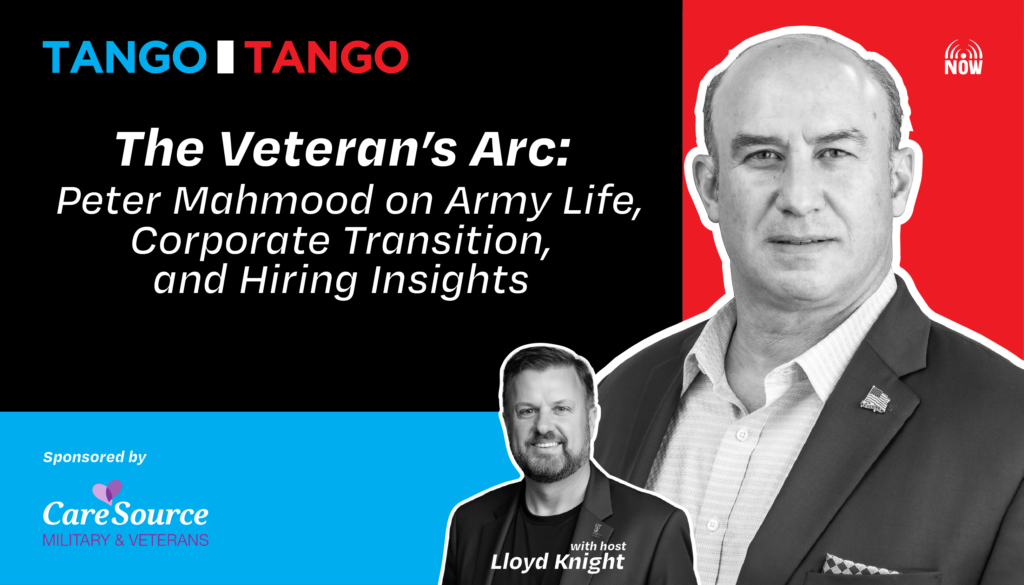
Welcome to the Tango Tango Podcast. I’m your host, retired First Sergeant Lloyd Knights. And first of all, I want to thank my team at Supply Chain Now Radio for allowing me to do this. And to our host, our sponsor this year, CareSource Military and Veteran. Today, I’m excited. I’m always excited for this, but I’m excited for this episode because I have one of my friends and one of my peers, Pete Mahmood from Cox Enterprises. He’s also a military and veteran recruiter. Pete, welcome to the Tango Tango Podcast.
Peter Mahmodd (00:49):
Thank you, Lloyd. Great to be here. Thanks for having me on.
Lloyd Knight (00:52):
Pete is an army veteran, and Pete and I were talking offline on Thursday or Friday about his army career because he had a very unique army career, enlisted an officer, but he also did a wide multitude of different career fields, which we’ll talk a little bit here in the future. But first of all, I want to talk about Pete growing up. Pete, what state are you from? I’m
Peter Mahmodd (01:16):
From the sunny state of Florida. Grew up here. High school here in South Florida is home for me now where I am working right now.
Lloyd Knight (01:24):
Oh, great. I didn’t know you were back home. So what high school did you go to, Pete?
Peter Mahmodd (01:30):
Yeah, so I went to Cooper City High School in South Florida. That’s in Hollywood, Florida area. I joined the military and told everybody I was from Hollywood. They were like, “Oh, California.” I was like, “No, Hollywood, Florida is what’s on my homer record and Cooper City High School, Cooper City Cowboys, proud graduate.”
Lloyd Knight (01:49):
And what did your childhood look like? What were you interested in? What kind of student were you?
Peter Mahmodd (01:54):
Yeah, so good student, happily. And I was a sports guy, so I was a typical sports guy in high school. I played soccer all four years for Cooper City High School, ran track, actually played water polo my senior year because one of my summer jobs was a lifeguard. So I was always a CPR lifeguard kind of guy and a sports kid in high school for sure.
Lloyd Knight (02:20):
And when you graduated the high school, did you go right in the Army or did you have a break where you tried to do something else?
Peter Mahmodd (02:25):
Yeah, no. So I met the recruiter my senior year, Army recruiter in the high school. I was planning to go off to college there in one of the local Florida colleges, but after conversating with the recruiter, I really wanted to travel and get overseas. So they promised me Europe on my contract. So I enlisted at 18 right out of high school.
Lloyd Knight (02:47):
And what career field and did you get Europe your first assignment?
Peter Mahmodd (02:51):
One of those not so smart on the MOS guys. I asked the recruiter to do something outdoors. They smiled and I was a combat engineer, MOS, which is 12 Bravo in the Army. But I did deploy to Germany for my first five years in the military, which was what I wanted. So a lot of that was spent outdoors for sure in that career field.
Lloyd Knight (03:13):
Very interesting. And where in Germany for that first five years?
Peter Mahmodd (03:16):
Yeah, so I was in Frankfurt, Germany, a little camp called Camp Eshbourne just outside of Frankfurt. Back in those days, we were still doing reforger in Germany, so we did a lot of field training. I always say soldiers that deployed to Europe is where you honed your field craft, setting up a lot of tents and camouflage out in the woods in Germany in places like Hanau and places like that. But Frankfurt was home.
Lloyd Knight (03:41):
Right. So you’re my age because Hanau’s long clothes.
Peter Mahmodd (03:46):
Yeah.
Lloyd Knight (03:48):
I was at camp and the reforgers, I did a bunch of reforgers. My dad was in the army, he did a reforger. So what did you like about that job?
Peter Mahmodd (03:57):
Really what I liked about the job was the location, being in Frankfurt, being able to travel all over Europe. Combat engineer, I was not the best combat engineer, probably why I changed my MOS later on. I was a sports guy, as I said in high school, so I was not handy with tools. So when they handed me a tool belt, I didn’t really know what to do with it, but I was around some really solid engineering guys, some true tradescraft guys that are friends for life right now, army buddies. But I felt like a fish out of water because I was not a true hands-on kind of guy, but I did learn a little bit in my time. So it taught me to get out of my comfort zone, which I think what I liked the most of that job.
Lloyd Knight (04:41):
Do that job at another location? I know you had a lot of career pivots. So after that five years, did you do a career pivot or did you move somewhere else in that role?
Peter Mahmodd (04:50):
Yeah, so as a combat engineer in Germany over those years, I actually deployed to Desert Storm from that as a combat engineer. Shortly after that, coming home from Desert Storm, I tried to change my MOS. I wasn’t able to, so I actually separated from my first enlistment and came back home to Florida, missed the Army and I re-enlisted only being out for about six months, but that allowed me to change my MOS. And I came back in as back then a 91 Bravo, which is now 68 Whiskey, which is a combat medic. Again, my lifeguard background in high school. So I decided to come in as a medic, change my MOS.
Lloyd Knight (05:31):
What a pivot. Wow. And how was that tech school?
Peter Mahmodd (05:37):
Yeah, that was an interesting pivot. I went down to Fort Sam Houston as an E4. They let me keep my rank and I was wearing a combat patch with the big red one, which drew a lot of tension for me with the cadre in San Antonio. So they quickly put me as the platoon guide in my new AIT and as a leader right away as an E4 prior service guy, training a lot there in Texas. And it was quite an interesting transition, but I was more in my element as a medic. I really enjoyed the medical field.
Lloyd Knight (06:08):
And where was your first assignment as a combat medic?
Peter Mahmodd (06:11):
Wow. So my first assignment, I was at the US Military Academy at West Point. I told my mom that I was going to West Point. She said, “Did you get in?” I said, “No, not exactly. I’m going as a medic to work at Keller Army Community Hospital at West Point.” And so my second assignment in the military was four years at the US Military Academy working primarily at the hospital in the emergency room where they put a lot of the field medics. So working as an EMT, got my paramedic certification while I was there and spent four years there at the US Military Academy at West Point, New York.
Lloyd Knight (06:52):
Fascinating. And after that four years, was it another pivot or did you move somewhere else to be a combat medic?
Peter Mahmodd (06:59):
No, my career has been interesting. My dad has always said, “You’re in the right place at the right time.” So I got assigned to Korea. I went back overseas after my time at West Point. Was there while I was at the reception station, they were actually standing up a new air ambulance company called Dustoff North in Korea where we would fly cover the DMZ. So at the reception station, these two master sergeants walked up to me. At the time I was Sergeant Mahmood, E5, and they saw the badges on my uniform, the combat patch. They tapped me on the shoulder and said, “Would you like to train and become a flight medic and get flight pay?” And I saw a long line of guys getting assigned to units and I said, “I’ll go with you guys.” They said, “You may have to do a year and a half here because we have to train you and you’re going to do an extension to get your wings and your training.” And I said, “Just sounds like more flight pay, so I’ll do it.” So I moved into 542nd medevac and trained as a flight medic and spent a great year and a half in Korea as a flight medic.
Lloyd Knight (08:05):
Yeah. If you haven’t figured out, Pete’s a bachelor at that point in time because another six months, no problem.
Peter Mahmodd (08:13):
Yeah, still a bachelor at that time, but enjoyed it. So that was a great assignment, a lot of certifications, a lot of flight hours on UH-60 Blackhawks.
Lloyd Knight (08:26):
And what was next for you?
Peter Mahmodd (08:27):
Yeah, so I came back to Fort Stewart, Georgia. Now as a staff sergeant, I was in the Third Infantry Division and I took an aid station NCOIC position. I had about 10 medics underneath me as a staff sergeant and had a great assignment there, a lot of field craft time deploying with Third Infantry Division at that time. But that time as a staff sergeant, I started to get the career pitch, what I wanted to do next. And I had different packets in my office drawer. I had a recruiting packet, I had a drill sergeant packet, and I also had an officer candidate school packet that I would look at every day trying to decide where my career, my army career was going to go after this.
Lloyd Knight (09:14):
Which packet did you pick?
Peter Mahmodd (09:15):
So I picked the officer candidate school packet. I applied to officer candidate school. And in between that time I did PCS over to Fort Sam Houston, Texas. So while I was a medic there in Fort Sam, Houston, Texas, the actual officer candidate school came out and applied to be a Medical Service Corps officer, but the Army needed air defense officers. So they commissioned me in air defense and I tried to fight it for a little while, but the way that the Department of the Army works, if one branch says yes and one branch says no, then it’s no. So Medical Service Corps accepted me, but Air Defense Branch didn’t want to let me go, so I ended up going to. I didn’t want to turn down the commission. So I left back to Georgia to Fort Benning to officer candidate school to become an air defense officer.
Lloyd Knight (10:08):
Another vastly different job than –
Peter Mahmodd (10:10):
Another pivot.
Lloyd Knight (10:12):
Another pivot. And what did that look like?
Peter Mahmodd (10:15):
Yeah, so that was pretty interesting because what that looked like while air defense officers at that time, they train in Fort Bliss, Texas. So dating myself, this is 2001 time. And what happened while I was in training was nine eleven. So air defense officers became very hot commodity. I actually was in officer candidate school, and I remember the commanding general came up to me and he had us write a paper of all of the students, new lieutenants, what it would like to deploy air defense assets in CONUS to protect the skies from aircraft or incoming. So that was an interesting time in nine eleven. And after officer candidate school, I was deployed, not deployed, I got assigned to Fort Hood, Texas First Cavalry Division as my first air defense platoon leader role.
Lloyd Knight (11:10):
Did you have any actual deployments in that role?
Peter Mahmodd (11:13):
Well, actually the first deployment was to the nation’s capital, to the air defense mission. So as a first lieutenant now, I was in charge of six sites across the Capitol, Pentagon, White House, other buildings to deploy air defense assets. In fact, at one point I was on top of a building, I can’t say building even now, and this three-star general climbs up to the top of the roof where I was posted, walks over to me because I was the site OIC, and it was the same general that had had me write the paper about deploying air defense assets in the United States. We stared out over the Capitol and had a long conversation about that paper. I said, “Sir, if you look out, there’s my assignment.”
Lloyd Knight (11:59):
Wow. Wow. That’s fascinating. So Fort Hood, Texas, deployment to DC. Where’d you go from Fort Hood?
Peter Mahmodd (12:07):
Well, yeah, back to DC as an executive officer. Soon after we came back from Washington, First Cavalry Division, replaced Fourth Infantry Division in OIF2 in Iraq. So I deployed to Iraq. Now, air defense assets weren’t really being used because we had pretty much dominance of the skies in Iraq in OIF, so we were used as convoy security. Now I had air defense avenger vehicles with 50 caliber guns riding up alongside convoys up and down between Taji, Iraq, Baghdad, all of the major cities. And so as the XO, again, as a first lieutenant, I was primarily sending my platoons out on convoy security missions, myself and my commander. We split up the entire territory of basically central Iraq to defend convoys. So again, right place, right time, so to speak, a lot of experience. Now my second deployment back into the Iraq theater.
Lloyd Knight (13:08):
And where was your first command at, Pete?
Peter Mahmodd (13:09):
Yeah, so I made captain over in Iraq. They took me out of the convoys and I ran the talk as a battle captain. I went to Fort Carson, Colorado. After that, actually didn’t have command right away. I was the brigade air defense officer for second brigade combat team, second ID. Had been in Fort Carson about six months and I though the unit wasn’t going anywhere, but that brigade was headed back to Iraq. So I had six months to move into a town home and headed off back to Baghdad for my second deployment six months after I returned. Not only six months, they said, “Well, you just came back. We’re going to send you on the advanced party because you know the area very well.” So lucky me, I was back in Baghdad, almost in the same territory, just wearing a different unit patch now from First Cavalry Division to Second Infantry Division.
(14:04):
So I spent my first year almost back in Baghdad. Came back, had a chance to take a break as a captain. They offered me command of recruiting. I wanted to stay. I had met my wife in Colorado Springs. My future wife, she was there working in Colorado, so I was able to take command of the Colorado Springs Recruiting Company, which is one of the largest recruiting footprints in the Army, almost 80,000 square miles from Denver all the way to New Mexico out to Kansas. So 55 active duty recruiters and nine recruiting stations. That was my introduction to recruiting and to army recruiting.
Lloyd Knight (14:42):
So at this point in time, Pete, before he meets his bride, is one of the most eligible bachelors in the army, being a bat player for most
Peter Mahmodd (14:48):
Of his
Lloyd Knight (14:49):
Career.
Peter Mahmodd (14:50):
In fact, I was so tired of deploying that I bought a town home next to an elementary school up in the north part of Colorado Springs near Peterson Air Force Base, and they probably thought it was strange. And at this point, I’m a captain, single, running around, jogging around the elementary school. And yeah, it was a catch. My friend who was an army buddy up there said, “I can’t believe that there’s a single captain running around North Colorado Springs with a house.”
Lloyd Knight (15:19):
With a house. And how would you meet your future bride?
Peter Mahmodd (15:24):
Yes. So she lived in that neighborhood. My daughter, my stepdaughter, was actually going to that elementary school. A lot of people, I met my neighbors, invited me over to a house party in the neighborhood and met my bride there in Colorado Springs. She worked for Wells Fargo as a banker, single, divorced mom, and we met and the rest is history. Her daughter was three years old at the time, who is basically my daughter who I raised, and we’ve been together ever since.
Lloyd Knight (15:54):
Yep. She’s kept Pete.
Peter Mahmodd (15:58):
She’s quite the catch.
Lloyd Knight (16:00):
And going back to your army, what did you like about the recruiter role?
Peter Mahmodd (16:05):
I really think I was in my element in recruiting. A lot of people don’t like that assignment. I love that assignment. I was the military relations person for the recruiting, which means I opened the doors in high schools, colleges, businesses for my recruiters. I really liked the civilian aspect of recruiting. I would put on a polo or a jacket and tie. I was in all of the chambers of commerce, the Denver chambers of commerce, the Pueblo, Colorado Springs chambers. I was all at the ribbon cuttings when they opened new banks or new businesses. I brought my army recruiters out to those event. I had the Army Golden Knights jump in and stomp on the head of the Air Force Falcon at the Army Air Force game. Hey, easy,
Lloyd Knight (16:50):
Easy, easy. So yeah, it was
Peter Mahmodd (16:53):
Very competitive. Actually, the Air Force and the Army, we were getting our butts kicked by the Navy in Colorado, and both the Army commander and I and the Air Force commander were trying to figure that out. And really what it came down to was job selection and the types of jobs that people had. But I thought that recruiting assignment really left a mark on me for what my future career was going to be after the military.
Lloyd Knight (17:18):
Yeah, I think it served you well. So for those of you who don’t know Pete, for what Pete and I do, there’s not many of us in the country as a military veteran recruiter, and Pete is very visible. He represents the brand well, which we’re going to talk about here in a little bit, but let’s go back to your army. And when did you decide that, “Hey, it’s time for me to punch out and retire from the Army?”
Peter Mahmodd (17:43):
So after recruiting, I had one more assignment. I went back to Fort Bliss, Texas, and I was working in actually brigade modernization command. I was the fires officer. I was a major now. I was the fires officer, basically testing at White Sands Missile Range, all of the new equipment coming into the army and going over into theater, into Afghanistan and Iraq. So kind of another pivot back into my air defense world. But after two years there, the air defense branch came to me and said, “You had recruiting assignment, you’ve had modernization back in an office. It’s time for you to deploy again.” At this point, we’re still in the 2000s, kind of later, mid – 2000s, and the army is still. And I had rolled the dice on acute deployments. I had a baby now, my little baby at home, baby daughter at home, and I had 24 years in the military at this point, so I just decided that it was a good time for me to retire from the military from that assignment.
(18:44):
Had a lot of family situation going on with toddler and things like that. So just decided 24 years was a good career. I was looking at lieutenant colonel selection, but I knew that was going to sign me up for another decade in the military, at least another five years to make that rank and hold that rank if I wanted to retire again. So I just decided it was a good time. I was young enough to make the change.
Lloyd Knight (19:10):
All right. So I know you had multiple roles when you transitioned and looking at your LinkedIn profile and knowing you, but let’s really talk about Cox. How did you find your way into one of the largest privately held companies in the United States?
Peter Mahmodd (19:28):
I had some time in actually junior ROTC for a while in Florida. We were bouncing between Florida and Colorado, moved back out to Colorado Springs because we had the house out there still. I actually started as a military recruiter in another automotive company prior to Cox, ran their military programs there in Colorado Springs. I was very familiar with the market, the territory from being the recruiting commander in Colorado Springs. Very successful, I think, in that role. But when COVID happened, we decided to move away from Colorado back to Florida. I was in Florida, had basically moved back to Florida to settle the family home, opened my profile on Indeed and on LinkedIn, and this is around 2022, and one of the Cox recruiters reached out to me. At that point, Cox being a very large organization, wanted to really get into the military space. So they reached out to me, they sent me this job description.
(20:30):
I looked at the job description and I thought there’s probably five people in the United States that could probably really do this job. One of them is probably at UPS, one of them is at Home Depot, one of them is at Lowe’s, probably one’s at Wells Fargo. So I told my wife, I said, “I think this job description is written for me. This is building a military relations program for Cox recruiting service members, veterans, and spouses.” Cox had me write some, actually, my second white paper that I wrote on how it was going to build this program out, and they hired me remotely from Florida to run and develop their military veteran outreach program.
Lloyd Knight (21:11):
Yeah, that’s amazing. So I heard the story very differently. So I heard the story that he was hired as a regular recruiter and just gave himself the job title of military veteran recruiter and just started to –
Peter Mahmodd (21:25):
Actually, that is close. That sounds like a John Thompson comment. So I was hired as a senior recruiter, but I saw it more as military relations, similar to my recruiting commander role that I had in the army to open the doors for the Cox recruiters. So I started branding myself right away as the Cox Enterprises military relations when I would go on the bases. And really, my first year, later in my first year, I was out at Camp Pendleton bringing a lot of the Cox Automotive roles and some of the Cox roles to the base and was talking to the military employment leads out at Camp Pendleton in San Diego, and they said, “Hey, we want all of the Cox roles, not just what you’re bringing.” So I went back to Cox Enterprises and I said, “Hey, I would like to bring all of our roles to the military, cybersecurity, IT, sales, operations, automotive.” In the military, we never take away from, we only add two.
(22:23):
So I added to that my portfolio typically gave myself a new title. Cox was happy with it. They were happy to be broadening. And yeah, we, like you’re saying, jumped really from being a senior recruiter into more military relations manager at Cox, and that was in 2023.
Lloyd Knight (22:42):
So Cox has got a really big footprint here in Atlanta, and it’s literally about a thousand yards away fro where I’m sitting now, but truly I had no idea what Cox did or does. They first hit my radar like everybody else. I thought they were just a cable company, but holy cow, this company is as diverse as companies get. Can you talk a little bit about the broad portfolio of companies that Cox Enterprises owns?
Peter Mahmodd (23:10):
Yes. So the broad portfolio, and again, it’s evolved, the portfolio before last week since we’ve had the merger, the one that I pretty much worked on from 2023 till just last week of August 20th, 2026, included Cox Communications, Cox Automotive. So Cox Communications at the time was the largest private telecom in the US, 30 states, seven million homes and businesses. So that was IT, cybersecurity, all of those roles. But Cox Automotive is one of the largest automotive groups in the US, includes 12 go-to-market automotive brands, which include Kelley Blue Book, Autotrader, Manheim Auctions, VinSolutions, Dealer.com, DealerTrack, just automotive opportunity both online and in person with our Manheim Auctions. Manheim Auctions, which is the largest auto auction in the world over almost a hundred locations in the US. These are campuses that employ technicians, painters, parts in the back. And of course in the front of the auctions, you have customer facing roles, sales roles.
(24:18):
So you have places like Manheim Atlanta, Manheim Nashville, Manheim San Diego, Manheim Tampa, Manheim Tulsa. So you’ve got the automotive footprint across the US, you have sales roles, you have now since the merger, we are really now with the Cox Enterprises brand and the Cox Automotive brand are going to be the two major brands, so we’re going to be really heavily into automotive. But prior to that and now, and still now, Cox has remote opportunities nationwide, logistics supply chain opportunities nationwide, and of course still IT and cybersecurity and network roles nationwide. So it is more than a lot of people think that the Cox family brand.
Lloyd Knight (25:02):
You guys even own greenhouses. If I remember right, you were the largest owner of greenhouses in the country.
Peter Mahmodd (25:08):
Yeah. So yeah, failed to mention Cox Farms, which was another last year acquisition, which is the largest greenhouse operation in North America. So you go into the stores and you see Bright Farms, Mucci Farms, those are Cox Greenhouse brands. So I think the future for us is going to figure out where we find veterans and military talent in hydroponics and agriculture and greenhouse operations in addition to all the automotive roles that we have. So it is just like every business with acquisitions and mergers, it’s dynamic. But for us, I see that the military talent that we have can match a lot of these roles in many companies and especially in our Cox companies. So
Lloyd Knight (25:51):
Talk a little bit about, and it kind of hit me by surprise, I read it over the weekend, you guys just had a merger with, was it Spectrum, if I get that right? Talk a little bit about that.
Peter Mahmodd (26:02):
Yeah. So Transformation Day was last week, August 20th, 2026, where the merger happened between Cox Communications and Spectrum Charter Communications. So that merger means that the Cox communications brand has gone over now to Spectrum to run the day-to-day operations and the Cox stores across the country will be Spectrum. The Cox Enterprises or Cox Communications, the leadership and the board still sit in Atlanta. So now what we’ve seen is a lot of Spectrum offices and Charter moving into the Cox building in Atlanta. But what that means mainly for Cox Talent, the talent side will move over to Spectrum and they’ve got probably their military and veteran side. So the Cox recruiting that I will do at Cox Enterprises, Cox Automotive, Cox Farms will stay with us at Cox Talent. So hopefully that just means that bigger companies on both sides and more opportunities for our veterans and military spouses for careers, but we will not and I will not have the day-to-day recruiting for Cox Communications that I had previously, but as we talked about with Cox Automotive and Cox Enterprises, those two thirds of the main brands that will stay under our military talent side.
Lloyd Knight (27:23):
Okay. Wow. It’s a little bit more clear now. When I was reading it, I was completely confused, but you cleared it up, but yeah, somewhat. So let’s talk a little bit about that military member making the transition. So what advice could you offer a service member that is about a year out from making the transition and is interested in going to work for Cox?
Peter Mahmodd (27:49):
So a year out, hopefully they’re in the TAP program, the Transition Assistance Program, and they are doing those things like looking at their VA benefits, they’re looking hopefully carefully at their resume, they’re working on their interview skills, and they’re trying to figure out where does my MOS or my interests lie? What kind of companies do I want to apply to? I’m either going to, like I did, pivot, like you said, I might be in automotive career in the military, but I want to pivot into IT, or maybe I’m in IT in the network world in the military and I want to pivot into a sales role. We have those type of things. Really what they need to be doing right now I think is honestly studying not just their MOS, but what have I done in the military? When I meet somebody at a job fair online, I talk to them and say, “What was your MOS and what did you do?” Because those can be two same things or different things, because in the military we have additional duties in addition to our MOS, or sometimes we’re working, MOS being our military occupation specialty, sometimes we’re working outside of our occupational specialty.
(28:58):
So when they’re in that 12-month window, they’re doing their homework, their research, they’re trying to figure out what roles. They are attending podcasts, webinars offered by a lot of our different partners and ourselves. They’re building their online presence, hopefully working on their LinkedIn profile. I have Cox partnered with over two dozen bases right now, the places that I travel to, and I go in and I speak to those soldiers, service members, spouses at different events, and I say, “Hey, work on your resume, work on your interview skills and start to figure out.” Because I believe at the four-month, 90-day mark, they should start applying to those roles that they’re interested
Lloyd Knight (29:38):
In. Yeah, great advice. And for those viewers and listeners that are out there and want to see Pete and I in person, you have your opportunity. We’re going to both be at the Military Influencers Conference this month in September and down in Tampa, Florida. So hey, if you’re there, stop by and visit Pete at the Cox booth and visit me at the UPSA So with that, Pete, any closing comments before we sign off?
Peter Mahmodd (30:03):
Yeah, so just to highlight, thankfully to someone, I believe in my veterans group at Salute Cox who nominated me for Veteran of the Year. I was selected as the Florida Veteran of the Year. Great voting from you and from all of our veteran partners, great voting from my Cox team, also from my Broward veteran group that I’m a part of here, Broward Vet Working. A lot of support got me to this Florida Veteran of the Year, hopefully competing for National Veteran of the Year. But what I really want to do with that is advocate again for our veterans and our veteran hiring. We don’t hire veterans for charity because they’re veterans. We hire them a lot of times because they’re the most qualified folks for the roles that are out there.
Lloyd Knight (30:49):
Well, Pete, you honestly deserve that award. So I was really happy to vote for you. I always kid around and said I voted like a certain political party and voted for more than once, but that’s not true. But you are my number one vote. I was so happy to see it because it’s well deserved. So Pete, look forward to seeing you at the Military Influencers Conference in Tampa. And for my listeners and viewers out there, be like Pete, be safe, be kind, and be remarkable.
Intro/Outro (31:19):
The Tango Tango Podcast is produced in partnership with supply chain now. Join the Tango Tango community for more inspiring stories. Follow us on Facebook, X, and LinkedIn. Subscribe to the Tango Tango YouTube channel and follow and listen to Tango Tango wherever you get your podcasts.