January 14, 2025
change

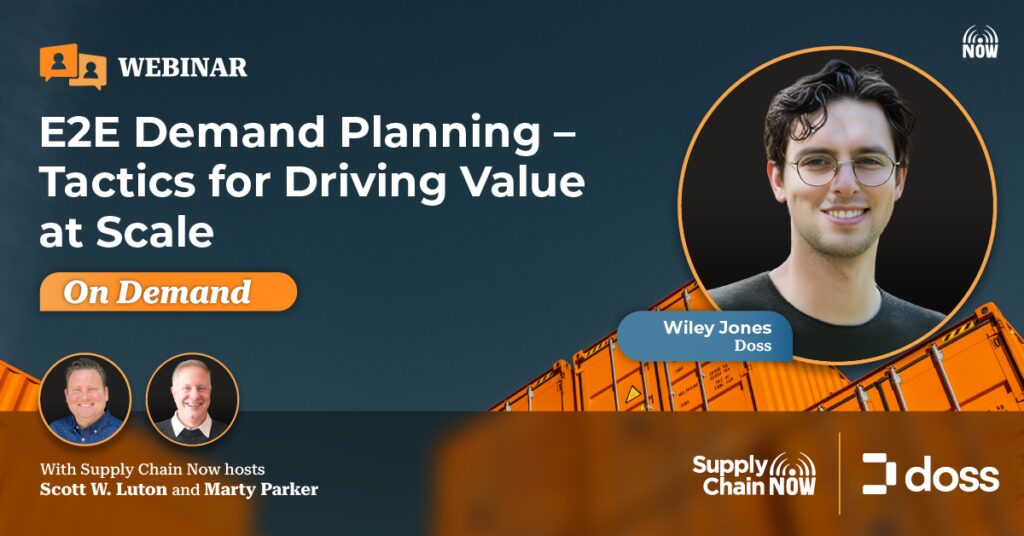
WEBINAR: E2E Demand Planning – Tactics for Driving Value at Scale

Share:

WEBINAR: E2E Demand Planning – Tactics for Driving Value at Scale

Demand planning is one of the most challenging yet critical aspects of running a modern supply chain. At its core, it’s about bringing together the right mix of data, workflows, and intuition to answer deceptively simple questions: What do we need? When do we need it? And how do we make it happen?

In this webinar, hosts Scott Luton and Marty Parker, along with Wiley Jones, CEO of Doss, will unpack the foundational elements of demand planning—what works, what doesn’t, and how Doss helps tackle the inherent complexity. We’ll focus on breaking down key components like data modeling, demand variability, and aligning forecasts with operational realities. The session isn’t about selling a silver bullet solution; it’s about understanding the building blocks that make demand planning possible and how Doss enables teams to build on them effectively.

If you’ve ever struggled to balance inventory levels, deal with forecast inaccuracies, or align procurement with production timelines, you won’t want to miss this session.

Key Takeaways:

  • The essential building blocks of effective demand planning: data, process, and adaptability.
  • How to model demand variability without overcomplicating the process.
  • Real-world examples of how teams use Doss to simplify demand planning while staying adaptive to change.

More Webinars
AI-driven decision making
play-button-webinar
webinar-person
Webinar
May 8, 2026

Ahead of Disruption: How AI-First Design Builds Supply Chain Resilience — and Transforms the Teams Behind It

Your network design process took months. Now it takes days. Your scenario analysis took weeks. Now it takes hours. The technology moved fast. Your organization didn’t. In this webinar, we’re having an honest conversation about what it means to lead a supply chain design function when the old constraints are gone—and new ones have taken their place. The companies pulling ahead aren’t just using better tools. They’re rethinking who does the work, how teams are structured, and what supply chain careers actually look like when data wrangling is off the table. Join us to explore: Why AI-speed design exposes the gap between your technology and your org model—and what to do about it How leading companies are onboarding new analysts faster and getting value from day one What it looks like when your team spends their time on decisions and scenarios instead of fighting with data Why the wall between strategic design and operations is coming down—and what that means for how you hire, structure, and retain talent If you’re responsible for supply chain design strategy, team structure, or how your organization makes network decisions, this session will challenge how you think about what’s slowing you down.
Operations
play-button-webinar
webinar-person
Webinar
August 30, 2024

Beyond Resilience: Capitalizing on Supply Chain Uncertainty

The only thing certain in life is that nothing is certain.” So said Roman philosopher Pliny the Elder nearly 2,000 years ago. For supply chain professionals this quote definitely rings true today. Unpredictable shifts in demand and disruptions to supply are becoming more frequent and more severe. Over the last few years, much of our focus has been on building resilient supply chains to prepare for the inevitable, unforeseen challenges ahead. However, some industry leaders are striving to go beyond resiliency to actually take advantage of future disruptions. They see the upside of supply chain uncertainty as an opportunity to capture share from slower competitors. In this Supply Chain Now webinar, hosts Scott Luton and Kim Reuter welcome special guests John DeSarbo and Bharathi Shankar from ZS to explore how industry leaders are capitalizing on uncertainty by building agility into their operations, rethinking traditional approaches to supply chain management, and utilizing AI and advanced analytics to uncover opportunities to capitalize on changing market dynamics.