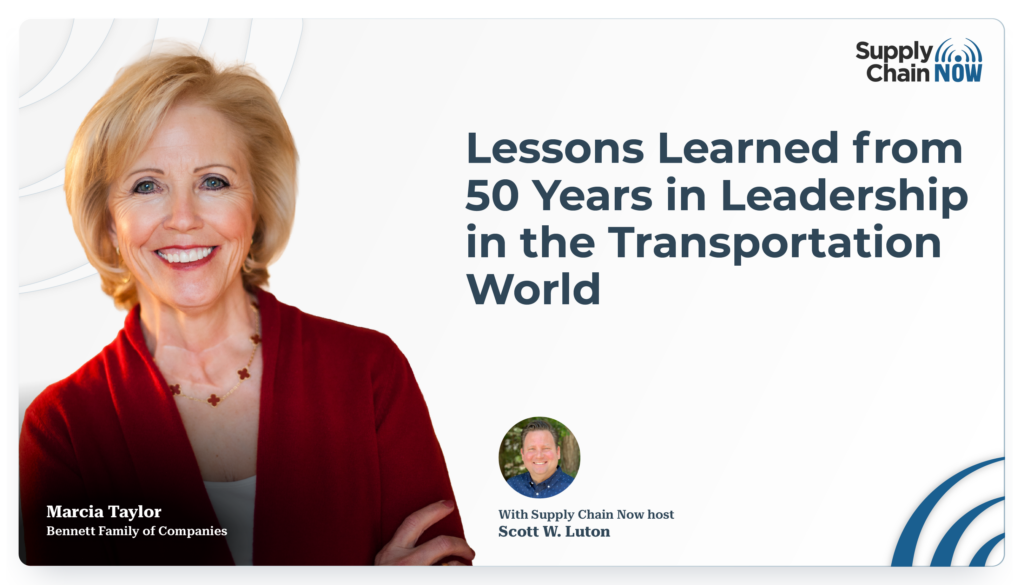
[00:00:00] Marcia Taylor: you know, it’s tough.
[00:00:01] Marcia Taylor: They have a hard job, and they need to be able to communicate with someone. They, when they got a problem, they need to be able to talk to somebody. Now, you know, are, are we always the easiest? Maybe not. But, I want there to be somebody on that phone that is talking to our drivers. I want somebody there talking to our customers, and I don’t want that to be a computer
[00:00:41] Scott W. Luton: Hey, hey, good morning, good afternoon, good evening, wherever you may be. Scott Luton with you here on Supply Chain Now. Welcome to today’s show.
[00:00:50] Scott W. Luton: Folks, today we’re speaking with the fearless leader of a big organization in industry, one who’s, uh, has quite a story, and I promise you it’s gonna inspire you. Today we’re talking about resilience in leadership, entrepreneurship, and some of the lessons that can only come from really decades of navigating change.
[00:01:10] Scott W. Luton: We’re gonna be exploring how great organizations preserve their culture while continuing to grow, why some leadership principles never go out of style, and what more than 50 years in transportation can teach us about where the industry is headed next. We’re even gonna look at some of the technologies reshaping supply chain, some of the human superpowers that can’t be automated, and some hard-earned wisdom for the next generation of leaders.
[00:01:35] Scott W. Luton: All of that and much, much more, so stick around for a great conversation. I’m gonna start by introducing our special guest here today I’m delighted to have. Marcia G. Taylor is the owner and chief executive officer of Bennett Family of Companies, an award-winning transportation and logistics provider. But it wasn’t always that way.
[00:01:56] Scott W. Luton: After un- the unexpected loss of her husband, Bennett founder JD “Buddy” Taylor in 1981, Marcia had some soul-searching decisions to make. But she leaned into the challenge and ultimately transformed the company into one of the nation’s largest woman-owned transportation and logistics companies. She has since spent more than three decades successfully growing Bennett, and Marcia’s has been, uh, Marcia has been recognized nationally for her leadership, including being named to the Forbes 50 Over 50 and Forbes America’s Richest Self-Made Women lists, and that’s just the tip of the iceberg.
[00:02:33] Scott W. Luton: I wanna welcome in Marcia Taylor, owner and CEO of Bennett Family of Companies. Marcia, how you doing?
[00:02:41] Marcia Taylor: I’m doing?
[00:02:41] Marcia Taylor: great, Scott. Thank you for inviting me to be with you today. I look forward to our conversation
[00:02:48] Scott W. Luton: Well, I do too. I do too. And, and, uh, you’ve got a lot of admirers. And as I dove more into your story and the background and the company and, and, uh, your, your journey, the whole, the whole thing. I wish we had six
[00:03:00] Scott W. Luton: hours to talk, but I’m gonna take an hour and I can’t wait to dive in with you, my friend. Um, I wanna start a little fun warm-up question though first, Marcia, if I may.
[00:03:09] Scott W. Luton: Um, we were talking pre-show about travel and some other things. I know you travel a lot, but you spend some of your time, you and your family, regularly a part of each year, I think up in Wyoming, where me and my son had a little, uh, trip up there a couple years ago. Tell me about what you do when you’re up in beautiful Wyoming.
[00:03:28] Marcia Taylor: Well, Scott, you know, uh, we bought this ran- we bought a little ranch outside of Jackson Hole about 24 years ago. Every Cr- We’re, you know, Bennett is a family company. And, uh, now I think all together with all kids and grandkids, there’s about 30 of us. So having a family company, you really don’t have an opportunity, uh, to have a lot of family time.
[00:03:55] Marcia Taylor: I mean, it’s just, you’re always working. So long time ago, I decided that we, uh, would go someplace for Christmas every year. And, um, and so we did that. We traveled to, I mean, gosh, we went everywhere like Aspen, different places. And, uh, we decided to come to Jackson Hole. And, um, I g- the first time I got off of a plane, I just, here in Jackson, I just felt like the weight of the world fell off my shoulders when I looked at those beautiful mountains.
[00:04:28] Marcia Taylor: And, uh, I said, “You know what? This is where we need to be.” So we bought a little ranch out here about 24 years ago, and, and it’s great. We, um, we live right on the Hoback River, so if we wanna go rafting, we can, or horseback riding or, um… Mike and I, we just like to, we just love being here. It’s just a peaceful place.
[00:04:52] Scott W. Luton: Wow, you paint quite a picture. A- and, uh, I know when I, when I speak with people that live in beautiful places like Wyoming, they don’t wanna get the word out because they don’t want a whole bunch of people moving up, but we’ve already done it. Uh, you paint what’s such a great picture. And, you know, those mountains and, uh, the Grand Tetons, I think, if my, if my map skills are right, they’re like omnipresent.
[00:05:15] Scott W. Luton: When we were there for, you know, a few days, everywhere you went, they were like, you know, looking over your shoulder. It’s just a, a captivating place, huh?
[00:05:22] Marcia Taylor: It is, and it, it’s peaceful. But people, uh, you know, um, people have found it, that Jackson has become quite a tourist, uh, town in, especially in the summertime, because everybody loves to go up into the park. And one of the things I love, the little valley we live in, um, we’re about 15 miles south of Jackson, is the largest, has the largest migration of animals in the state of Wyoming, elk especially.
[00:05:53] Marcia Taylor: And so in the fall and winter, um, you, we might see 300 or 400 elk out here in our pasture, and in our, and in our yard eating our flowers and trees and everything. But you know what? It’s such a beautiful sight, and, uh, just makes you understand a little bit more and appreciate nature and, and, uh, you know, all of God’s beautiful works
[00:06:18] Scott W. Luton: That’s right. You almost have one elk for every family member of Taylor family, Marcia.
[00:06:24] Marcia Taylor: Yeah. Almost. Yeah
[00:06:25] Scott W. Luton: All right. Well, I guess I, I’d love to
[00:06:27] Scott W. Luton: talk more about Wyoming and, and getting outdoors, but we got a lot to cover with your journey and all the things you’re doing in global supply chain. And I want to start this.
[00:06:35] Scott W. Luton: Before we get deeper in your story, I think it’d be helpful for our folks who are tuned in, watching or listening to us, if you could just level set at a high level of what the Bennett Family of Companies does and all the many ways that you help all of us in, in our global supply chains keep moving forward every day.
[00:06:52] Scott W. Luton: Give us that overview if you would, Marcia
[00:06:55] Marcia Taylor: Uh, well, a lot of times when, you know, people say Bennett, they think, “Well, it’s just a trucking company.” But actually we’re made up of 14 different companies that do 14 different types of transportation. Everything from general freight to heavy haul, drive away. We’re the largest transporter of manufactured housing.
[00:07:18] Marcia Taylor: Uh, we’re aerospace. We, uh, we’re one of the largest carriers for ammunition explosives for the government. We do a lot of work in that space. Uh, aerospace, we, we move a lot of rockets. Um, we are very involved, uh, with NASCAR and, uh, do a lot of, um, putting together a lot of the tracks for, um, for some of the sports centers.
[00:07:48] Marcia Taylor: And so we just, we do a lot of warehousing, logistics. So over the last 52 years, you know, we’ve diversified and, and, uh, find ourselves getting involved in… Oh, we just, one thing I’m really excited about, we just, um, bought property in Alaska and just opened a, a new office there and, and we really feel like, I know they say that’s the new frontier, but I think for us, it’s definitely gonna be the new frontier, um, because we’ve worked out some great, um, arrangements as far as getting things barged and, and, uh, we have trucks now based there and an office.
[00:08:36] Marcia Taylor: So yeah
[00:08:38] Scott W. Luton: I’ve got about a million questions. It sounds like you’re all doing, y’all have the opportunity to do so many cool things in the industry. I’m a big space nerd, so you certainly have my ears perking up with, um, the work y’all do in aerospace. But we got a lot to get to. I’m gonna ask you this. You mentioned NASCAR.
[00:08:53] Scott W. Luton: Have you seen, I didn’t realize they were gonna do this, but they’re coming up with a sequel to Days of Thunder. I’m not sure when it’s coming out. Have, have you seen that yet?
[00:09:02] Marcia Taylor: No, I have not. No, no.
[00:09:06] Scott W. Luton: We’ll see if it’s anything like the original, which I think came out in early ’90s. Um, all right. So thank you for that overview.
[00:09:13] Scott W. Luton: Uh, and I tell you, I, I mentioned some of your, uh, recognitions and awards earlier as I was introducing you. The, the Forbes Self-Made 250, I think was another of your many, uh, accolades. Uh, congrats to that. And, you know, I, I really enjoyed… You had a great
[00:09:30] Scott W. Luton: interview and a bit of a profile in The Atlanta Journal-Constitution, um, a while back.
[00:09:37] Scott W. Luton: Loved that. And there are so many things I could call out there, but in particular, I loved your passion that it, that, that just came out in that interview for professional truck drivers and their families. Before I go back in time, that seems to be a really, it’s in your bones a bit, Marci. Would you tell us about your passion for, for that component of our workforce?
[00:09:58] Marcia Taylor: Oh, yes. Um, well, and Driver Appreciation Week is just k- is just getting ready to come up on, and we l- we love that week ’cause we get a chance to celebrate all of our drivers. Um, so early on, uh, my husband, uh, JD, he w- he was a truck driver. I mean, that was his… that’s what he had always done. And so he always laugh and say, and when we started Bennett, and when we were married and then started Bennett, some of the best times I ever had was sitting on the back of a flatbed trailer listening to truck driver stories after we got off work.
[00:10:36] Marcia Taylor: And so, I mean, my heart i- is with our drivers out there on the road. And one of the things that, um, we have tried to do at Bennett too, is we wanna celebrate all of our women drivers. We have a lot of wonderful, uh, men drivers that, and a lot of our drivers at Bennett have been with us for many, many years.
[00:10:57] Marcia Taylor: And so especially when we were a lot smaller, um, you know, had a chance to really get to know our drivers and their families. In fact, early on, we had a lot of drivers that would stay with us. They would just come home with us, and my mom would cook Sunday dinner for
[00:11:14] Scott W. Luton: that’s awesome
[00:11:15] Marcia Taylor: And, uh, so one of the things that we- we’re trying to do now is, is really highlight a lot of our women drivers.
[00:11:24] Marcia Taylor: And as Driver Appreciation is coming up, um, we pick one woman from each one of our divisions, and she becomes our driver of excellence. And I just have the great honor and privilege of getting to interview each one of these women and hear their story. How did they get in the business, and why do they wanna drive a truck, and, and what are some of their challenges out on the road?
[00:11:52] Marcia Taylor: And, uh, we have a, we have a whole group of women that work for us, and w- and, uh, we call it Women in the Driver’s Seat. And so they’re kind of… They’re our advocates for all of our women. We’re try to, um, think about the thing, the challenges women have on the road, like safety and, you know, work-life balance.
[00:12:16] Marcia Taylor: And so, so yes, my heart, that’s where my heart stays, is with all of our drivers out there on the road.
[00:12:23] Scott W. Luton: Well, I love that. I admire that. And, uh, we need more advocates for our professional truck drivers out there, and I really love how big of an advocate, an actionable advocate that you are. Um, you referenced, I’ll tell you what, I wish so- I wish I could gather some of those truck driver stories on the back of a flatbed if I just grab a camera and a mic and just go.
[00:12:44] Scott W. Luton: So next time, let me know. But, um, you mentioned your husband. Uh, and I want, I want, I want to go back because this is a big part of your story. As I think I referenced in the intro, in 1981, your husband unexpectedly passed away.
[00:12:57] Scott W. Luton: Um, and y- I think at the time, if I’ve got the story right, Marci, you were raising three young children.
[00:13:03] Scott W. Luton: Of course, all of a sudden, you found yourself in a really big decision, uh, that had to be made, right? Future of the business. And of course, you leaned in, as we talked about, and, and the rest is kind of history. But what, in that moment, what gave you the courage to keep, to, to, to lean into the challenge and, and do the, do the impossible?
[00:13:26] Marcia Taylor: Well, I’m a, I’m a woman of faith. My, that, I, I lean on my faith all the time for everything. And when JD and I s- uh, bought Bennett in 1974, you know, we had 15 trucks and 30 trailers, and, um, no money. I mean, we, we started with $500. And it took us a while to get a bank to where, I mean, we- we’d have to pay something off and go and, and, uh, and then borrow s- money and, and anyway, it took a while to get a bank that would trust us to, um, uh, you know, give us a line of credit.
[00:14:08] Marcia Taylor: And, um, and we had two small contracts. So when JD passed away in 1981, um, I mean, we had some wonderful people that were working with us. There wasn’t many of us, b- and we had some great drivers that drove for us. And, um, uh, there really wasn’t a lot of choice when, because, um, I, the one thing I wasn’t certain about was whether or not the bank would go ahead and trust…
[00:14:41] Marcia Taylor: You know, there wasn’t a lot of women back then in trucking, and certainly there weren’t women that were in a lead- in a leadership position. And, um, s- so I kind of gathered the folks that, that worked for us and, and we talked about everything and, um, and I knew that they were there helping to support what we wanted to do.
[00:15:07] Marcia Taylor: And the bank kind of just took a approach, “We’ll just wait and see.” Our, and my, and our customers were kind of at a wait and see. And we just put it in God’s hands. And, uh, you know, He just saw us through that time. Um, had a wonderful gentleman that worked with me that became a real mentor to me, that had worked for Ford Motor Company, and he, um, he, he gave me a lot of great advice.
[00:15:37] Marcia Taylor: I had a great gentleman that had retired that kind of worked for us, an accountant. He gave me great advice. And, um, so it, I, I just trust that God got us through that time
[00:15:54] Scott W. Luton: I tell you what, Marcia, I– that is, uh, such a, and it all worked out. And it all worked out. You could say that times maybe 1,000. Um, so, y-y-you know, we think of all the challenges we have today in 2026, but the picture you painted from 1981, especially with women in leadership and women in industry, I mean, just a remarkable story.
[00:16:17] Scott W. Luton: Um, I wanna ask you this. W- earlier you mentioned, uh, all the different, uh, diversification,
[00:16:24] Scott W. Luton: uh, com, uh, com, uh, all the different diverse companies that m- that are part of the family of companies at Bennett, and it really is. I tell you, we could spend hours, I mean, from the explosives to aerospace to warehousing, Alaska, the new frontier.
[00:16:40] Scott W. Luton: Let me ask you this: How deliberate was this diversification strategy, uh, number one? And number two, how important has it been to the, to the overall organization and its growth?
[00:16:52] Marcia Taylor: Well, when, when JD passed away, um, one, we, as I said, we had two small contracts, and one of them was with Sunshine Biscuit. We were, uh, we delivered all their cookies. And the other one was with Ford Motor Company, uh, on the ag side. And, um, it was just about the time that deregulation came about, and one of the things that I realized very quickly, that if we were gonna stay in business, that if we were gonna, uh, survive, especially when deregulation happened, that we had to diversify, and we had to get out of the mainstream.
[00:17:35] Marcia Taylor: And so, um, w- that’s exactly what we did. We, um, I wanted to be a carrier, that our pricing was a little bit above midline, and I wanted to be a carrier that we were speciali- that we were a little bit more specialized so that, um, we could limit our competition. And having, uh, as I started, when we started, uh, we were a contract carrier.
[00:18:08] Marcia Taylor: So what that w- that kind of, that mindset for me was if you’re a contract carrier with a customer, you take care of whatever their needs are. It doesn’t matter. That’s your job. So we kinda, that was a philosophy that we carried forward as well. And, um, so when, um, we’ve always been an entrepreneur company, and I love entrepreneurs.
[00:18:33] Marcia Taylor: I, that’s the people we wanna hire at Bennett, is people that, that are, uh, forward-thinking. And, um, so we, um, really leaned in on the ag side of our business and, um, had flatbeds and drop decks and, and, uh, gosh, we’ve moved combines. We moved all kinds of things. And, um, w- uh, we had a customer that, um, if they had a need, for example, um, we were moving, um, we were moving a lot of product, and we had a customer that had a need that, um came to us and said, “We have these trucks.”
[00:19:16] Marcia Taylor: They were with, um, um, out of Louisville. “And we’d like to know, could do all these trucks?” And, and we said, “Sure. We, we can do that.” We didn’t know how we were gonna do that, but we knew we were gonna do that. So my oldest son, David, you know, my, all my children, uh, as they grew up, they all came to work in the, in the business and, uh, all an intricate part.
[00:19:41] Marcia Taylor: And of course, I wouldn’t be here today if it hadn’t been for them. And, and they each one have taken a different part of Bennett and helped to grow it. And so we kind of figured out, David Lynn worked on figuring out how to load these, these trucks onto one of our drop decks and made these, uh, special ramps and so forth.
[00:20:02] Marcia Taylor: And anyway, so as we were doing that, when we would deliver them, we’d have a customer say, “Well, that’s really great, but do you do drive away?” And we said, “Well, we, we can do that.” And so so literally, Scott, every business, everything that we have done, that’s how it’s come about. We’ve just listened to the customer.
[00:20:29] Marcia Taylor: Um, John Deere was building a new plant over in Augusta, and, uh, we were doing business with John Deere. We were one of their carriers and, and they said, “Do you know, do you wanna come and, and, um, do some warehousing?” We said, “We can do that.” And we w- And my son Danny, um, you know, figured out how to do that, built warehouses.
[00:20:51] Marcia Taylor: And, and so just, it’s just gone from one thing to another. But we never want, I never wanted to, like we had an opportunity, um, to get into manufactured housing. We’re the largest transporter of manufactured housing and modulars in the US. And, uh, um, we brought in, we went out and found somebody that specialized in that business and brought them on board, and we figured out how to do that.
[00:21:26] Marcia Taylor: And so you can just go Right?
[00:21:28] Marcia Taylor: down the line of everything we’ve done, and that’s the way that we built Bennett
[00:21:33] Scott W. Luton: Well, you know, what I am, um, gleaning from what you just shared there, Marcia, and l- let me know if I’m wrong. It seems like as you have been able to put yourself in position to say yes to customers and do new things, uh, you then invested in each of these, these, um, specializations, these customizations, and then of course, creating different formal divisions so you can further invest and really matur- um, drive maturity and development in those specialized areas.
[00:22:07] Scott W. Luton: And it seems like that’s been a big strength and of course, a big deliberate part of the strategy, but a big strength. Would you… Is that right, Marcia?
[00:22:14] Marcia Taylor: Yes, that i- that is correct. Because one of the things, Scott, that when, you know, over 52 years, business, you know, it cycles. You know, one, one area will be busy and another area will be very, very slow. So the thing that has always helped us, um, over the years is the fact that if one area slows down, something else seems like it always picks up.
[00:22:45] Marcia Taylor: And it just kind of has helped us get through, helped us to grow. We’re very conservative. Uh, you know, we’re a privately held company. Uh, we’re a family company. My, uh, as I said, I have three children that work there. And now we’re third generation. I have, uh, gosh, let me count. And I have four, four grandchildren that work there, and two great, uh, two, uh, grandson-in-laws that work in the business.
[00:23:15] Marcia Taylor: So we’re, we’re way into the third generation. And, um, the thing that has always d- just helped us is the fact that we don’t base our decisions, and we haven’t based decisions on whether we wanna get into a business or wanna hold on to that business, um, on the bottom line. We base it on the people, and we base it on where we think the need will be and if we can take care of our customers
[00:23:47] Scott W. Luton: Hmm. fascinating stuff, Marcia. Fascinating stuff. Let me ask you this. You mentioned earlier, um, you’re entrepreneurs at heart, I think it was, was the phrase you used. And, you know, as you’ve grown
[00:23:58] Scott W. Luton: tremendously, right, from 1981 to 2026 and, and all these different divisions, all, all– as the family’s gotten bigger and it’s gotten more involved, uh, which I find to be a really cool aspect, uh, of the story, how have you been able to protect those key elements to your culture, such as entrepreneurial thinking and, and faith in the business?
[00:24:22] Scott W. Luton: You know, that’s, I’m assuming that’s something you’re pretty adamant about, Marcia.
[00:24:27] Marcia Taylor: It’s, yes, it, it certainly is. We, uh, we say we have a family culture. We have a, we have a set of, um, uh, goals and priorities and, uh, values, and we try to live to those values. Uh, I mean, uh, that’s the most, one of the most important things to me, and we try to train on those values. And I always say that we make our decisions for those values, and they might not always be the most popular decision, but it’ll be the right decision if we live to our values.
[00:25:07] Marcia Taylor: And culture is one of those, is that we will have a, a family culture. And, um, you know, it’s, it’s certainly much easier when you’re smaller and you know everybody and you’re, you’re, you’re family. And, and really when we renamed Bennett, um, we rename… I wanted to name it the Bennett Family of Companies, because for me, that’s what it is.
[00:25:32] Marcia Taylor: Um, you know, uh, that’s why I still work, is because I love the people I work with and I love, I love what we do. And some of the ways that we preserve that is that, you know, we’re faith-based and we have a chaplain. Uh, we do a Bible study every, uh, Wednesday, and our chaplain is there if somebody needs it.
[00:25:59] Marcia Taylor: We have a prayer group. We pray for each other. We care about each other. Um, and we try, we work hard, but we try to have a lot of fun along the way, too, and I think you have to do that.
[00:26:12] Scott W. Luton: Absolutely. Very important. Very, you know, as I like to say, uh, especially in these friction, uh, friction-filled times, we gotta maintain that sense of humor. Gotta, gotta be able to laugh through the, even the toughest of days. Um, so I’m curious. We were talking pre-show. I’m, I’m, I’m not always a big fan of hypotheticals, but I’m gonna pose one to you.
[00:26:34] Scott W. Luton: And I liked your, your , when I mentioned this in the pre-show, I liked your, your quick response. But let’s say you’re building Bennett from scratch in 2026. I got a three-part question for you. Number one, what would you do differently? What’s one thing you’d do differently? Number two, what would you prioritize?
[00:26:53] Scott W. Luton: And number three, what is one thing, no matter 1981, no- no matter 2026, that you would not change at all?
[00:27:02] Marcia Taylor: Well, as I told you in the pre-show, I probably wouldn’t do it at all?
[00:27:07] Marcia Taylor: I wouldn’t even start it. But, um, you know, trucking certainly has changed over the years. The regulations, the, the, you know, what we have to deal with, with, uh, all the plaintiffs’ attorneys. You know, trucking has a great big, um, you know, they’re a big target on our back.
[00:27:29] Marcia Taylor: And, uh, if I was starting over again today, I don’t know that I’d do a lot different. I mean, I, um, I mean, at the end of the day, Scott, it’s all about relationships. It’s all about people. And, um, and, and it’s just bringing people together that, that love what they do. And so I don’t know from that standpoint I’d do things different.
[00:28:00] Marcia Taylor: Now, technology today is much different. We didn’t even, you know, we didn’t have cellphones, we didn’t have computers when we started. We didn’t even hardly have a fax machine. Uh, so, uh, you know, you have to embrace technology now, and that, that’s, um… And, and we are doing that at Bennett. I mean, we’re, we’re all in to
[00:28:22] Marcia Taylor: looking at how we can be more efficient and, uh, and get, and be better with our drivers.
[00:28:30] Marcia Taylor: And what would I do d- You know-
[00:28:34] Scott W. Luton: What, well, I’ll tell you what. W- since you wouldn’t change a whole bunch, and I guess you don’t have a whole bunch of reason to change a whole bunch, is there one thing, that you might prioritize more so if you were to start over today than maybe you did in 1981?
[00:28:50] Marcia Taylor: Well, yes, probably the technology. Um, you know, one of the things that I’ve been talking to our folks about right now is, um, as technology is changing and, and, you know, we’re, we’re all in. We are embracing AI. We’re, um… The thing that I’m finding that I’m enjoying about it is that, um, a lot of the people that work in different departments, we’ve kind of turned them, you know, we’ve turned kind of Claude over to them to, to work in, And uh
[00:29:26] Marcia Taylor: they have developed some of the greatest little programs that we’re finding that, uh, is helping us to be more efficient.
[00:29:37] Marcia Taylor: Because they know what they need. You can go out and try to buy a program, but it, it’s not gonna give you exactly what you need. And folks in our safety department are coming up with some really great programs that’s, uh, given us a lot of good safety statistics. And, um, so I’m excited about that, to see all the various things that we’re gonna be able to do that’s gonna make it, make us more efficient.
[00:30:07] Marcia Taylor: The one thing that we’ve all been very clear on, and we’re in, we’re into this whole big program right now about redesigning all of our, um, all of our software and everything, is that we never want AI to be forward-facing. We have to make sure that it is kind of in the background doing the work, but that, that, that people are always forward-facing.
[00:30:34] Marcia Taylor: And I find that as we get, as we grow, and one of the things that we’re just going in, in fact they’re doing strategic planning today at, um, at our company, is that we’ve got to find a way to do, be better at communication. Um, so many people now, you wanna text, they want, you know, and, and they don’t wanna talk on the phone.
[00:30:56] Marcia Taylor: And, and we can never lose that, um, that communication, that connection, uh, to people. How many places do you call now that they don’t wanna talk to you? You can’t even get a telephone number to call somebody.
[00:31:14] Marcia Taylor: I don’t, I don’t ever want us… I know s- I know we get, I know we’re complicated, and sometimes it’s hard to get through to us, but I never want not to have somebody answer that phone
[00:31:26] Scott W. Luton: Well, so I’m glad you brought up technology. Uh, something I want to ask you a couple questions around. And I want to go back to your AI comments and your comments around how your, um, you, you kind of alluded to how a lot of times there’s a lot of value in, in building versus buying, so you can really design exactly what your customers or what the team n- or the organization needs.
[00:31:49] Scott W. Luton: Um, and I tell you what, uh, y- it’s tough… I’d be hard-pressed to find and think about a force of, of business like AI that has just been, just been driving so much change across industry. When you think of the innovations, uh, in your space, right? Transportation, logistics, you know, supply chain maybe. Is A- does AI come to top of the list in terms of innovations that are really driving incredible change, Marcia?
[00:32:20] Marcia Taylor: I believe so. Yes, I think, I think it is. Um, but like I said, we have to be careful and not let it be the forward facing. It, it has to be in the background. I think what it’ll do, at least for us, is it’s gonna help us become a lot more efficient. It’s gonna help us, um, w- what I’m hopeful for is it’s gonna help us give our drivers more information.
[00:32:48] Marcia Taylor: Uh, it’s gonna help us better with safety. You know, safety’s priority one at Bennett, and we work on safety constantly. And, uh, you know, we have all this technology in the trucks, you know, that help the drivers know if they’re following too close, if, you know. We’re, we’re really struggling Right
[00:33:10] Marcia Taylor: now to find some technology that, um, for lane change.
[00:33:16] Marcia Taylor: Uh, you know, the cameras are just not there yet, but we’re hopefully, hopeful very soon that we’re gonna be able to get, um, a camera that’s gonna help us with, w- our drivers be able to tell when there’s a car that’s cut in beside them or… And we’re, we’re trying to work with the railroads to, um, work on safety for when our trucks are crossing the tracks.
[00:33:42] Marcia Taylor: And so I, I think their technology’s gonna allow, I think, uh, us to be safer on the highways than, than maybe we are right now
[00:33:53] Scott W. Luton: Love that, Marcia. When you find that lane change technology, please let me know, ’cause I want to equip my oldest that’s in her first year of driving. I’m gonna put it on her Honda. So you let me know when y’all… all right, one last thing about technology, then I wanna talk about some of, um, what all of your decades of leadership experience, um, kind of how it’s one of your superpowers.
[00:34:18] Scott W. Luton: But before I ask you that, you were really adamant a couple of times about, you know, keeping that technol- don’t let it be kind of forward-facing, I think is the phrase you used. And it seems like to me that when it comes to the human superpowers and the beautiful human element, uh, one aspect that may be irreplaceable, uh, in your, in your, uh, uh, in your mind rather, is that communication, that customer service, that, um, you know, taking care of, of, of, um, you know, the customers.
[00:34:53] Scott W. Luton: You don’t see that being automated. That’s, that’s what I’m, I’m gathering from you. Is that right?
[00:34:58] Marcia Taylor: Not from us. Now I don’t, I don’t know about other companies. As I said, you know, sometimes when you try to get to somebody, it’s difficult. Not from us. If we lose that, we’ve lost who we are. We’ve lost our identity. Uh, no. And, and drivers need that. They’re out there on the road every day and, and you know, it’s tough.
[00:35:22] Marcia Taylor: They have a hard job, and they need to be able to communicate with someone. They, when they got a problem, they need to be able to talk to somebody. Now, you know, are, are we always the easiest? Maybe not. But, um, I want there to be somebody on that phone that is talking to our drivers. I want somebody there talking to our customers, and I don’t want that to be a computer
[00:35:49] Scott W. Luton: Okay. You know, Marcia, um, it’s probably been a couple years now that I was ordering a pizza, and it didn’t dawn on me till halfway through that the, uh, person or the, the voice on the other side was a robot. It was an agent. And I tell you what, I w- I was kind of surprised because, um, they messed up my order, and then, and then I, and I pointed it out, and the con- the robotic conversation was almost…
[00:36:18] Scott W. Luton: It was really tough. If you weren’t paying attention, you would’ve thought you were talking to, you know, uh, a human neighbor. But it’s, it’s really amazing here in the golden age of, of supply chain tech. However, it’s a good segue because I know you’ve seen a lot, technology, leadership, industry, regulation, deregulat- you’ve seen a lot in 50 plus years in global supply chain, um, and what you’ve learned and, and what you might just, you know, um, can do in your sleep that the rest of us are still trying to learn.
[00:36:50] Scott W. Luton: So when you think about some of the patterns and trends that, a- again, it’s almost like muscle memory for you today given your experience that other newer leaders may not see, what comes to mind?
[00:37:03] Marcia Taylor: I keep going back to this, but it’s still, it’s still people. You still have to communicate. You’ve got, you’ve, you’ve got to, um, be out there. You’ve got to be talking to your drivers. You’ve got to be talking to your customers. You’ve got to always be looking forward. You know, what is, what are the new trends?
[00:37:26] Marcia Taylor: What is, uh, like right now, you know, data centers. We’re really busy moving product for data center. Where does it go after that? You know, we just opened up in Alaska. So yeah, I think you’ve got to constantly be looking at what… We do a lot of project work and, uh, big projects, huge projects, ’cause we’re, you know, we are a super heavy hauler.
[00:37:52] Marcia Taylor: Well, all those projects, they’re usually, some of them are maybe six months out that you’re starting on. You’re bidding them way in advance. Um, you know, we do a lot of big crane work. We have to get 900 ton in cranes. So you’ve always got to keep things in the pipeline. You’ve got to keep working ahead.
[00:38:15] Marcia Taylor: And that’s probably one of the, the things that we can never forget, is that you’ve got to, you’ve got to always be thinking about what’s next, what can I do? And you got to be talking to your customers, ’cause that’s how you’re going to figure out what, what it is that you’re gonna do next.
[00:38:33] Scott W. Luton: You know, Mars, as you’re sharing that, um, um, your response, I was thinking of, you know, it’s really digital fluency is an important part of, you know, the leadership co- toolkit, so to speak, in 2026. But it’s, it doesn’t stop there, kind of to your point. You gotta get out and, and, uh, uh, talk with customers. You gotta solve problems.
[00:38:55] Scott W. Luton: You gotta, uh, uh, be there with your team
[00:38:58] Scott W. Luton: members in a palpable, tangible way. And a lot of times, you know, texts or Slacks or emails, they don’t cut it. And I think, uh, in, in, in my experience, some new leaders kind of start and stop when they think about leadership. They think about, you know, making decisions and communicating it in all those different ways.
[00:39:18] Scott W. Luton: But to me, leadership is so much more, and I think you’re illustrating, um, a lot of that with, with many of your responses today
[00:39:26] Marcia Taylor: Well, I, I just, I think that leadership is being, um, you know, our people at Bennett are our greatest assets. They, uh, we wouldn’t be here if it wasn’t for our drivers, if it wasn’t for our employees. I mean, I’ve got employees at Bennett that’s been there 30 and 40 years. And in fact, they’re retiring on me, and I don’t know what I’m gonna do.
[00:39:51] Marcia Taylor: But in fact, my kids are retiring. Wow.
[00:39:54] Marcia Taylor: They’ve all just sat me down and said, “Hey Mom, we’re ready to retire.” And I’m like, “Whoa, wait a minute. We can’t retire.” Not ready to go yet. But, you know, people that have been there by my side for so many years, a lot of them are, are, have retired and just retired. So one of the things I think leadership has to do, and I’ve kind of learned this a little bit the hard way just because I have had people that’s been with me so long, is you’ve gotta constantly be looking at who is your next leader.
[00:40:27] Marcia Taylor: Who is the, who are the people that are gonna come behind? And, um, and it probably really, uh, resonated with me whenever both David, Danny, and Lynette sat me down, they’re each one a year apart, and they each one do, did a different thing over all these many years at Bennett and just said, “Hey, we’re tired.
[00:40:47] Marcia Taylor: We’re ready to retire.” And so I’m like, “Okay.” But, um, some of the things that we do at Bennett and, and, uh, um, like
[00:40:57] Marcia Taylor: I have an advisory board. U- I have a, uh, my general board that manages all the, all the Bennett companies, but then I have an advisory board that maybe are the next set of leaders. And they, they meet just like my board. Uh, they, um, we give them full autonomy to talk about what they wanna talk about, work on the areas they see.
[00:41:21] Marcia Taylor: And then below that, I have a young leaders board that is, uh, where the y- y- we have, we have some really talented young leaders that have all these wonderful ideas that I want to c- to capture. And so we have, we have a board and they, they… You know, I work at, in Bennett, but I don’t always know everything that we do Right
[00:41:50] Marcia Taylor: or everything we do wrong.
[00:41:51] Marcia Taylor: But people that work in different areas, they see where we can improve. And so that’s what these groups do. They really work on things that we can do to be better. And, uh, so I, I, I think as a leader, that’s one of the key things, is you’ve always gotta be looking to see who your next leadership is and, and, and how can you groom them and bring them along
[00:42:18] Scott W. Luton: Marcia, I love that. Um, and also I love how you kind of illustrate the leaning into help from others to fill in your blind spot that all of us have as leaders, right? Uh, some of the leaders have bigger blind spots than others, as I’ve learned in my time. Sometimes it’s me. Uh, okay. We’re coming down the home stretch, and I really appreciate your time here today.
[00:42:41] Scott W. Luton: I want to ask you this. You know, you’ve been in industry, you’ve seen a lot. We were just talking earlier. Um, and you know, the one, one silver lining about the pandemic, I think many consumers around the world really, um,
[00:42:54] Scott W. Luton: not everyone, but there seem to be some awareness gains that we made as a supply chain industry, right?
[00:43:01] Scott W. Luton: Folks are starting to connect the dots. Uh, when you think about public or, or, um, the public or policymakers or really anyone out there that really just doesn’t understand trucking or in a broader sense, supply chain, what’s one or two things you wish more folks would understand about this industry of ours?
[00:43:22] Marcia Taylor: Well, for one thing, I wish they gave our drivers a lot more respect and credit. My goodness. You know, the thing I remember, Scott, I’ll tell you this really quickly. When the pandemic hit, we just happened to be a, we were happened to be out here in Jackson and, and, uh, I went to the grocery store. And, uh, went to Smith’s, and I was walking around, and a lot of the shelves were empty ’cause people had just came in there and just bought, you know, just everything.
[00:43:51] Marcia Taylor: And I was lo- standing there looking at this shelf that was, uh, was soups and things. And, um, the, one of the ladies that worked there, she looked at me and she said, “Don’t worry, there’ll be a truck here tomorrow.” And that just, oh my gosh, that just hit my heart because I thought if everybody could just realize that, and give our drivers and the people out there on the road that every day, y- you know, I mean, they’re away from home, they, they have to deal with so much stuff that they shouldn’t have to deal with.
[00:44:29] Marcia Taylor: We give them the respect that they deserve. I, I feel like we would’ve accomplished something. And, you know, you mentioned earlier about our podcast. Um, we’ve never done podcasts before, but, um, you know, God always talks to me in the shower. That’s where he, that’s where he, that’s where he talks to me. So one morning I was, um, was in the shower, and it just, it just, it’s like, Okay.
[00:44:58] Marcia Taylor: we need to, we need to start a podcast.
[00:45:01] Marcia Taylor: We need to be a positive voice in the trucking industry, and, and try to, um… There’s so much negativity out there that we need to get our drivers’ stories out, and we need to be a positive, uh, voice. And, um, and because we are, we do, um, do a, a Wednesday, um, faith message. We need to, uh, uh, the dr- when drivers are on the road, you know, they don’t always have an opportunity to go to church.
[00:45:35] Marcia Taylor: We do, um, uh, on Wednesday when we do our, um, we do an all call. We’ll have 300 or 400 drivers listening to, to, um, our chaplain and, and, uh, and to Lee Gentry, who they work together. And drivers need that. They need that encouragement.
[00:45:57] Scott W. Luton: We all need it, right? We all need it. Sure
[00:46:00] Marcia Taylor: And so that’s why we started, uh, Transportation Nation.
[00:46:05] Marcia Taylor: We’re just, we’re trying to figure it out. I think you’ve probably got it all figured out, but, uh, we’re t- we’re trying.
[00:46:12] Scott W. Luton: Well, I, I, I really admire that. Um, and I love when companies that have found success and, and have, have stood the test of time, they keep pushing themselves into new areas, right? Just like you’re doing with digital media. And I tell you, I, I was on your YouTube channel earlier. You got a bunch of subs- clearly you figured it out because you got a bunch of interest, bunch of subscribers.
[00:46:33] Scott W. Luton: And I love the different channels from faith focused to industry trends to you name it. Uh, I love what you’re doing. I, I would just, for whatever it’s worth, from one digital media, uh, um, content creator to another, keep doing it. I think it’s good for industry and it’s good for drivers and a lot more folks out there.
[00:46:53] Scott W. Luton: And that’s Transportation Nation. I, I think, um, Marcia, if I’ve got this right, if folks go find, um, the Bennett Family of Companies on YouTube, that’s where they’ll find all the different channels for Transportation Nation. I think I’ve got that right, Marcia. Does that sound right?
[00:47:11] Marcia Taylor: That, yes, it does. I, um, you know, I, uh… We’re trying to get our, we’re getting ready to get our own channel on YouTube, and, uh, I think that’ll make it a lot easier. As I said, we’re still in the learning stages. We’ve only been doing this less than a year, so we’re, um, we’re working to get it figured out
[00:47:34] Scott W. Luton: I’ll tell you what. Uh, you teach me how to move rockets and I’ll teach you how to launch the podcast. How about
[00:47:39] Marcia Taylor: Okay. Yeah. one of the things, uh, if I ha- have just a minute, Scott, um, that I didn’t talk about that, that I really wanna just take a moment to talk about, if that’s okay. Um, you know, a long time, many years ago, as I said, God always talks to me when I’m in the shower. He, um, we’ve always been a company and employees that give back, and, um, so we, uh, uh, was led for us to start a family foundation.
[00:48:10] Marcia Taylor: And, and I just wanna say I think that’s one of the strong things about our culture, is our folks at Bennett, all of our employees, all have such giving hearts. They really, really do, uh, give back to our communities and to our drivers. And so I didn’t wanna forget to mention that
[00:48:31] Scott W. Luton: You know, um, we, we, we, we wrap every show, uh, where we encourage folks to do a couple different things, and giving forward is a big part of that. And, you know, s- just like it sounds like you and, and all of your wonderful colleagues and the culture you have, it seems like it’s very generous. I’ve been fortunate in my journey to work with some of the most generous and giving individuals.
[00:48:55] Scott W. Luton: I’ve been related to some of them. I’ve just been colleagues with others. And I’ll tell you what, um, they, it changes the world. It changes the world, and we don’t, we never have enough of those types of folks, and I really admire that part of your culture and how you’re, you’re investing resources into, um, helping others in so many different ways.
[00:49:14] Scott W. Luton: So Marcia, you’ve shared a lot. I know, and it, and, and we’re just, just tip of the iceberg. Um, but if folks wanna learn more about anything you’ve shared about the Bennett Family of Companies or, uh, any of your services you do, of course, all a- across all the divisions, you name it, what’s the easiest way for folks to connect with you and the team, Marcia?
[00:49:36] Marcia Taylor: If I just go look at our website for the Bennett Family of Companies, it’s bennettig.com and, uh, there, it lists out all of our different services, all the different companies. And then of course, you can always look for us on Transportation Nation. And one of the, um, you know, couple of the big things we have, of course, coming up is driver appreciation.
[00:50:00] Marcia Taylor: And then we are, um, patriotism is one of our key values, and we’re, we’re working really hard. Uh, we always work to cover all the grave sites in Andersonville. And, uh, so that’s one of the things that if you go on our website, you’ll see all about that, uh, what’s going on with that right now.
[00:50:23] Scott W. Luton: I love that. I, I really admire the culture, the organization, the team, uh, the purpose, and, and most importantly, arguably, is the difference you’re making out there beyond just doing the business part, right?
[00:50:38] Scott W. Luton: Uh, because a lot of companies and leaders stop there, right? With just doing the transactions, just doing the business, but you clearly, you are making such a bigger impact, and I’m really appreciative that we’ve had a chance to sit down and I can learn straight from, uh, Marcia Taylor.
[00:50:53] Scott W. Luton: So Marci, thank you so much for being here with us today on Supply Chain Now
[00:50:57] Marcia Taylor: Thank you for having me, Scott. I really appreciate it. It’s been a great honor to be here
[00:51:03] Scott W. Luton: Well, uh, look forward to reconnecting soon. We’ll get an update on all the great things you’ve got going on. Maybe we’ll do it in person down there on the square in McDonough when you come back down here to the state of Georgia
[00:51:12] Marcia Taylor: Well, hey, you come down and do a, do a podcast with us with Transportation Nation.
[00:51:18] Scott W. Luton: Let’s make it happen. I r- uh, sounds great to me.
[00:51:21] Scott W. Luton: Um, well, uh, thanks again. I’ve been talking to Marcia Taylor, owner and chief executive officer of the Bennett Family Companies. Thanks so much for being here, Marcia
[00:51:31] Marcia Taylor: Thank you. Appreciate it, Scott
[00:51:33] Scott W. Luton: And to folks listening or watching, I tell you what, I, I promised, and I think we delivered an intriguing story, right? I’ll tell you, so many different aspects of, of Marcia’s journey I’d love to dive more into. It could easily be a 12-hour podcast, but I think you caught a, a bunch of meaningful highlights just over the last hour.
[00:51:53] Scott W. Luton: Uh, so I hope you enjoyed the conversation as much as I have. But you’ve got homework, folks. You know the homework. I don’t even have to tell you. Marcia gave us, uh, a, a model I think m- many of us, many folks out there could, can follow, right? You gotta take one thing from all the good stuff that Marcia shared, take one thing and do something with it, deeds not words.
[00:52:13] Scott W. Luton: That’s how we’re gonna continue to change the world and leave no one behind. And with that said, Scott Luton on behalf of the whole, the whole Supply Chain Now team challenging all of our audience members out there, do good, give forward, be the change that’s needed. Hey, be just like Marcia Taylor, the world will be a much better place.
[00:52:30] Scott W. Luton: And we’ll see you next time right back here on Supply Chain Now. Thanks, everybody.