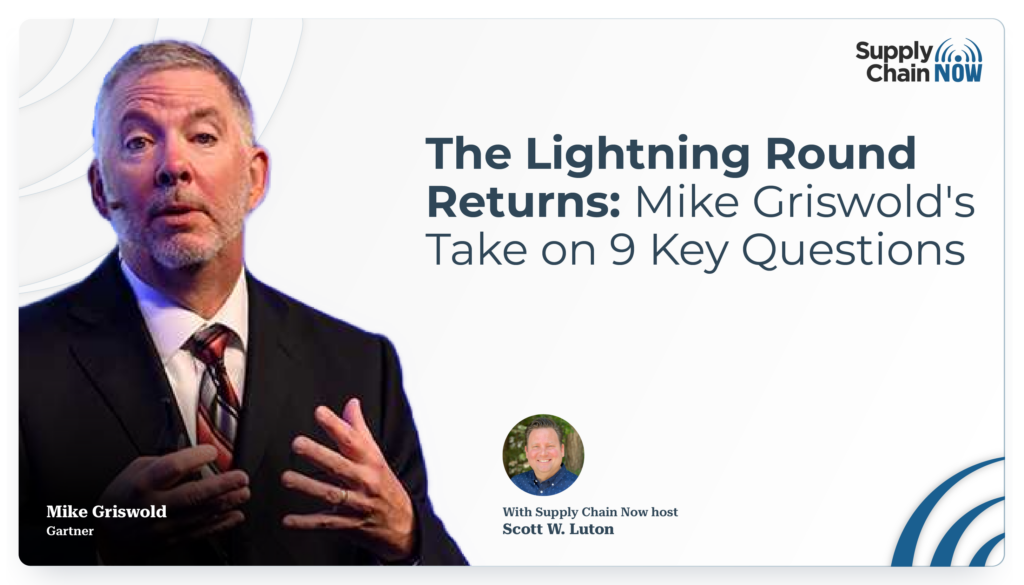
[00:00:00] Mike Griswold: an area that I would definitely discourage people from thinking about, which is using AI as a replacement for entry-level roles.
[00:00:08] We are seeing a lot of organizations start at the entry-level role level and use AI to kind of disintermediate those roles out of the organization. Our perspective is, is that’s a mistake. You’re gonna lose institutional knowledge. It’s gonna cost you more to bring in people at a higher level with more experience.
[00:00:33]
[00:00:46] Scott W. Luton: Hey, good morning, good afternoon, good evening, wherever you may be.
[00:00:50] Scott Luton and the always special guest, Mike Griswold, here with you on Supply Chain Now. Welcome to today’s show. Mike, how are you doing today?
[00:00:59] Mike Griswold: I’m doing well, [00:01:00] Scott. I always look forward to our get-togethers, so I’m excited on today’s format as well
[00:01:05] Scott W. Luton: You and me both. I get a little bit smarter, sometimes a lot smarter, after each of these conversations where I, we, we all learn from you, Mike. So today is gonna be a good one, folks. We continue our longest running, one of our longest running, at least, and most popular series called Supply Chain Today and Tomorrow with Mike Griswold from Gartner.
[00:01:25] Mike, of course, serves as vice president and analyst with the Gartner organization. And folks, you asked for it, we’re delivering. Today, the lightning round is back. That’s right. I’ve got nine thought-provoking questions teed up and ready to go for Mike, including what’s one of his hot takes that some folks may not agree with.
[00:01:46] Hey, where can global supply chain learn from other sectors? And if Mike was a big venture investor, what is one supply chain tech that Mike wouldn’t invest in? That’s gonna be a good one. Stay tuned for all that and much, much more [00:02:00] right here today with the one and only Mike Griswold. So Mike, before I get to the fun warm-up question, we got some tough questions for you.
[00:02:07] Did you eat your Flintstones vitamins this morning?
[00:02:10] Mike Griswold: Yes. And, and lots of, uh, I’m not a big fan of spinach, but I thought I would take some spinach in, in reference to Popeye. So hopefully, hopefully that will help. We’ll see.
[00:02:21] Scott W. Luton: Outstanding. So let’s start with, I think, a fun warm-up question. So, um, Mike, I know you’re a fellow history nerd. Uh, on August 5th, we’re recording, folks, this episode today on August 5th. And, uh, if you look at this day way back in 1899, Henry Ford founded the Detroit Automobile Company. It was Ford’s first foray into building automobiles.
[00:02:47] Unfortunately, the company, depends on how you look at it maybe, the company would close up a couple years later after Ford and his organization had built less than two dozen vehicles. That would eventually lead to [00:03:00] Henry Ford starting the Henry Ford Company, which also would dissolve, uh, through s- uh, a disagreement of investors.
[00:03:09] Uh, one of those investors went and, and started Cadillac, as a matter of fact. But ultimately, and the bigge- biggest, uh, note here is that then Henry Ford, all that would lead to Ford Motor Company, of course, and the rest is history. Giant, um, uh, titan in industry, in automotive industry, you name it. So all that said, Mike, a little walk down through memory lane.
[00:03:34] The fun warm-up question is this: What is the first car that you drove, Mike?
[00:03:40] Mike Griswold: Yeah. It, uh, I’m gonna take everyone back to the, to the mid-’70s, so obviously I’m gonna date myself. Grew up in a small town, and we had a three-speed manual transmission Volkswagen Bug, uh, orange-ish in color, and, uh, that’s what I learned to drive on. I [00:04:00] mean, I’m sure a lot of our audience is not even familiar with a standard manual transmission.
[00:04:04] But it, it was, uh, my dad had one rule, so I needed to be able to drive it and, and manage the, the gas and the brake and the clutch, which is probably the hardest thing to learn in a manual transmission. But we lived in a town that had a couple of big hills, and my dad said I could not drive by myself until I could keep the manual transmission Volkswagen Beetle, uh, not moving on a, on an incline.
[00:04:35] ‘Cause obviously someone comes up behind you, you can’t be rolling back with your standard transmission and hitting them in the, in the front of their car. So, uh, it took, it took me a while. It took me some, you know, early mornings and late nights when other people weren’t around, but, uh, i- to this day, I can drive a manual transmission.
[00:04:54] My brother has– Uh, he likes to collect cars, and he’s got, uh, [00:05:00] a manual transmission Nissan that I drive when I go back and visit my dad. So… And I can still do it. I mean, it’s, um, it is literally like riding a bike. Once you’ve learned to drive a manual transmission, um, you can, you can pretty much drive, uh, it forever.
[00:05:18] So youngsters, go look up manual transmission and you’ll see what I’m talking about.
[00:05:24] Scott W. Luton: I gotta put myself to the test. It has been, it has been a, a, I bet it’s been 15 years since I actually drove even a single time a manual transmission. I, my first couple vehicles were all manuals. Um, but you know, Mike, you mentioned the hills. And so folks, if you’re watching or listening and you’ve never driven a manual transmission, let me just paint a, a simple picture of why that’s so tough.
[00:05:46] So you got two feet, right? Well, so in a manual transmission-driven car, you’ve got the clutch, which is critical to shifting in different gears, right? You gotta push the clutch in as you change the gears with your right hand. And, and you push the [00:06:00] clutch in with your left foot. Well, then, of course, you got the brake pedal, which requires at least a foot, or at least half a foot, and then you got a gas pedal, right?
[00:06:07] So you got three pedals. So when you’re on a hill and you’re at a s- red light, so to speak, not only did you have to push the clutch in with your left foot, but you had to use your right foot for both the brake and the gas so you wouldn’t slide back before you know, the engine pushed you forward. It w- it took a long time, and Mike, your father was a very wise gentleman, for you to s- say, “Hey, you can’t drive anywhere until you can make sure you don’t hit other cars on the hill.”
[00:06:35] Mike Griswold: Yeah, I mean, it, it’s probably one of the harder things to do is to find that balance between the gas and the clutch so the car kind of stays, and then when it’s time to go, find the right balance between putting the gas, because if you, if you let go of the clutch too soon, the car stalls.
[00:06:53] it’s just a mess. It is one of those things I’m sure our younger audience right now is rolling their [00:07:00] eyes saying, “How hard can it be?” Blah, blah, blah. So my challenge to our younger folks is go out and find a standard transmission and, and give that a, uh, a try. The other thing I can remember, Scott, again, dating myself, is it used to be less expensive if you bought a new car with a manual transmission.
[00:07:19] Uh, and in, in theory, I don’t know if any of this was ever proven, in theory it was better mileage too.
[00:07:25] But today you would be hard-pressed unless you went, you know, to the high end of the price range to find a car that’s gonna come standard with a manual transmission.
[00:07:36] Scott W. Luton: So true. Times have changed. And, uh, folks, report back in. We’d love to get your thoughts, whether, whether you grew up driving manual shifts and you got your own memories, or if you’ve yet to driven one, go out and try it and report back.
[00:07:51] Mike Griswold: A- and if they’re really brave, Scott, in today’s environment, let’s, let’s see some video.
[00:07:57] Scott W. Luton: Yes. Oh. whatever. Let, let– [00:08:00] Show us you driving a manual transmission. It w- it’s a great episode, I think, on, in the future, Scott
[00:08:06] Mike, I love it. I love it. Folks, we’ll be on the lookout for that. Uh, all right. So the only thing tougher maybe than learning how to drive a manual transmission is the lightning round here on Supply Chain Now. And Mike, We got nine questions, and these are t- I think all these are new ones we posed to you, despite how many conversations we’ve had. So I’m gonna get into the first one here, the first of nine. This is a true or false question. More data always leads to better decisions. Mike
[00:08:36] Mike Griswold: Yeah, that’s false. And I think everyone that’s listening to this or listens to this will, will kind of nod their head. We’ve had conversations around analysis paralysis. That’s really where it comes from, right? It’s from having too much data. So I think it is, it is less about the quantity of data and more about the quality of data.
[00:08:57] We’re doing a ton of research right now. We’re gonna [00:09:00] have some, um, some research published from my team around things like delision- decision velocity. How fast can you make good decisions? So it’s about quality, not quantity, because we’ve had lots of data for a long, long time, and our decisions haven’t necessarily gotten better
[00:09:16] Scott W. Luton: That’s right. And folks, if you remember those math problems from, say, sixth grade, uh, where it, it talked about the two trains leaving from Chicago, and they gave you 17 different pieces of data, and you really needed three or four, right? So we have– We all know that. Uh, so good stuff, Mike. And I look forward to that research.
[00:09:35] Decision velocity is a fascinating field of study here these days. Um, all right, number two, true or false: A just-in-time inventory approach is outdated. Mike
[00:09:48] Mike Griswold: Yeah, I s- I think that is true. I’m afraid in today’s environment where, you know, the customers have lots of choices and they are [00:10:00] very adept at switching channels, trying to keep that fine balance of inventory at the exact time someone’s gonna want it, I think is really hard to do in today’s environment.
[00:10:12] I think today we need probably to err a little bit more on the side of having a little bit higher inventory balance than maybe we would have if several years ago. But I think the just-in-time, and I think it reared its ugly head during COVID. As soon as COVID hit, we realized that that just-in-time inventory, yes, there were other supply chain challenges going on at the same time, but it did shine a light on some of the challenges of trying to manage inventory that tightly.
[00:10:43] Uh, and I think, I think just-in-time is probably not the way to go in today’s environment
[00:10:49] Scott W. Luton: Okay. And folks, if you’re a fellow baseball fan, I know we’re in September or late September maybe and winding towards the, uh, the playoffs soon, but I would also [00:11:00] argue that a just-in-time inventory approach or approach to managing baseball teams is outdated. My Atlanta Braves, they made no big moves at the deadline, right?
[00:11:10] We gotta sign these free agents in the off-season, folks. Man. Um, okay. So here’s lightning round question number three, Mike, and I’m really curious about this one. So if Mike Griswold was promoted tomorrow to chief supply chain officer at a leading retailer, what would be your number one priority in your first 90 days?
[00:11:31] Mike Griswold: Number one priority would be, let’s call it in general alignment, but I think it needs to be alignment across our business strategy, our supply chain strategy, which we’ve talked about a lot, but I think now there’s a third element to that, and what’s our AI strategy? We’re doing, a lot of research in this area as well around what is the overarching AI strategy, how does that align with what you wanna take to [00:12:00] market, and then ultimately, what are the impacts of that AI strategy and that alignment on your supply chain?
[00:12:07] One of the hot topics we’re finding right now is the relationship between AI, the impact it has on how we redefine work, how do roles change, and then ultimately with these role changes, what happens to the structure of our organization? So we’ve talked on, on this show quite a bit, Scott, you know, both directly and kind of tangentially around that strategy and supply chain alignment.
[00:12:35] The third element now has to be an AI strategy. So for some organizations, it’s even just being able to articulate what is our AI strategy and then how does that fit with the other two
[00:12:48] Scott W. Luton: Yeah, I, I like that. Um, I know you used the phrase like seven-level chess or 7D chess regularly, but you kind of described it, um, you know, how those str- [00:13:00] various business strategies, including the AI strategy, you know, how at that intersection you’ve got impact, roles, w- how work is defined, uh, the structure of the organization, and so much more.
[00:13:14] It’s a very busy intersection. And Mike, as we all know, if all those forces and the other major forces in any enterprise, um, aren’t aligned, eventually you can often have 7D tug-of-war, where you’ve got various functions, various aspects of the organization, they’re all pulling the rope, and the, and the organization and its investments, its direction, you name it, in opposing, uh, uh, directions.
[00:13:42] And, and Mike, that happens probably more than most folks realize. Would you say? I don’t know
[00:13:46] Mike Griswold: It does. It does. I mean, let’s just use one example, and I’m, I’m not suggesting that this is a good AI strategy, but one AI strategy could just be job reduction. That’s all I care about, right? And [00:14:00] again, full caveat, not suggesting that that’s necessarily a good one, but if that, if that is the strategy, then you need to figure out what impact does that have on your overall business strategy, right?
[00:14:12] If we’re taking, you know, bodies out and replacing them with AI, what does that mean? And then how does that affect not only your supply chain strategy, but potentially, you know, your manufacturing strategy, your logistics strategy, whatever it might be. So it really is important to have, you know, and be able to articulate what the AI strategy is so that the business, to your point, right, so we don’t have seven people going in seven different directions.
[00:14:38] Scott W. Luton: Well said. That’s a great example, uh, to share with folks. Uh, again, one we wouldn’t recommend, it- and one that Mike wouldn’t recommend. Um, all right, so that was the third one of our lightning round, our leisurely lightning round. Number four. It’s like we’re rafting down a Chattahoochee, Mike. Nice and easily with a b- adult beverage in our hand.
[00:14:59] Mike Griswold: let’s not [00:15:00] get to like stage four rapids, that category four rapids. Like this, I don’t want this to turn into whitewater rafting.
[00:15:06] So far it’s it’s like the lazy river rafting, which is fine with me
[00:15:11] Scott W. Luton: Love it. All right, number four. Number four of nine. Mike, name one aspect of supply chain technology. Again, if you were a big time venture capitalist, right? Making educated bets and major investments here and there. Name one aspect of supply chain technology that you would invest in, right? Would be a priority for you, and one that you would not invest in, Mike
[00:15:36] Mike Griswold: Yeah, I think I’ll start with the, with the area that probably has the most opportunity, and it’s around the kind of the intersection between AI and HR tools. So whether that’s tools that, that help in the, in the hiring and the candidate identification process, whether it’s tools that can help from kind of a knowledge management perspective.[00:16:00]
[00:16:00] So now that we’re introducing AI into the environment, are there, you know, can there be tools that help us understand upskilling? Who needs to be upskilled? What do they need to be upskilled on? So I think there is a huge opportunity with the impact that AI is having on people, people in general. I think there’s some systemic opportunities there for that, for those technologies to kind of come together
[00:16:26] Scott W. Luton: I like it. And now the one you wouldn’t invest in, Mike
[00:16:31] Mike Griswold: Yeah, and this, this one will probably surprise people only because it’s, it was in my core coverage for quite some time, and you and I have talked about it a lot. It, it’s the forecasting space. And the reason I say that is there is so much going on technology-wise within that forecasting market and the incorporation of AI, that to me, I think there’s still opportunities for the technology providers in that space to [00:17:00] figure out how are we going to introduce or include AI better in our tools.
[00:17:06] I also think there’s probably too many forecasting tools in the market right now, depending on what people are looking for. So that’s the area that I would maybe not necessarily not invest in, but maybe the area that needs a lot more due diligence than maybe some of the other areas like a transportation planning system or a WMS system.
[00:17:30] you know, I think those areas that are, that are highly operational, I think have figured out maybe a little bit better how AI can fit within those types of very transactional systems. I think we still have some work to do around the forecast
[00:17:47] Scott W. Luton: Hmm. I like it. Might make sense on both accounts. Um, all right
[00:17:52] Mike Griswold: can I put in a shameless plug then for our, um, planning summit? Because I think the forecasting and [00:18:00] the intersection of AI, not only from a technology perspective, but from a planner perspective, is a huge topic of interest, and obviously we’re spending two days talking about it in Denver and in London
[00:18:13] Scott W. Luton: Love it. And folks, that’s a great event. Uh, been to the, uh, Denver version of it last year. We’re hoping to get the call from the producers for renewals to be back out this year. We’re gonna keep our fingers crossed. But Kid Inside, folks, uh, we encourage you to go check that out. You can learn more at gartner.com.
[00:18:30] And let us know, give us your take on the value you got out, all the, all the sidebar conversations, of course, the presentations, networking, you name it. Um, all right, so number five, I think. I may be losing count. Let’s see. Number five is, uh, five of nine here. I think that was a Star Trek character. Uh, what is one Mike Griswold hot take that you fully believe in, Mike, wholeheartedly, that garners more disagreement from [00:19:00] those in industry?
[00:19:00] ‘Cause I bet you’re used to, my hunch is, I’ve known you for a long time, you’re usually one of the smartest folks in the room. My hunch is you usually have folks, when you’re making a eureka point out there, that they agree, they’re nodding their heads. So I’m really curious, what’s one thing you fundamentally believe in that you don’t find as many, as much agreement out there?
[00:19:19] Mike Griswold: I think there is less agreement on the depth that AI will impact kind of the, the workforce numbers. I think a- again, as we alluded to earlier, you know, uh, AI as a workforce reduction is not a strategy we, we would endorse. I do think, though, there are a lot of people that are setting fairly high expectations around what AI can take out of their workforce that I don’t think is, is necessarily realistic and/or practical.
[00:19:59] So [00:20:00] to me, it’s, uh, I bring it back to let’s understand the AI strategy, let’s understand the work that needs to be done, and let’s figure out where does AI enable that? I’ll give you one example, a- and this is an area that I would definitely discourage people from thinking about, which is using AI as a replacement for entry-level roles.
[00:20:26] We are seeing a lot of organizations start at the entry-level role level and use AI to kind of disintermediate those roles out of the organization. Our perspective is, is that’s a mistake. You’re gonna lose institutional knowledge. It’s gonna cost you more to bring in people at a higher level with more experience.
[00:20:50] Doesn’t mean that there can’t be opportunities in some of those areas, but I think what our research is telling us is [00:21:00] going in with that as a strategy, AI is gonna significantly reduce our entry-level roles, is a mistake. And not everyone has– not everyone agrees with that, quite frankly. So, uh, we are, we’re having– my team is having a lot of discussions with folks around that balance between entry-level roles and where does AI fit in that, in that process
[00:21:24] Scott W. Luton: you know, Mike, adding to that, I think that’s a great one, uh, to think about and to ponder a- amidst all the changes and, you know, going back to the savings, to the headcount reductions. For so many organizations, that’s been like the North Star, unfortunately. I’m really curious, moving forward, how that, you know, we also know we’re in a war for talent, which I know is, is partly contributing towards what we’re doing there.
[00:21:47] But, you know, I think back at some of the folks that have, come here to Supply Chain Now, and it’s been their first job or an early job and, you know, uh, on the earlier side or at kind of at entry level, uh, position, [00:22:00] and they’ve moved right up through the ranks, and all of a sudden they’ve known the whole business, and they gain so much value from that entire journey that it gives so much more value to the organization.
[00:22:10] So it’s a win for them, win for us. And then you extrapolate that among, uh, to many, many larger organizations that have much bigger talent needs, and gosh, by skipping over that, those, those critical early stage, entry level, early stage careers and eliminating them largely as we’re seeing, are we, what’s the phrase?
[00:22:30] Uh, are we, um, cutting off our nose to spite our face? Did I say that right? I might have them reversed.
[00:22:36] Mike Griswold: Yeah, no, you’re…
[00:22:37] Scott W. Luton: about
[00:22:38] Mike Griswold: It is. This is not a great analogy or metaphor, but I’ll use it anyway. We think about the number of stories we heard of, you know, if I go back to my background, which is retail, right? How many stories did we hear of senior executives that started by ringing a register or bagging groceries or unloading a truck?
[00:22:59] None of [00:23:00] those are necessarily, you know, impacted by AI, but the message is still the same. They grew up in the business learning the basics on the ground and being able to layer experience upon experience upon experience to get where they ended up, you know, running the organization.
[00:23:18] So I think there are, you know, non-grocery store examples of that in other aspects of business, where getting in on the ground floor, learning how the business actually operates, and being able to, to layer those experiences I think is important. And it’s those experiences that AI just can’t do, right?
[00:23:41] It’s, it, it has no institutional knowledge. It has no kind of tribal knowledge. And, and I think for a lot of roles and a lot of organizations, that is really important that we have that tribal knowledge, that we have, that we’ve learned some of those experiences ourselves
[00:23:58] Scott W. Luton: That’s right. [00:24:00] I completely agree. We’re, we’re, we’re close to publishing the latest edition of our resource hub at supplychainnow.com that features a sit-down interview of a very successful chief supply chain officer that started on the very front lines some 30 years ago and has moved up into the CSCO suite with the same organization doing big things.
[00:24:19] And gosh, to have thought that maybe his role where he started had been eliminated, think about everything the organization would’ve missed out on. So anyway. All right, we beat up that one number good. Uh, number five good, Mike. Um, all right, so number six, six of nine. We all know, and some folks may argue with me out there, and they’re gonna have to fight me, because supply chain indeed touches everything.
[00:24:44] Everything. So we’ve often seen, Mike, a lot of other sectors, right, uh, other functional areas, other different parts of industry borrow ideas and approaches and innovations from supply chain management. But I wanna flip it around, Mike, and ask you, [00:25:00] you know, ’cause we are certainly an industry that in rapid, uh, evolutionary times, what is one industry out there that you think global supply chain could learn something from?
[00:25:11] Mike Griswold: I think, uh, I’m gonna bring us back to kind of the conversation we had with Laura last time, which is let’s look at our supply chain top 25, and let’s look at our high-tech companies. The Schneider Electric, number one, Cisco, Lenovo, right? Those companies in the high-tech space have– they, they have to do a lot of things really well.
[00:25:36] I mean, think about some of them have to do their own manufacturing when it comes to, to chips and computer parts. Some of them have made decisions that we’re going to outsource that, but we’re gonna pr- put a premium on how do we manage those relationships such that we can keep our, our end finished goods, you know, in stock.
[00:25:58] They often have, you [00:26:00] know, could have long lead times that they’re managing. They have pretty complex bill of materials that they’re managing. If you think about, you know, building a computer, right? There, there’s a lot of literally moving parts to that. So I think the high-tech one is one that people probably don’t give a lot of thought to.
[00:26:20] And, and, and I think part of it too is it’s just, it’s not one that’s talked about a lot, right? You hear a lot about the, the consumer products companies, you hear a lot about the life sciences companies and, and those supply chains are complex, have their own nuances and, and things like that. But I think the high-tech company is, are the ones that have a lot of interesting, traits that are probably more transferable than people give them credit for.
[00:26:51] You know, people look at our, our top 25, they look at our masters and they say, “Yeah, consumer pro- I see myself in a consumer products [00:27:00] company. I don’t necessarily see myself in a high-tech company.” And my message to folks is, I think if you look a little harder, you will find a lot of similarities between your supply chain and your challenges and the things that you wanna get really good at.
[00:27:16] You’ll find a lot of similarities to some of the things that are present in our high-tech companies
[00:27:20] Scott W. Luton: Yep. That’s a good one. Uh, good stuff. All right, so number seven of nine. So Mike, this will be the first time I’ve asked you this in the seven years or so we’ve been doing this show. So here recently, one of the big carriers out there had a very interesting quarterly earnings call, and it really fueled a lot of the conver- a lot of conversations around the industry, a lot of chatter, a lot of, uh, analysis.
[00:27:46] And I’m not gonna mention any names, of course. Uh, but a lot of what the CEO said about their competition, about where they’re headed, it really created a lot of interesting, uh, takeaways. So I wanna ask you, Mike, I can [00:28:00] only imagine some of these calls you’ve sat in, analyst calls, earnings calls, you name it.
[00:28:05] What’s a moment from one of those calls that you will never, ever forget?
[00:28:10] Mike Griswold: I think it’s, it’s probably wasn’t necessarily a, uh, an earnings call, but I was sitting with, um, when I was covering sales and operations planning, and we’ve been working with this organization for quite some time. And we were sitting in on one of their actual S&OP meetings as, as kind of just a neutral Switzerland and give them some feedback after the meeting.
[00:28:39] And as I’m sitting there listening to them talk about, you know, demand and supply and matching it over different planning horizons, it just, it just felt like they, they had… The light bulb had gone on, and they had got all of the things that we’d been talking [00:29:00] about for the last probably 12 to 18 months with them around the importance of the S&OP process.
[00:29:07] We’ve had this conversation a, a lot, right, in our time together around the value of S&OP and, and how do you balance planning and execution. But to sit there and, and basically see and hear the light bulbs go on around how they were gonna match demand and supply, and having a very productive conversation around the trade-offs they were gonna need to make around inventory and transportation, and to have them do that all in kind of real time and then collectively come to an answer that they could all live with was– It felt really good, Scott.
[00:29:50] It was kinda like, you know, seeing, seeing your kids graduate, you know, having your kid learn to drive, whatever it might be. But all of the things you had, you’d imparted [00:30:00] on them had actually all kinda come together and materialized in real life. that was pretty cool to see that
[00:30:07] Scott W. Luton: Sounds like you had a great opportunity to watch John Williams both devise his latest incredible manifesto, right, orchestra manifesto, movie theme, and then watch the orchestra play it all at the same time, Mike. Is that right?
[00:30:23] Mike Griswold: Yes, yes
[00:30:24] Scott W. Luton: And y- are you familiar with John Williams?
[00:30:26] Mike Griswold: Oh yeah, he does. He’s, he’s, I mean, basically any, any, um, he’s done all the Star Wars. I think he’s done most of the Indiana Jones. So any big blockbuster movie, he probably is behind the soundtrack
[00:30:40] Scott W. Luton: So true. He is a living legend, folks. And I’ll tell you, that, that was not a lightning round question, by the way. It was a little sidebar. But he, he const- he, uh, devised one of my favorite moments of all time that’s g- uh, is still inseparable from anything Superman today, and that’s [00:31:00] the, the Superman March.
[00:31:01] And there’s a moment in each of those movies, except some of the later ones, when you knew Superman had been beaten down, and now it was time for him to do the b- the beat downs. And this triumphant music set the stage like nothing else could. So anyway, tip of the hat to John Williams. And hey, kudos to all those folks out there doing the hard work in the SN- SNOP trenches, and I hope you find your own John Williams Superman March moment like, uh, Mike was able to see firsthand probably countless times.
[00:31:31] all right. So Mike, let’s see here. We’re at number eight now. Eight of nine. So when you think … This is gonna be a tough question. When you think of all of the supply chain stories, developments, innovations, breakdowns, you name it, over the last, let’s c- we gotta call it 20 years, because if we go any deeper than that, it even makes it a tougher question.
[00:31:50] So the last 20 years or so, right, what do you think supply chain programs will still be studying and teaching about in, [00:32:00] say, 2050, some 24 years from now?
[00:32:02] Mike Griswold: Yeah, it’s, it’s one of the things that we’ve seen in some of the broader Gartner research as it relates to AI, and that is the implication of AI on what traditional would’ve been people skills. So we have found in talking to organizations and doing our research that there, there is the potential for decline in things like just interpersonal skills, things like critical reasoning, those types, conflict resolution.
[00:32:37] Those types of skills are gonna continue to be needed even in an environment where AI is doing, you know, significantly more of the work than maybe it’s doing today. The ability to, to figure out what question do I wanna deploy AI against, something as simple as that. The ability to interpret the [00:33:00] outputs.
[00:33:00] I mean, those I think are gonna be some of the other skills we’re going to need from a, a curriculum perspective is, look, AI is spitting all this stuff out. How are we going to interpret those outputs as, as kind of des- potential decisions? Do I wanna go with, with this decision? Do I wanna go with that decision?
[00:33:21] So the, the, the critical reasoning and the data interpretation and those types of skills, I think have, have a longevity to them that we definitely need to continue to curate
[00:33:34] Scott W. Luton: Okay. And then that leads me to, it’s a great segue to our, our f- ninth and final lightning round question. So Mike, uh, in a, in a few weeks we’re doing a show that’s gonna focus on where supply chain management degree programs, tr- traditional four-year degree programs are today, right? And in a very frank manner, we’re gonna discuss and debate a little bit about [00:34:00] how they need to evolve, right?
[00:34:01] It’s gonna be a fascinating, uh, session. So I wanna ask you, especially given in light of your last response there, what would be one thing you’d like to see change in all those wonderful and popular, growing in popularity, undergraduate degree programs that offer, you know, supply chain management educations?
[00:34:20] Mike Griswold: I think there, there needs to be some intersection between technology, whether it’s a, it doesn’t have to be solely AI, but this intersection between technology and where does it actually intersect with supply chain activities. So whether that’s, you know, how does a warehouse management system actually integrate with the workflows that happen in a distribution center?
[00:34:50] What’s the impact of a transportation scheduling system and a routing tool and a network design tool? What are those impacts on the [00:35:00] physical nature of the supply chain? So I often see when I look at some of these curriculums, I see, great opportunities in those areas kind of individually.
[00:35:11] What I’m not seeing is that intersection of technology and oper- let’s call it operations for lack of a better term. I think that’s a, a huge opportunity for curriculum is to help people see the impact that all of this emerging technology is gonna have on the way work actually gets done. Because to me, as we talked about in one of our earlier questions, AI in particular is really forcing us to relook at how the work gets done, which is then gonna lead us to think about how do we wanna organize the work and organize the people.
[00:35:48] But that’s hard to do when you don’t see that connection between the technology and the actual work
[00:35:53] Scott W. Luton: Hmm. You know, we could spend a lot of time talking about just this one question and, and your response there, and it reminds [00:36:00] me of a, of a aspect of a conversation we had recently. We were talking about professional associations, especially those out there that have bodies of knowledge and certifications, uh, built on those bodies of knowledge, and, you know, those are very popular, right?
[00:36:13] That, that– I wish I had a, economic quantification figure in terms of how m- you know, how big the certification industry is. And as good as that is, and I’ve spent a bunch of time in associations. I’ve loved it. I love the networking. I love the p- professional development. I love the, the service component you’ll find in a lot of those organizations.
[00:36:31] But the flip side is often the bodies of knowledge, because it takes so much to get them in place, to get them accredited, to get them in a good spot where there’s lots of value, oftentimes that, that, all of that mindset locks it into place and it becomes very static, right? And Mike, I think what, what you– one of the points you made there, especially in 2026, uh, as, you know, in 2016, t- in 2006, it still needed [00:37:00] to be dynamic.
[00:37:00] But now, based on the velocity of everything taking place, not just in our industry but in global business, static bodies of knowledge can pose a very big risk, especially as we’re training the new leaders, uh, coming in to, part of the now generation coming in to make their own impact. And, uh, just react to that a bit.
[00:37:21] Do you– If you see it the same way, Mike, uh, your thoughts?
[00:37:24] Mike Griswold: You know, I, I agree. I mean, I, I think there is a lot of value in going through a structured process and, and getting kinda certified and accredited. The, the challenge is, depending on the area, right? If it takes you nine months to get certified, the world could have changed in nine months, right?
[00:37:44] And, and now basically what you’re certified in is, is not what people need to be working on or, or is not the technology that people are using, you know, nine months from now. So it is, it, it puts these, [00:38:00] these kind of, um, certification bodies in a really, really tough spot, right? Which is we, we want people to be accredited, but how do we do it quickly enough such that what, what they’re actually accredited in is still useful, but not rush them through so it looks like everyone’s getting a trophy, right?
[00:38:21] So I, I feel for those. Um, I mean, think about Lean Six Sigma just as one example, right? That the process to become a, a green belt and a black belt is, is pretty meticulous, right? Pretty, you know, pretty time-consuming. And you, when you come out at the end of it, y-you’re, you know, very, very well-knowledged. But the world potentially has changed significantly in the time you went through that training.
[00:38:47] So they’re in a tough spot. I, I appreciate the spot that they’re in, in, in trying to do that.
[00:38:52] Scott W. Luton: Yep. And they’re gonna find a way. They’re gonna find a way. The industry needs, uh, so many different aspects of value proposition, [00:39:00] but much like the rest of global supply chain, it’s being reinvented as we, as we hope and breathe. So we’ll see how c- how, how it plays out. Um, and by the way, Lean Six Sigma, I gotta give a, a quick shout-out to Mark Preston and to Peter Sherman, two folks I’ve spent a ton of time, uh, learning from, especially when it comes to Lean and Six Sigma methodologies and, of course, where they intersect and, and drive great value.
[00:39:22] Okay. So Mike, we’ve talked about the Gartner Supply Chain Planning Summit, both in London and in Denver. Folks, go to gartner.com, learn more. It’s a great … If you love all things planning, it is the place to be. and then secondly, Mike, you’re getting better at LinkedIn. We’re getting more and more, uh, I hate to say fan mail.
[00:39:43] It’s not fan mail. We’re getting more and more observations and takeaways put out there on social from these conversations, and we embrace it. We’re gonna pull more into future episodes. But how can folks reach out and connect with you, Mike?
[00:39:55] Mike Griswold: Yeah, easiest and probably the most efficient for both [00:40:00] of us is email, believe it or not, mike.griswold@gartner.com. Uh, LinkedIn for sure. Would, to your point, Scott, would love to hear people’s reactions to the lightning round. you know, certainly these are, you know, your perspectives, my perspective doesn’t mean they’re certainly not the only perspective, particularly around the first two true/false questions.
[00:40:20] So would love to get feedback from people around that, um, and just in general reaction to the, to the topics. They were great questions, Scott, by the way. I felt like we weren’t in category four or five, but we were, we were getting close, particularly with eight and nine. Uh, but I, I enjoyed it. I think it’s a good format
[00:40:39] Scott W. Luton: I did too. I did too. And folks, the, uh, the pickle in that earlier question, that second question, true and false, uh, congrats to our, our friends that are Dodger fans out there because not only did they lean into the just in case approach, they also leaned into the just in time approach with their trade deadline acquisition.
[00:40:56] So it must be nice to be a Dodger fan. But [00:41:00] anyway
[00:41:00] Mike Griswold: yes, but I also think at some point when there’s either a lockout or a salary cap, we can all thank the Dodgers for that. I’m throwing that out there as, as a, not even a casual baseball fan. But, I think there, there’s definitely some opportunities in baseball to, to kind of try to, to level the playing field.
[00:41:21] Uh, and I think that’s gonna come one way or the other.
[00:41:23] Scott W. Luton: I completely agree. It is as much as it, it’s a game, right? It’s a game. But as much as it is a game, it is a big-time business, and we’ll see if these two sides can find some common ground to protect, uh, the 2027 season. We’ll see, folks. all right. Mike, I got about nine more questions.
[00:41:42] Uh, we got a whole second part of the lightning round. We’ll have to save that till next time. Really appreciated your thoughtful responses, especially on some of these tougher questions, but all of them really, and I look forward to our next episode. So big thanks to Mike Griswold, vice president analyst with Gartner.
[00:41:57] We’ll see you soon, Mike
[00:41:58] Mike Griswold: Thank you, [00:42:00] Scott. Looking forward to it
[00:42:01] Scott W. Luton: Folks, I tell you, um, I really enjoyed the lightning round. I hope y’all did too. Uh, we picked nine tough questions, many of which we have not posed to Mike before. And, you know, I think we’ve called for your input and your feedback and, and your thoughts, whether you agree or disagree several times here. As we build the next lightning round, what are the questions you would want us to ask Mike?
[00:42:22] We’d love to know. But folks, regardless, whatever you do, hope you enjoyed today’s episode. Take one thing that Mike shared here today, share it with your team, share it with your colleagues, share it with your family, your Aunt Edna up in Idaho. I don’t know. But take one thing and do something with it.
[00:42:37] That’s the power of deeds, not words, will help, which will help us trans- continue the transformation of our industry and leaving no one behind. And with all that said, Scott Luton here challenging all of you out there, do good, give forward, be the change that’s needed, and we’ll see you next time right back here on Supply Chain Now.
[00:42:53] Thanks everybody.