September 4, 2026
N-tier supply chain

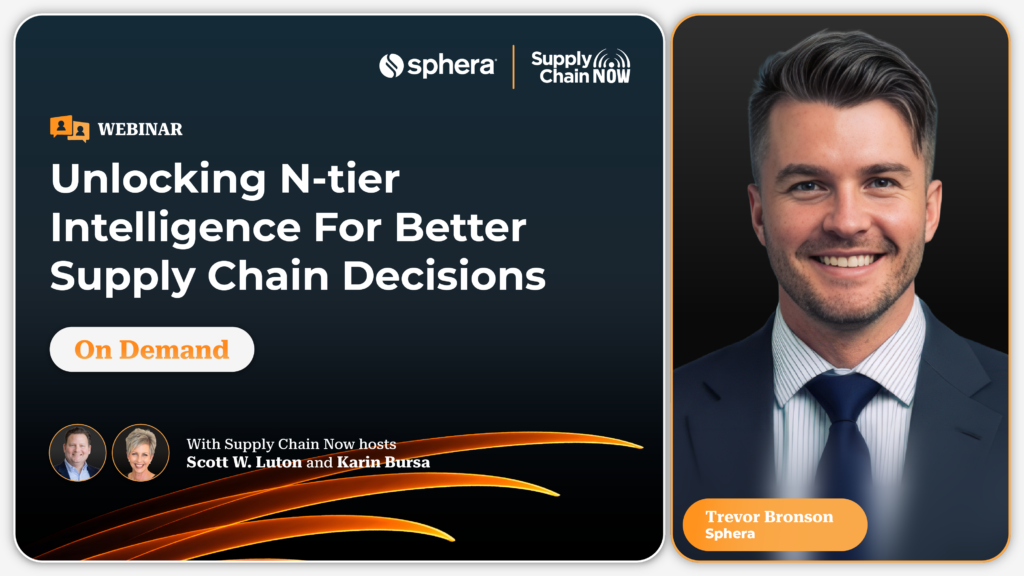
WEBINAR: Unlocking N-tier Intelligence For Better Supply Chain Decisions

Share:

WEBINAR: Unlocking N-tier Intelligence For Better Supply Chain Decisions

Most organizations understand their direct suppliers. Far fewer understand the suppliers behind them.

As supply chains become more complex, the greatest risks often originate well beyond Tier 1, from critical sub-tier suppliers, shared manufacturing dependencies, geopolitical exposure, raw material shortages and single points of failure that remain invisible until disruption occurs.

Join Sphera and Supply Chain Now to explore why leading organizations are adopting an N-tier approach to supply chain risk management. We’ll discuss how greater supply chain transparency enables organizations to uncover hidden dependencies, understand the true impact of supplier risk on products and operations, and make faster, more informed decisions before disruption affects the business.

Whether you’re responsible for procurement, sourcing, supply chain operations or enterprise risk, you’ll gain practical insights into how N-tier intelligence is helping organizations move beyond reactive risk monitoring towards proactive supply chain resilience.

You’ll learn:

  • Why taking a product-first approach to supply chain intelligence delivers more actionable insights than monitoring suppliers alone.
  • Why understanding your supply chain beyond Tier 1 is becoming essential for managing operational and business risk.
  • How to uncover hidden supplier dependencies, concentration risk and single points of failure before they lead to disruption.
  • How to connect supplier intelligence to products, materials and business-critical operations to prioritize what matters most.
  • How AI-powered supply chain intelligence is helping organizations identify emerging risks earlier, assess potential impact faster and take decisive action with confidence.

More Webinars
smart data fabric
play-button-webinar
webinar-person
Webinar
June 20, 2024

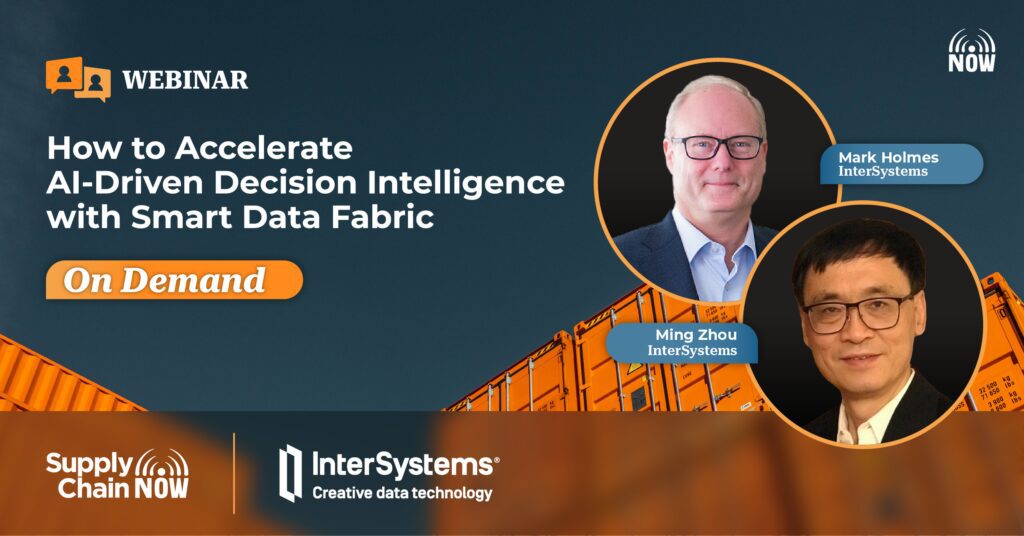
How to Accelerate AI-Driven Decision Intelligence with Smart Data Fabric

Increasing operational costs, labor shortages, and geopolitical tensions are keenly felt by supply chain organizations and highlight the importance of fast, informed decision-making. Join this exciting webinar to learn how a smart data fabric can be used to unify data across disparate sources and accelerate AI-driven decision intelligence. We’ll delve into real-world use cases showing how this approach can be used to leverage real-time predictive and prescriptive analytics, as well as generative AI, to optimize your supply chain operations. Register to learn about smart data fabric and how this approach can help organizations attain an agile supply chain with integrated decision intelligence. Key Takeaways: – InterSystems Smart Data Fabric for consistent unified data – Supercharged problem-solving with Data Fabrics and Generative AI – Accelerated business value to LOB with decision intelligence
agentic AI
play-button-webinar
webinar-person
Webinar
February 9, 2026

Building the Foundation for Agentic AI in the Modern Supply Chain

In this Agentic Age, Supply chain leaders are racing to adopt AI—but isolated solutions and disconnected systems often limit real impact. The true promise of AI emerges only when we reimagine the supply chain as a fully connected enterprise, breaking down decades-old silos across planning, logistics, materials, finance, and sustainability. In this session, Manik Sharma, Head of Supply Chain GTM AI at Celonis—magic quadrant leader, recognized globally and ranked #3 on the Fortune 50 Most Promising Companies list—will unpack how a modern AI-enabled tech stack can unify fragmented data, systems, and processes through a connected semantic layer that digitizes the physical value chain. Once established, this semantic layer becomes a dynamic foundation for intelligent, data-driven operations by infusing it with enterprise context—from rules, constraints, and parameters to policies and proven models—unlocking true end-to-end enterprise intelligence. This intelligence can then be democratized across the organization to power self-serve analytics, build composable AI solutions, and orchestrate workflows, collaboration, agents, and actions at scale. We’ll explore how companies are using this approach to unlock self-serve analytics, accelerate development of composable AI applications, and orchestrate autonomous workflows and agents at scale. This is not a future vision but a proven path for organizations that…