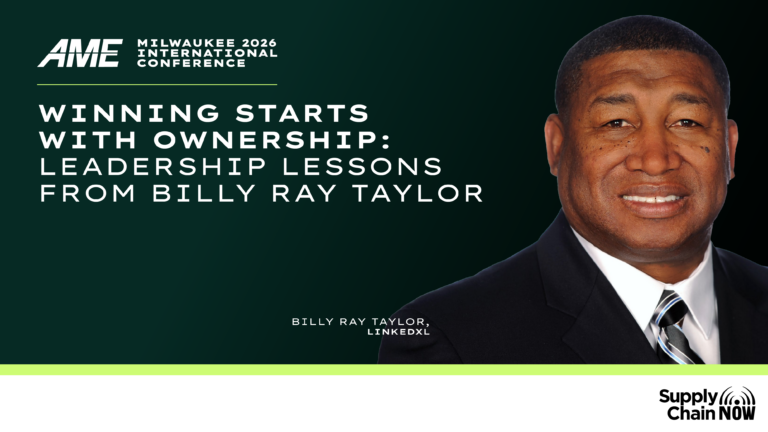
Winning Starts with Ownership: Leadership Lessons from Billy Ray Taylor
Some leaders have a remarkable ability to turn complicated business challenges into simple, memorable lessons. Billy Ray Taylor is certainly one of them. Whether he’s discussing operational excellence, organizational accountability, or the wisdom passed down from his parents, Taylor has a gift for making leadership principles come alive through storytelling.
At the Association for Manufacturing Excellence (AME) International Conference 2026 in Milwaukee, Supply Chain Now Founder and CEO Scott Luton caught up with his longtime friend and frequent podcast guest, Billy Ray Taylor, President and CEO of LinkedXL and outgoing Chair of AME’s Board of Directors.
The two have shared plenty of conversations over the years – – and their friendship was evident throughout this latest discussion, which explored why organizations struggle to execute, how AI is changing manufacturing, and what great leaders understand about people.

The Evolution of Operational Excellence
Taylor has spent decades helping organizations transform their operations, including a distinguished career at Goodyear. But when Luton asked what had changed most about his leadership philosophy over the past 20 years, Taylor pointed to a fundamental shift in how organizations solve problems.
Two decades ago, operational excellence frequently involved lengthy meetings, classroom instruction, and employees waiting for direction. In the modern world, technology has dramatically accelerated access to information, while frontline workers increasingly possess the knowledge needed to identify and eliminate operational constraints.
“Today, it’s about action. It’s about action and accountability,” Taylor explained.
Even traditional visual management boards have evolved. Rather than simply displaying performance results, Taylor believes they should drive specific actions and empower employees to solve problems at their source.
The ultimate goal is a workforce that takes ownership of improvement instead of waiting for management to provide answers.
Why Great Strategies Still Fail
One of Taylor’s strongest convictions is that organizations frequently struggle because they fail to translate strategy into meaningful execution.
“Most companies don’t fail or they rarely fail because of a bad strategy. They fail because they don’t know how to execute.”
Taylor argues that companies often focus excessively on key performance indicators (KPIs) without identifying the specific actions required to improve those results. He calls these key performance actions (KPAs), and believes every important action needs a clearly identified owner.
Using a football analogy, Taylor explained that the scoreboard offers all sorts of information to coaches & players on teams: game clock, timeouts, down and yards to go, etc. But the most important metric on the entire scoreboard is the score, which lets teams know if they are winning or not.
The same principle applies in business. Leaders must ensure employees specifically understand what winning looks like, including what actions drive success, and who is responsible for delivering those actions.
Taylor also encourages organizations to confront problems openly rather than conceal disappointing results.
“Celebrate the red so you can harvest the green,” he advised.
It’s a memorable reminder that acknowledging problems creates opportunities to address them before they become much larger challenges.
Leadership Standards and Extreme Ownership
For Taylor, accountability begins with leadership standards. And he offered another memorable observation about the difference between establishing expectations and actually enforcing them.
“A standard isn’t what you write down, it’s what you walk by.”
He illustrated the point with a teenager repeatedly arriving home two hours past curfew. If parents consistently overlook the violation, they’ve effectively established a new standard through their own inaction.
The same dynamic occurs throughout organizations when leaders tolerate behaviors that contradict their stated expectations. Taylor credits his mother, Vera, with another powerful leadership lesson: “Be hard on the process baby and you can lead easy on the people.”
That philosophy supports his belief in extreme ownership, where employees throughout the organization understand their responsibilities and have the authority to act. Organizations with strong ownership cultures empower frontline teams to identify problems, take corrective action, and understand how their contributions influence business results.

AI Will Never Replace Individual Accountability
Artificial intelligence was another major topic during the conversation, and Taylor made clear that he’s an enthusiastic adopter. He believes AI is accelerating operational excellence by providing faster analysis, identifying potential solutions, and helping organizations make better-informed decisions. However, he also offered an important caution about expecting technology to solve every business problem.
“AI will never replace IA: individual accountability.”
Taylor’s point is straightforward. AI can identify a problem and recommend a solution, but someone typically still needs to take responsibility for implementing the necessary changes.
He also warned against treating AI as a universal solution, particularly when organizations fail to consider how the technology should be applied to specific operational challenges. Ultimately, the value of AI depends heavily on how effectively people use the information it provides.
The Real Value of AME
After serving two terms as AME Board Chair, Taylor is transitioning into a past-chair advisory role, with Bart Reimer stepping into the leadership position. Taylor remains a passionate advocate for AME because of its ability to connect practitioners, share proven approaches, and accelerate learning across industries. But he cautioned attendees against returning home with an overwhelming collection of new tools and initiatives.
Instead, he encouraged leaders to understand what their organizations genuinely need and involve employees in determining how improvements should be implemented. As Taylor explained, change is much more likely to succeed when it’s developed with employees rather than imposed upon them.
That perspective closely reflects the conference’s 2026 theme, People First, Progress Together.

The Human Side of Leadership
Perhaps the most meaningful part of the conversation came when Taylor reflected on empathy and the lessons learned from his family. He shared how his father regularly checks on his well-being, asking whether he’s getting enough rest rather than focusing on his professional accomplishments.
For Taylor, those conversations demonstrate what genuine care looks like. Leaders who understand the needs, concerns, and motivations of their people create stronger relationships and more productive organizations. That philosophy also shapes how Taylor treats everyone he encounters, from manufacturing employees to front-desk associates and rideshare drivers.
That personal connection reinforces one of his central leadership beliefs: making people feel valued creates trust, commitment, and lasting relationships.
As their conversation concluded, one message stood above the rest. Winning organizations establish clear standards, empower their people, and consistently translate strategy into action.
And as Billy Ray Taylor continues to demonstrate, the best leadership lessons often come from everyday experiences, meaningful relationships, clarity in communications, and a genuine commitment to helping others succeed.
Where to Learn More
We invite you to check out Billy Ray Taylor’s best-selling book, “The Winning Link”. You can also connect with Billy on LinkedIn, as well as learn more about his organization, LinkedXL, via the company website here: https://linkedxl.com/
More Blogs
From Integration to Impact: Lessons in Modern Supply Chain Leadership