
More

Global Trade Trends
December 6, 2024
Global Trade Trends: Three Businesses Bringing Innovation to Supply Chain
Global trade practitioners face waves of uncertainty with the possibilities of slews of international tariffs and work stoppages at ports on the U.S. East and Gulf coasts. There are other weighty challenges as well, including conflicts in Russia-Ukraine and the Middle East, increasingly dangerous storms, and seasonal capacity strains and congestion. Technology plays an increasingly important role in overcoming the many challenges in the global supply chain. “The evolution of supply chain technology has allowed the shipping industry to enhance its operational capabilities. Automation, real-time tracking, and improved throughput have helped manage the heavy volume growth experienced during the pandemic, but recent challenges have highlighted the need for even more robust strategies,” Karim Jumma, e2open’s vice president of product management, wrote in a contributed SupplyChainBrain article. Jumma cited geopolitical conflicts, extreme weather events, and logistical bottlenecks as examples of challenges that have tested the industry and “increased the need for innovative solutions that prioritize flexibility and data-driven decision-making to mitigate against ongoing disruptions.” Supply Chain Now is highlighting E2open, WCAworld, and DP World, three companies continually working on innovative solutions to global trade’s most pressing challenges. DP World Takes Collaborative Approach to Global Challenges DP World’s marketing material says the…
January 29, 2021
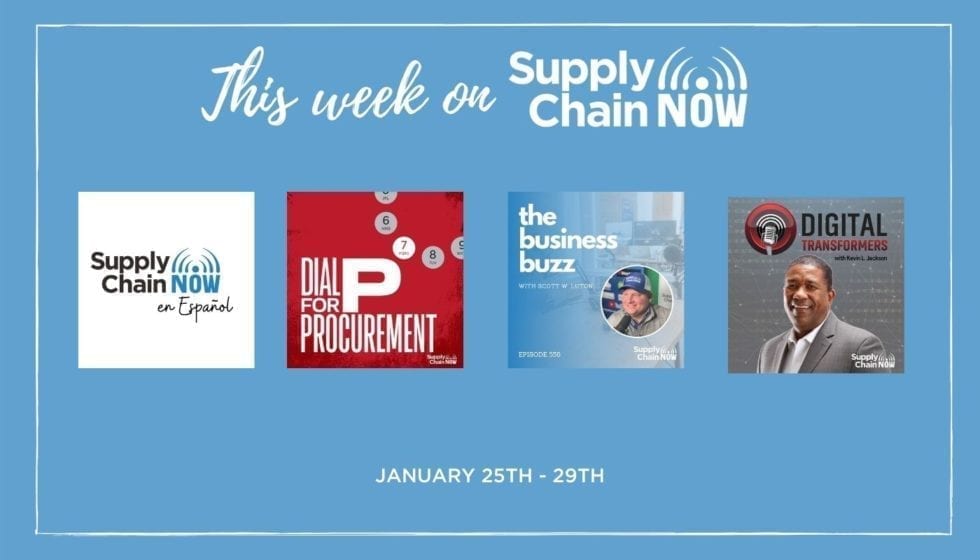
This Week on Supply Chain Now: January 25th – 29th
It’s been an exciting week here at Supply Chain Now! Catch up on all the latest episodes, interviews, conversations, and livestreams right here for all the hottest supply chain news! On Monday, we launched Dial P for Procurement with program co-hosts Kelly Barner & Scott Luton who welcomed two professionals who have put their procurement and supply chain experience to work in the service of others: Anna McGovern, Chief Supply Chain Officer at the Food Bank for New York City, and Kathy Fulton, Executive Director of the American Logistics Aid Network. On Tuesday, Laura Cyrus with Truckers Against Trafficking joined host Enrique Alvarez to share how supply chain & trucking workers are uniquely positioned to combat human trafficking. On Wednesday, we launched our new Digital Transformers series in partnership with Total Network Service. Check out our first episode as Scott Luton, Kevin L. Jackson, and special host Thomas Carter welcome Dave Stehlin and Chris Poli to the show. On Thursday, we released The Supply Chain Buzz with Kevin L. Jackson, Greg White, & Scott Luton who discuss leading stories from global supply chain and global business, including the skyrocketing costs of medical supplies, the impact of IoT…