









Share:

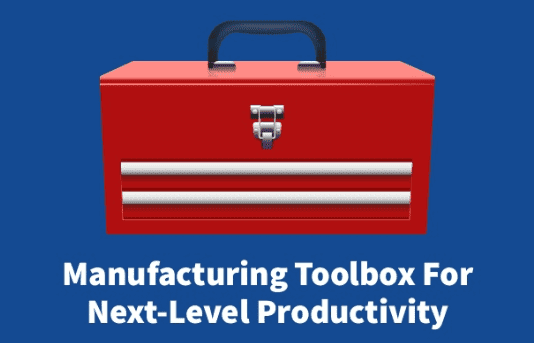
Manufacturing Toolbox for Next-Level Productivity

The story of the manufacturing industry has been one of progress. Few manufacturers continue to produce the same products as they did in their infancy years. In order to remain competitive, manufacturers must continue to evolve their products to meet the demands of the marketplace. But meeting consumer demand is only half the battle — the other half is staying up to speed with industry advancements.

New technology brings a host of changes that manufacturers must recognize. For example, increasing dependence on automation leads to the need for more skilled workers who understand these advanced systems. If workers cannot adapt successfully, organizations could find themselves struggling to keep up with the rest of the industry.

To remain competitive in this dynamic environment, organizations should have several tools at their disposal that go beyond the physical equipment and technology innovations used in their facilities. These tools are ideas manufacturers can keep in their toolbox and use to produce next-level productivity. For example, one tool can be an investment in regular maintenance, which can ensure that machinery stays in service for as long as possible. This results in higher productivity and fewer costly downtime periods.

For more ideas manufacturing companies should keep in their toolboxes, check out this infographic containing important concepts manufacturers can use to boost their production and become more efficient overall.

There’s more than one kind of tool necessary for success in manufacturing. Here are some concepts and ideas you should have in your toolbox to yield higher productivity.


 

More Blogs

Latin America
Blogs
June 26, 2025

What a Buyer Wants, What a Buyer Needs

Special Guest Blog Post written by Bernadine Henderson Ms. Henderson, senior director of procurement at Protolabs, lifts the lid on buying in manufacturing and why relationships are central to it.   Simply put, the job of a buyer is really about buying the right thing at the right time for the right price. It sounds simple, but it really is very complicated because everything that’s going on in the world impacts the timing, the availability, and the price of the product. This means that buying has recently got a lot more complicated. World events have very real consequences on global supply chains. Just one example is the way in which buyers have responded to tariffs in the U.S. by re-routing sourcing locations. It takes a certain amount of agility to be a buyer in 2025, and this quick responsiveness is helped along by one key ingredient, and that is strong relationships with suppliers. Relationships Built on Trust A widely held misconception is that buyers are only interested in getting to the lowest price possible. In fact, the most important thing to a buyer is for suppliers to bring solutions that deliver overall value. In my experience, a really strong supplier…
logistics
Blogs
July 10, 2025

Five Questions I Wished People Asked Me About Public Sector Supply Chains

Special Guest Blog Post written by Gary Smith, CPIM-F, CSCP-F, CLTD-F, Author of “The Bridge,” Supply Chain Engineer, and Educator   1. Do Supply Chains exist in the public sector? The short answer is “YES!” I spent the first 25 years of my career in the private sector where I worked in warehouse operations, industrial engineering, and consulting, all in the logistics andsupply chain area. I cut my teeth on retail, automotive, chemical, food and beverage, publishing, and manufacturing. During that time, I also completed projects for the public sector in education and for the Department of Defense. In 2005 I was named Director of Supply Chain Operations for the New York City Housing Authority (NYCHA). We operated a 200,000 sq. ft. warehouse that shipped repair material to 335 developments in New York’s five boroughs. In 2013, I was named Vice President of Supply Logistics for New York City Transit, the largest public transportation organization in North America. We operated over 1.5 million sq. ft. of warehouse space covering all of New York City. Several years ago, I was on a national committee for the Association for Supply Chain Management (ASCM). We created this elevator speech to describe Supply Chain…