
This week has been packed with so many great stories! What was your favorite episode? Make sure you tune in next week for more great conversation, timely topics, and exceptional guests on Supply Chain Now!
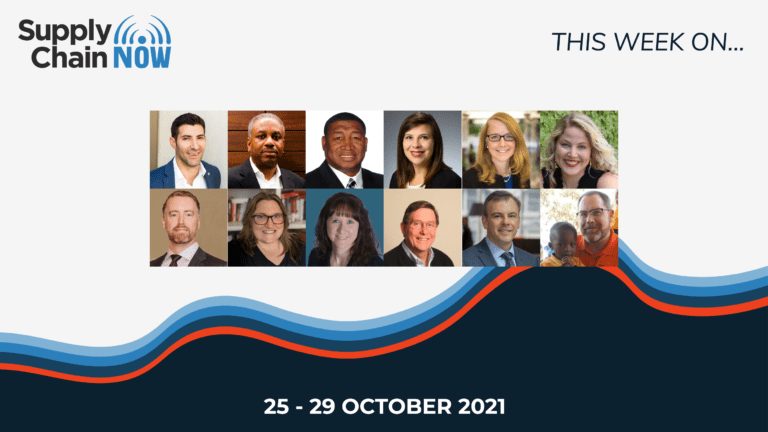
This Week In Supply Chain Now: October 25th – 29th
Stay up to date on all the latest conversations, interviews, and episodes we released this week here at Supply Chain Now!
We started this week off with an episode of Digital Transformers with host Kevin L. Jackson. During this episode, Kevin sits down with three digital experts to discuss new approaches to establishing trust and provenance within a supply chain that is increasingly both digital and physical. This episode features Dustin McIntire the CTO of COMSovereign Holding Corporation. Eric Adolphe the CEO of Forward Edge-AI and Joshua Pendrick the CEO and Co-founder of Rypplzz.
For Monday’s This Week In Business History episode, Kelly Barner talks about the political act that led to an increase in organized crime and the end of the Great Depression.
On Tuesday, we released a new episode of Supply Chain Now with host Scott Luton and guest host Allison Giddens. They welcomed the head of Global Supply Chain for Peloton, Jennifer McKeehan, to the show. They discussed how the hybrid work environment is allowing the best leaders to shine by continuing to build strong, meaningful relationships, and much more.
This week we released an episode of Logistics With Purpose with hosts Enrique Alvarez and Kristi Porter. During this episode, they interviewed Julie Reusser, the Program Manager, for Feed the Hungry, and Roger Walterhouse the Director of Ministry Programs. This episode focuses on how the Feed The Hungry organization feeds over 380,000 children and maintains partnerships with over 23 countries.
For Thursday’s Supply Chain Now episode, Scott Luton interviews the great Billy Taylor. In this episode, Billy gives a little insight into his life and the lessons he learned to become a great effective leader at The Goodyear Tire & Rubber Company.
On Friday, we released the Supply Chain Buzz with Scott Luton and Greg White. They are accompanied by Robin Gregg, CEO of RoadSync, and Lee Klaskow, Sector Head and Senior Analyst of Logistics for Bloomberg Intelligence. During this episode, some of the topics covered include port congestion, when to start holiday shopping, and the ongoing clash of logistics titans.
And to wrap up the week, we released an episode of Supply Chain is Boring with host Chris Barnes. This episode wraps up the sequel interview with Richard Sharpe from Competitive Insights.
More Articles

resilience in supply chain
Articles
September 26, 2024
Supply Chain Now’s Guide to Resilience in the Supply Chain
The resiliency of the supply chain has been tested time and time again — strained by weather-related events like hurricanes, global crises such as COVID-19, disasters like the Francis Scott Key Bridge collapse, and security breaches from cyberattacks. Supply chain resilience will continue to be tested. In fact, a major supply chain crisis could be just days away as the International Longshoremen’s Association (ILA) could stage a strike at ports all along the East and Gulf coasts of the United States as soon as Oct. 1. Beyond the Buzz: What is Supply Chain Resilience? “Supply chain resilience refers to the ability of a supply chain to prepare for unexpected events, adapt to disruptions, and recover quickly to restore its normal service levels,” Inbound Logistics said. “It’s not merely about preventing disruptions but being able to turn challenges into opportunities for growth and improvement.” Supply Chain Dive said because of events like COVID-19, the Panama drought, and Houthi attacks in the Red Sea, supply chain disruptions have become “part of the public’s consciousness and everyday nomenclature.” “The risk in our global economy is that supply chain disruptions are guaranteed to continue, but no forecast exists to tell us when or how…
Red Sea
Articles
April 14, 2025
Supply Chain Now’s Guide to the Red Sea Crisis
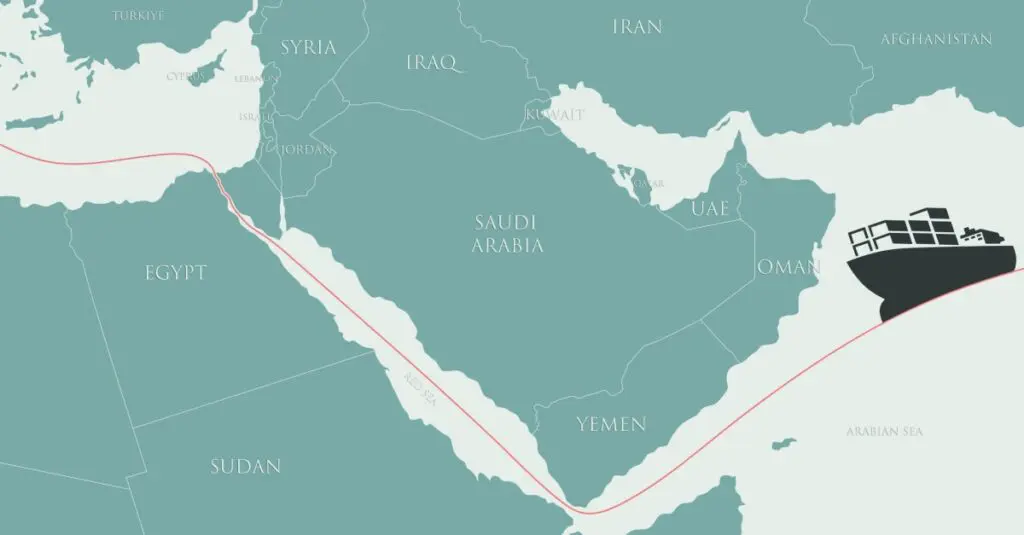
An estimated 12% of global trade worth more than $1 trillion traverses the Red Sea each year. When Houthi rebels started attacking commercial vessels in November 2023, ocean carriers began rerouting container ships around Africa’s Cape of Good Horn rather than through the Suez Canal on voyages from Asia to Europe. That greatly increased travel time and costs. As of March of this year, shipping through the Red Sea was still down 70% from before the attacks began, according to The Economist, with many ocean carriers still avoiding the Bab el-Mandeb Strait, which separates the Red Sea from the Gulf of Aden and the Arabian Peninsula. Maritime Industry Caught in the Crosshairs Houthi rebels launched attacks on ships in the Red Sea in response to Israel’s military operations in Gaza. The Houthis attacked more than 100 cargo ships between November 2023 and January 2025. The attacks, with missiles and drones, sunk two vessels and killed four sailors. In late October 2024, a headline in gCaptain read, “Red Sea Is Now So Dangerous Even NATO Warships Are Avoiding It.” “The United States Navy continues to send warships through the Red Sea, but its mission to protect merchant ships – Operation Prosperity…