Share:

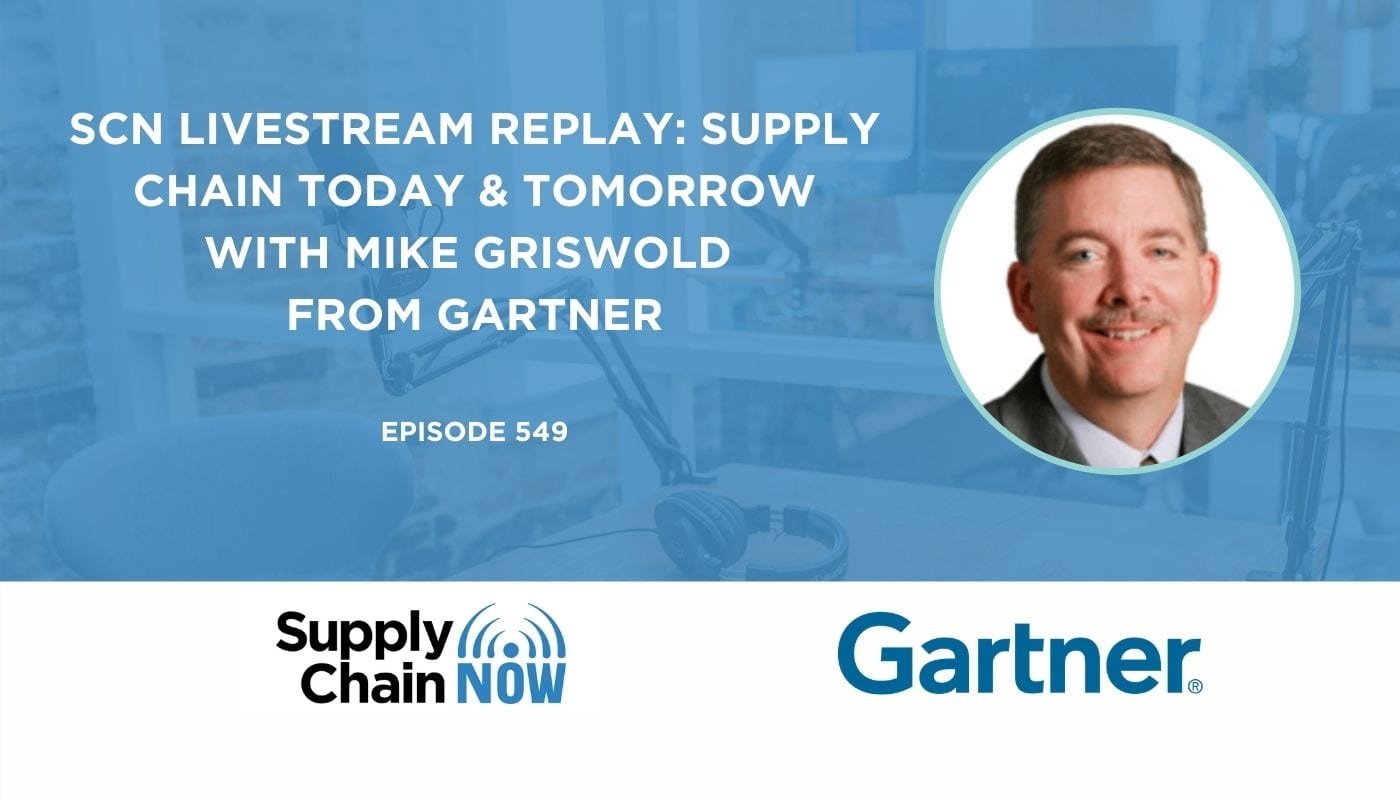
“Be true to who you are as a supply chain and be true to who you are in terms of how the supply chain enables your business.”

– Mike Griswold is the Vice President of Research at Gartner


Everyone learned a lot from 2020. Companies and individuals have now made the best decisions they can about how to manage themselves in 2021, despite the fact that uncertainty remains.

Mike Griswold is the Vice President of Research at Gartner, specializing in retail with a particular focus on forecasting and replenishment. He is responsible for Gartner’s annual Top 25 Supply Chain ranking and joins Supply Chain Now on a monthly basis to discuss the latest in retail supply chains from an analyst’s perspective.

Since his last visit, he has been put in charge of a team of five strategy and enablement analysts who focus on everything from talent organization design to environmental, social, and governance-related trends. This has given him good reason to think about coaching and leadership styles as well as to make a few new year’s resolutions.

In this conversation, Mike tells Supply Chain Now Co-hosts Greg White and Scott Luton:

· The importance of understanding all of the different communication styles (both speaking and listening) on each team in order to keep them moving in the same direction

· Why staying focused on proven supply chain fundamentals is just as important as emphasizing agility

· The ‘silver lining’ he sees from the challenging conditions of 2020

More Podcast Episodes
industrial real estate
play-button-podcast
podcast-blue-microphone
Podcast
November 12, 2025

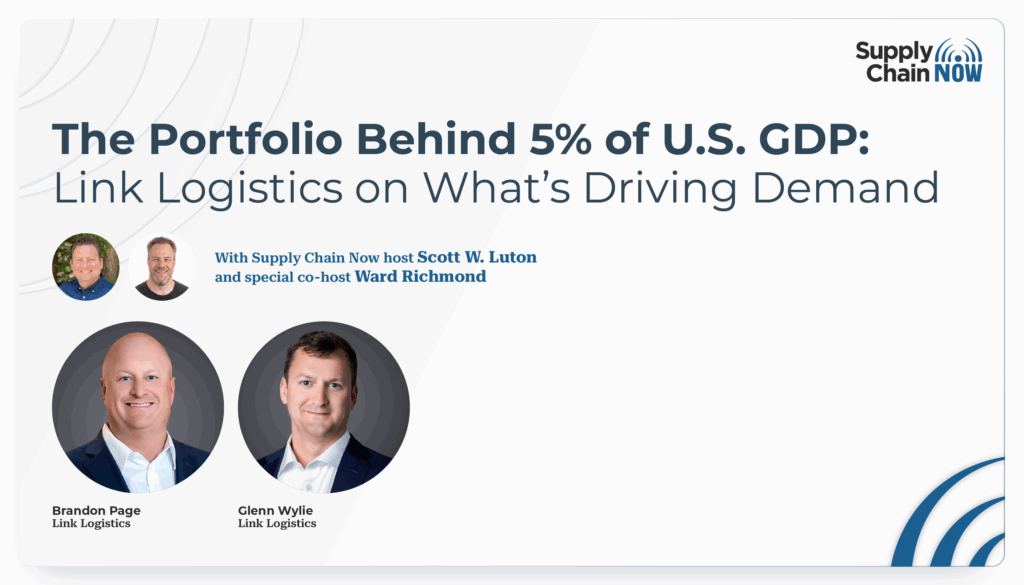
The Portfolio Behind 5% of U.S. GDP: Link Logistics on What’s Driving Demand

In this episode of Supply Chain Now, Scott Luton teams up with special guest host Ward Richmond (Vice Chairman, Colliers) to dig into the state of industrial real estate with Brandon Page. EVP, Head of Leasing & Customer Solutions and Glenn Wylie (Senior Managing Director, East Region at Link Logistics. The conversation frames what a “balanced market” looks like in 2025 (tight small-bay infill vs. more options at bulk) while unpacking the demand stack from e-commerce and nearshoring to data center spillovers and the renewed importance of 3PL flexibility. The group gets practical on bonded warehouses and FTZs (where and why they fit), market dynamics across the Southeast, Texas, and Phoenix, and how power availability and automation readiness are influencing site decisions. You’ll also hear how Link Logistics uses data and AI, from rent-modeling insights to faster decision support across an infill-centric portfolio (with most assets within an hour of dense populations). The throughline: customers want flexibility, optimization, and speed, and the teams that blend relationships with good data will find the next wave of opportunity first. This episode is hosted by Scott Luton, and produced by Trisha Cordes, Joshua Miranda, and Amanda Luton.   Additional Links & Resources Check…
decarbonization
play-button-podcast
podcast-blue-microphone
Podcast
December 17, 2025

A Bold, New, Decarbonized Future: A Conversation with Steve Wilhite

Global supply chains are facing a dual transformation, an accelerating shift toward clean energy and a rapid evolution in AI-driven decision-making. As companies navigate rising expectations for sustainability, transparency, and resilience, leaders are rethinking how ecosystems come together to reduce emissions, digitize operations, and unlock new forms of value. In this episode of Supply Chain Now, Scott Luton sits down with Steve Wilhite, Executive Vice President of SE Advisory Services at Schneider Electric, live from the Innovation Summit North America 2025. Drawing on more than three decades of experience across energy management and sustainability strategy, Steve offers a rare inside look at how Schneider Electric is helping organizations tackle decarbonization at scale. Scott and Steve explore the leap forward enabled by AI-native platforms, the growing power of supply chain–wide renewable energy programs, and why collaborative intelligence, where humans and autonomous agents work together, will shape the next decade of transformation. They also highlight real-world examples from Levi Strauss & Co., Marks & Spencer, Walmart, and other global brands that are redefining how ecosystems mobilize around climate action.   This episode is hosted by Scott Luton, and produced by Trisha Cordes, Joshua Miranda, and Amanda Luton.   Additional Links & Resources…

Supply Chain is Boring – Episode-549

Share: