
This week has been packed with so many great stories! What was your favorite episode? Make sure you tune in next week for more great conversation, timely topics, and exceptional guests on Supply Chain Now!

This Week In Supply Chain Now: September 13th – September 17th
Stay up to date on all the latest conversations, interviews, and episodes we released this week here at Supply Chain Now!
On Monday we started the week off with an episode of Supply Chain Now with Scott Luton and TEKTOK host Karin Bursa! The two welcomed COO of SAPICS, Jenny Froome, and the Business Development Executive at SAPICS, Tonya Lamb.
On Tuesday, we published a new episode of This Week In Business History with host Kelly Barner.
On Tuesday, Scott reflects on the 2021 global summit with Lora Cecere, Kelly Barner, and Kevin L. Jackson. These four talk about some of the most impactful conversations that happened during the event, including effective leadership and how it goes hand in hand with supply chain planning, and more.
On Wednesday we released an episode of Logistics With Purpose. This episode features Henok Berhanu, Founder & CEO of Carry 117, and Ashley Bohinc, Executive Director of Carry 117.
On Thursday we published a new episode of the Freight Insider with host Page Siplon. Page welcomed Christian Fischer, President and CEO of Georgia Pacific, to the show.
On Friday, we published the podcast version of our Monday Supply Chain Buzz livestream, with special guest, Mark Morley with OpenText. Scott, Greg, and Mark discussed the OpenText ConnecXions conference, and the top news in supply chain for the week.
We also released another episode of Supply Chain is Boring with host Chris Barnes on Friday. This episode is the continuation of the conversation from Dave Anderson with Supply Chain Ventures.
More Articles

sustainable supply chain management.
Articles
August 29, 2024
Eco-Friendly Innovations: How Sustainable Practices Are Reshaping Supply Chains
Scope 3 emissions reportedly account for more than 70% of businesses’ carbon footprints. That huge percentage gives an indication of just how critical supply chain sustainability efforts are to the planet. Thankfully, a growing number of eco-friendly innovations are helping reshape global supply chains. Supply Chain Sustainability: An Industry Imperative in a Changing World It is becoming increasingly important for companies to accurately calculate their supply chain emissions and create an information-sharing ecosystem, according to Matthew Gardner, co-founder and managing partner of Sustainserv, a consulting firm that helps businesses implement sustainability strategies. Gardner said accounting for supply chain-related greenhouse gas emissions includes such challenges as: Data gathering of “materials, manufacturing processes, activities of second- and third-tier suppliers, and overall data governance and quality.” Calculation methodology that “reflects the realities of raw material sourcing, product manufacturing, transportation and distribution, and other life-cycle impacts that may affect reported greenhouse gas totals.” Supplier relationships, which can be strained as a result of emissions assessments. Businesses also need to keep in mind their relationships with consumers. PDI Technologies said 80% of U.S. consumers it surveyed were willing to pay more for sustainable products. “Between these statistics and the regulatory conversations that are happening in…
supply chain podcast
Articles
March 31, 2025
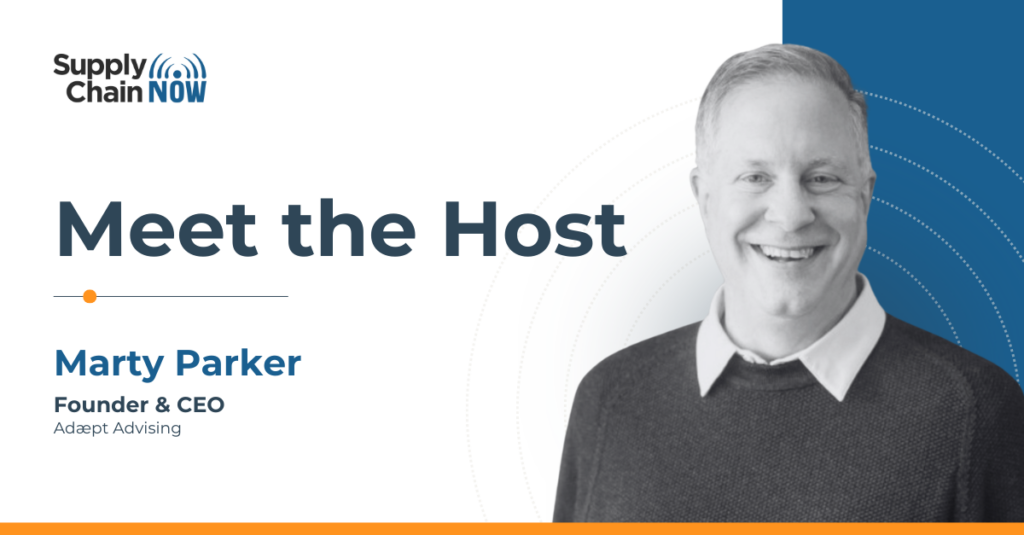
Meet the Supply Chain Now Host: Marty Parker
Supply Chain Now is the voice of the supply chain industry, and our hosts are experts in the field. Podcast listeners tune in to hear the words of wisdom from host Marty Parker, whose practical advice is taken everywhere from the classroom to the C-suite. An Educated Voice in Supply Chain Parker certainly has the supply chain chops to back up his advice. He has 30 years of experience in the supply chain C-suite (COO, CMO, CSO), is the founder and CEO of Adæpt Advising, and is an award-winning senior lecturer in supply chain and operations management at the University of Georgia. He also founded and leads UGA’s Supply Chain Advisory Board, is the academic director of the university’s Leaders Academy, and serves on multiple advisory boards, including the Trucking Profitability Strategies Conference, Zion Solutions Group, and Carlton Creative Co. Mentoring on Campus and in the C-suite Parker’s mentoring carries supply chain stakeholders from their student days to the C-suite. At UGA, he helps his students network and land internships and post-graduation jobs. Through Adæpt Advising, he works with C-suite executives to improve their skills, become better leaders, and develop strategic plans with detailed action steps and financial targets. He…